Why your AC runs all day in North Carolina summers
Tell a local repair pro what your air conditioner is doing.
Your AC kicks on in the morning and it's still running when you go to bed. In a North Carolina summer, with the humidity sitting on the house all day and into the night, that's what the system has to do to keep up. It's not necessarily broken. But a unit that runs nonstop is also a unit that's not getting ahead of the heat, and that's worth a look rather than an assumption.
A unit working that hard is also a unit where small problems turn into long run times fast. A dirty coil, a low charge, a weak capacitor, any of these can be the reason the system can't catch up, and the fix is usually specific to what's actually happening in your unit, not a guess.
Most homes in North Carolina heat with electricity, so the same system working overtime in July is the one you'll lean on again come winter. Worth knowing what's going on with it now rather than later.
Figuring out which of those it is usually means getting a contractor out to look at the actual equipment, and that's the part that eats time. Calling around for someone available, explaining the same thing to three different companies, waiting on quotes that are hard to compare because nobody looked at the same unit.
That's the piece this page shortcuts. Tell it what's going on with your AC and you get matched with a contractor who handles this kind of repair and knows the area, and they'll reach out to you directly. No list of names to sort through, no repeating the story from scratch each time you pick up the phone.
From there, it's between you and the contractor to figure out what your system actually needs.
Why does my AC run all day in the summer here?
You keep checking on the AC like it might stop, but it just keeps running, hour after hour, straight through the hottest part of the day and into the evening. You're not hearing bad noises or smelling anything off. It just never shuts off, and you're trying to figure out if that's normal for summer here or a sign something needs attention before it turns into a bigger repair.
It's doing its job against the heat and humidity
North Carolina summers stay humid from morning to night, and a sticky house makes an air conditioner run longer because it has to pull moisture out of the air, not just cool it. On a muggy afternoon the thermostat may never see the temperature it's asking for, so the system keeps cycling instead of shutting off. That alone doesn't mean anything is wrong. What matters is whether the house ever cools down and feels dry, or whether it stays warm and clammy no matter how long the unit runs. A system that runs all day but still keeps the house comfortable is working as it should. One that runs all day and still can't keep up is worth having looked at before a small issue, a weak capacitor, a low charge, a clogged coil, turns into a system that can't run at all.
Running long, but keeping up
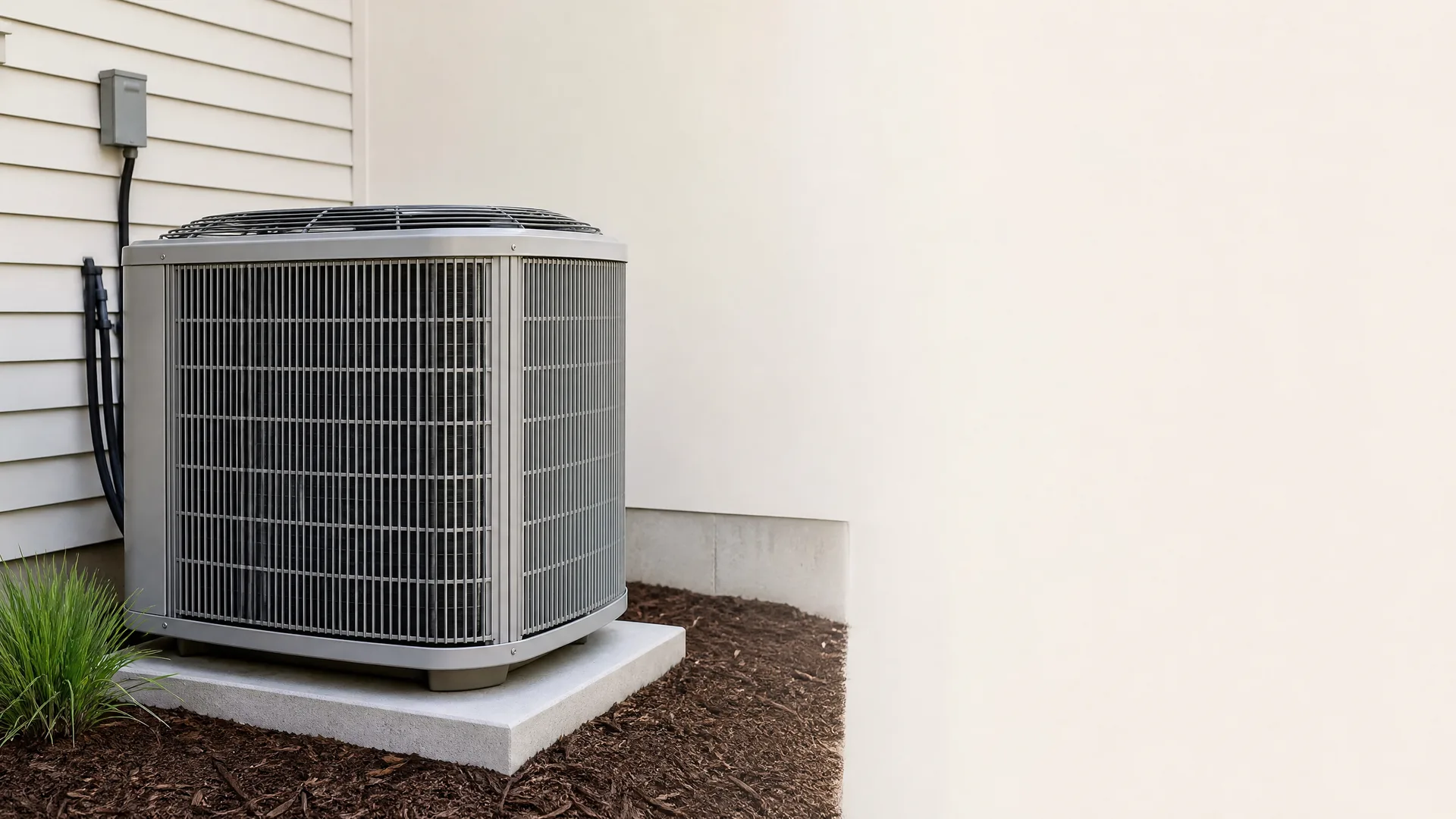
The outdoor unit cycles on in the morning and stays on through the heat of the day, and the house still holds a comfortable temperature. The lines and the wiring are intact, the grilles are clear, and the air coming out of the vents is cold. Long runtimes alone don't mean trouble.
Running long, and falling behind
This unit looks its age. Dirt has built up on the grilles, air can't move through them the way it should, and the house stays warm no matter how long it runs. A unit working this hard against its own buildup is a reason to get it looked at, not just listened to.
Clean and clear
The cabinet is clean, the fins are open, and the shrub next to it is cut back so air can move through. A unit that looks like this can run long hours in a North Carolina summer and still move heat the way it should.
Dirty and restricted
Dust and grime cover the cabinet and the mesh is caked over. Air can't pass through the coil like it needs to, so the unit works harder and runs longer to cool the same house. Left alone, that strain is what leads to a repair call.
Before you get your air conditioner repairAfter you get your air conditioner repair
Describe your air conditioner job once, to one pro.
No fee to send it, and nothing to sign.
What long runtime actually costs
A system that runs for hours instead of cycling off doesn't use power at a flat rate the whole time. The compressor and fan draw the most current the moment they start, then settle into steady draw while running. Long, steady runtime is usually less hard on the system than starting and stopping over and over. Where this bites you is the bill, since more hours running means more electricity used, even at a typical rate. It's a cost worth watching, not necessarily a sign something's wrong.
When runtime means something's off
A coil caked with dust, a filter clogged with a summer's worth of pet hair, or a fan motor losing strength all make the system work harder to move the same amount of heat. When that happens, runtime climbs on top of what the weather already demands, and the house may not even hold its temperature despite the extra hours. That gap, long runtime without the comfort to show for it, is what separates a system working through a hot stretch from one that needs a look before something fails outright.
Power costs 14.00 cents per kilowatt-hour statewide
At 14 cents a kilowatt-hour, a system that runs most of the day adds up fast, and there's no way around that once the heat and humidity set in. The difference shows up when the AC can't keep up on its own, since a repair that gets it cycling normally again is the only thing that brings the bill back down.
EIA-861 2025 statewide residential average
What you'd notice first
The thermostat shows the temperature you set, so the house feels fine. What you notice instead is the sound. The outdoor unit is running when you leave for work and running when you get home. Rooms farthest from the air handler might feel a touch warmer than the rest of the house by late afternoon, even though the system never stopped trying. None of that means something is wrong. It means the unit is working close to its limit for hours at a stretch instead of a shorter run here and there.
What's at risk over time
A unit that runs long hours has less time off to rest its moving parts, and if there's already a weak capacitor, a low charge, or a dirty coil behind the long runtime, those hours add wear faster than they would on a system cycling normally. A small problem that would barely show up in April gets pushed harder in July and August. Catching it while the system is still keeping the house comfortable, rather than waiting for a day it can't, is the difference between a repair and a breakdown on the hottest afternoon of the year.
A North Carolina AC that runs all day isn't necessarily failing. It's working against heat and humidity that don't let up from morning to night. Long runtime on its own just means the house is holding its temperature. What matters is whether the system is keeping up doing that, or straining to. If the rooms stay even and the power draw looks like steady work instead of a struggle, the system is doing its job. If not, that's worth a look before the strain turns into a bigger repair. Either way, you don't have to figure out which it is on your own, or spend an evening calling around to find out. Once you're matched with a contractor who knows these systems and these summers, you explain the problem once, to someone who shows up knowing what a long North Carolina summer does to an AC, and you go back to not thinking about the sound coming from outside.
Air Conditioner Repair
Get the right pro for your air conditioner
A local pro who knows air conditioners gets your details and gets in touch.
Send the request and finding a pro stops being your problem.
After this form, you can stop searching for an air conditioner pro.
Explain the job once and skip repeating it on every call.
Skip searching for an air conditioner pro and answer a few questions instead.
Your request stays with one local pro.
Your request goes to one pro, not a list of companies.