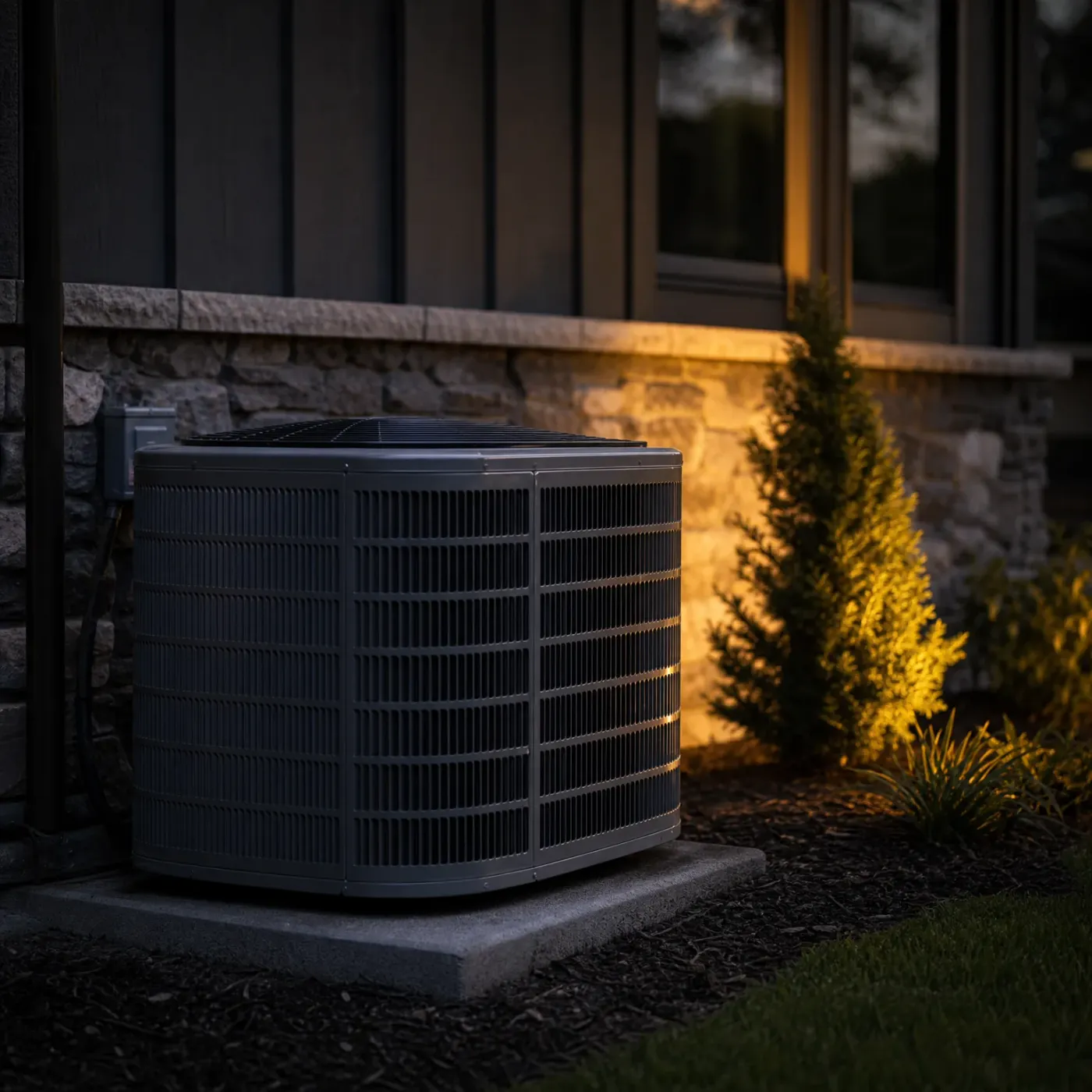










An outdoor air conditioning condenser unit on a concrete pad beside a house with stone veneer and vertical board siding, with a small shrub and mulch bed lit by a ground light at dusk.

Let someone else find the pro

Why one room stays hot with the AC on in North Carolina

One room that won't cool down while the rest of the house is fine usually points to something specific, a blocked vent, a duct run losing air, or a system that was never sized right for that space. This page gets into why it happens and what to check in your house. When you're ready for someone to look at it, send the form and stop chasing down contractors yourself.

Hand it off

A room that won't cool down usually comes from one of two places: the air isn't getting there, or it's getting there and still losing. Check the vent first. If it's closed, blocked by furniture, or barely blowing compared to other rooms, the duct feeding it may be crimped, disconnected, or just too long a run from the air handler to deliver much by the time it arrives. If the vent is blowing fine and the room still won't cool, the problem is usually the room itself gaining heat faster than that duct can offset it, a west-facing wall, a room over a garage, or a stretch of attic ductwork baking all afternoon in a North Carolina summer. Either way, the fix is specific to that room, not the whole system, which is good news: the rest of your house cooling properly means the unit itself is probably fine. What's left is finding where the air is being lost or outmatched, and that takes someone looking at the actual ductwork and the room.

A gray outdoor air conditioner condenser unit on a concrete pad beside a house with horizontal lap siding, with a wall-mounted disconnect box and conduit to its right and shrubs to the left.
An outdoor unit running clean keeps the air moving through the ducts the way the system was designed to.
An outdoor air conditioning condenser unit on a concrete pad beside a house with horizontal lap siding, with a conduit and electrical disconnect box on the wall at right.
A coil caked with dirt and grime makes the whole system work harder, and the farthest room is the first to lose that fight.

Getting air to a room is only half the job. It has to come back out too, through a return that pulls the old air so new air can take its place. Block that path and the vent can blow all day without the room cooling. Distance matters as much as blockage. The farther the duct run, the more turns it takes, the more pressure it loses before it ever reaches the room, so a room near the air handler will always have an easier time than one at the end of the line. A joint that's come loose along that run lets the cooled air out into the attic before it arrives at all. Sun and location add their own load. A west facing room or one over a garage takes on heat through the afternoon that the rest of the house never deals with. And a single thermostat reading one number for the whole house can shut the system off before that room is actually done.

Why That Room Falls Behind

  • Return air has to come back from that room too, and a closed or blocked return door starves it of airflow even if the supply vent is wide open.
  • A duct run that takes more turns or travels farther to reach that room loses pressure along the way, so it gets less air than a room closer to the air handler.
  • A leaky duct joint anywhere along that run lets cooled air escape into the attic or crawlspace before it ever reaches the vent.
  • West facing rooms and rooms over a garage take on heat through the walls and roof all afternoon, so the system has to fight a bigger load there than in the rest of the house.
  • A thermostat set to read one average temperature for the whole house can call the system off before that one room actually reaches the setpoint.
  • If the room was added onto the house later, the duct feeding it may be tapped off an existing run that was never sized to carry the extra air.
A smiling man in a blue denim shirt over a white tee sits at a light stone kitchen counter with a grey mug and a bowl of oranges and bananas, with pendant lights and shelving behind him.
A smiling bearded man in a grey long-sleeved shirt sits at a kitchen counter with a dark mug, with a dining table, pendant light and glass doors onto greenery behind him.
A bearded man in a dark green knit sweater smiles and looks off to the side while standing at a kitchen counter with a white mug of coffee, with open shelving, a potted tree, and a dining table near large windows behind him.
A man with dark curly hair in a dark green sweater stands smiling and looking to the side in a kitchen with white cabinets, a potted plant, a stone countertop with a ceramic mug, and a dining area with framed art in the background.

One request and it's handed off

Describe what your air conditioner is doing once, in one form.

No charge to send it. You decide if you hire them.

Where the room sits matters

A bedroom at the far end of the house, or one over the garage, or one above a stretch of ductwork running through a hot attic, has more working against it than a room near the unit. Every foot of duct in a hot attic picks up heat before that air ever reaches the vent. In North Carolina, attic ductwork can sit in extreme heat all summer, and a room fed by a long attic run will always lag behind one fed by a short, direct one, even with both systems working exactly as they should.

Sizing shows up as temperature

A system sized for the house as a whole can still leave one room short if that room has more windows, a west-facing wall, or sits above a garage with no conditioned space below it. The equipment moves the air it's built to move, but a room that gains heat faster than the rest of the house needs more of that air to hold the same temperature. If the room has always run warm, even with a system that checks out fine everywhere else, that mismatch between how the room gains heat and how much air it gets is often the real reason.

An outdoor air conditioner condenser unit on a concrete pad beside a house with light gray vinyl siding, with a gray electrical disconnect box and conduit on the wall, gravel beds and dried plants nearby, and a concrete sidewalk in the foreground.
Before you get your air conditioner repair
A gray outdoor air conditioning condenser unit on a concrete pad beside a house with horizontal siding and a stone veneer base, with a wall-mounted disconnect box and conduit, next to a shrub bed and a concrete patio.
After you get your air conditioner repair
A gray outdoor air conditioning condenser unit on a concrete pad beside a house with horizontal lap siding, with a conduit and electrical disconnect box on the wall and a green shrub in mulch to the right.

Clean and clear

A condenser like this one sits on its pad with nothing piled around it and the grille open to the air. The line set runs up to the disconnect with no blockage in the way. A unit that looks like this can move the air it was built to move.


A weathered outdoor air conditioner condenser unit on a concrete pad beside a house with horizontal vinyl siding, with a conduit and disconnect box on the wall to the right.

Dirty and choked

Leaves and debris have built up around the base, and the grille is coated in grit. Dirt on the coil forces the system to work harder just to shed heat, and the room farthest from this unit feels it first when airflow falls off.

Power costs 14.00 cents per kilowatt-hour statewide

At 14 cents a kilowatt-hour, a room that never quite cools down is costing you something every day the system runs trying to make up the difference. Fixing the vent or duct behind it is what stops that room from dragging on the bill.

EIA-861 2025 statewide residential average

A closed laptop and a ceramic mug of dark coffee sit on a wooden table, with a blurred kitchen counter, potted plant, wooden utensils and cutting boards, and a large window in the background.

One room hot, the rest fine, and a reason behind it

A room that won't cool down with the rest of the house comfortable almost always traces back to something you can find: a vent that's closed or blocked, a return starved for air, a duct run that loses pressure on its way to that room, or a stretch of ductwork sitting in a hot attic picking up heat before the air ever gets to you. Where the room sits in the house matters too. None of that means the system is broken everywhere, just that this one room is losing a fight the rest of the house isn't.

Finding which of those it is takes someone checking the vent, the return, and the duct run itself, not another summer of closing the door and running a window fan. Once you send the form, you're done tracking down a contractor, calling around for someone who can look at it, and explaining the same problem over and over to get a quote worth comparing. That part becomes someone else's job. The room still needs the actual work done, but you stop carrying the search for who does it.

A light-colored ceramic vase holding green leafy branches sits on a round wooden table, with a wooden-framed armchair draped in a cream throw, a tripod floor lamp, and sheer curtains blurred in the background.
A smiling bearded man in a green t-shirt sits on a gray sofa, looking down toward a device at the bottom of the frame, with a bookshelf and a green plant blurred behind him.
A bearded man in a plaid flannel shirt stands indoors looking out a window at snow-covered conifers, with a ceramic mug on the wooden sill and wooden cabinets behind him.

Air Conditioner Repair

Done looking for an air conditioner pro

Fill out one short form instead of calling around.

A black-framed smartphone standing upright against a plain light gray background, its screen filled with solid green.
RepairCentral ACNorth Carolina
Step 1 of 2

What ZIP code is the job in?



