Why mini splits drip inside in sticky North Carolina summers

A white wall-mounted mini-split air conditioner indoor unit shown straight-on against a plain light gray background.
Find a mini split pro

That drip is condensate overflowing because the indoor unit can't keep up with how much moisture it's pulling out of the air. North Carolina summers run thick with humidity, and a mini split is doing double duty, cooling the air and wringing water out of it at the same time. That water is supposed to leave through a small drain line and pan built into the indoor head. When the line clogs with algae or dust, or the pan cracks, or the unit was mounted slightly off level, the water has nowhere to go but out the front, down your wall, or onto the floor below. A dirty air filter makes it worse by icing the coil, which then melts and overwhelms the drain all at once. None of this is normal operation. It's a sign something in that drain path needs attention now, before it does any water damage or grows mold inside the wall.

A woman in a gray turtleneck sweater stands by a window looking outside at snowy ground, with a dimly lit living room containing a sofa, shelves, lamp and a lit candle behind her.
A woman in a cream cable-knit turtleneck sweater stands in a warmly lit living room with a fireplace and shelves behind her, looking out a window toward snow-covered trees and a railed deck.
A woman in a cream knit turtleneck sweater stands by a window looking out at snow, with a lit fireplace, sofa and lamp in the room behind her.
A woman in a gray knit sweater sits by a window looking out at falling snow, with a dimly lit living room containing a sectional sofa, pillows, a lamp and houseplants behind her.

How the drain actually works

  • Inside the indoor unit, a drain pan sits under the cold evaporator coil to catch the water condensing off it.
  • That pan empties through a condensate line that has to run downhill the whole way to drain outside.
  • A clogged line is the usual cause: algae, dust, and insect debris build up inside the tubing over a humid summer.
  • Some systems use a small condensate pump to lift water uphill to the drain, and that pump can fail or jam.
  • If the drain line or pan backs up, water rises past the pan's edge and drips inside instead of draining out.
  • A dirty air filter makes the coil run colder than it should, which pulls more moisture from the air than the drain is built to handle.

The indoor unit is built to handle condensation, not just move air around it. Behind the cover, the evaporator coil runs cold enough to pull water straight out of the air passing over it, and that water has to go somewhere. It falls into a drain pan underneath, then leaves through a condensate line that needs a steady downhill slope from the unit to wherever it empties outside. That slope matters because the whole system relies on gravity unless yours has a pump doing the lifting. Over a humid summer, algae and dust settle inside that line and narrow it until water backs up faster than it can drain. If your unit has a condensate pump instead of a gravity line, that pump is one more part that can seize up or fail outright, and when it does, the water has nowhere to go but up and over the pan's edge. A dirty filter adds to the load in a less obvious way. It restricts airflow across the coil, the coil runs colder than it's supposed to, and a colder coil condenses more water than the drain was sized to carry. None of this is a flaw in the system. It is a drain that is clogged, a pump that quit, or a coil working harder than it should, and each of those has a specific point where someone can find it and clear it.

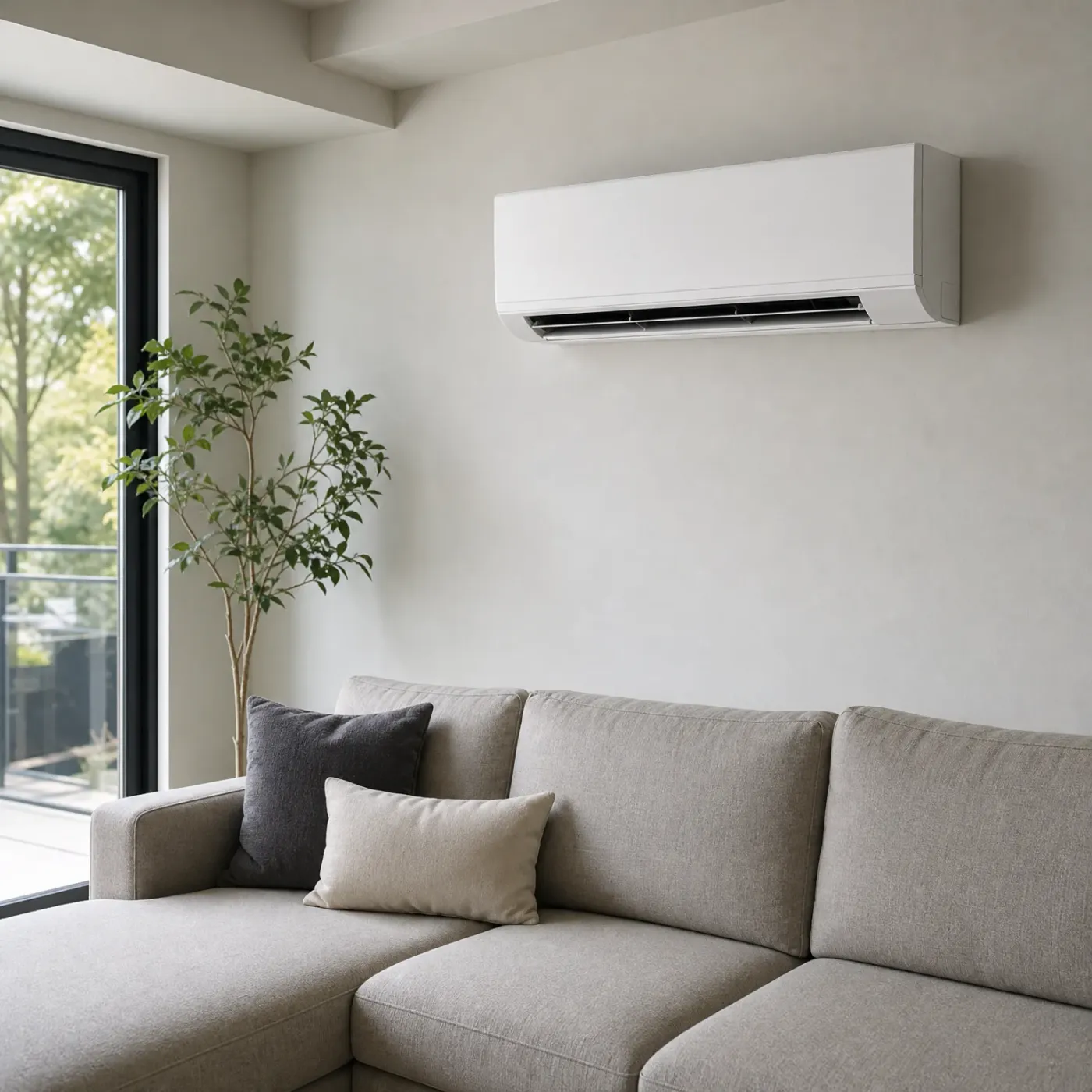
A white wall-mounted mini-split indoor unit high on a beige interior wall, with a potted olive-like tree at right and an armchair and window visible through a doorway at left.
This unit is clean and the coil behind it can shed water the way it's supposed to.
A wall-mounted mini-split air conditioner indoor unit with visible dust and staining, installed on a beige interior wall below white crown molding.
Grime like this holds moisture against the coil and fins, and that's where the drip starts.
  1. Humid air passes over the cold evaporator coil inside.

  2. Moisture condenses on the coil and drips into the pan.

  3. The pan channels water into the condensate drain line.

  4. The line slopes downhill and carries water outside.

Is the drip actually spreading past the unit itself

Look below the indoor unit for a water stain on the wall or a damp patch on the ceiling if it's mounted up high. Carpet or wood flooring underneath will show it too, and you might catch a musty smell before you see anything. Check the drain line where it exits outside. If nothing is coming out there during a muggy stretch, the water is backing up and finding another way out, usually down the wall behind the unit. Left alone, that moisture sitting in drywall or flooring can turn into mold, and the stain tends to spread each time the unit runs through another humid day.

A dusty, stained white wall-mounted mini-split air conditioner indoor unit installed high on a plain off-white interior wall near the ceiling.
Before you get your mini split repair
A white wall-mounted mini-split air conditioner unit installed high on a beige interior wall below white crown molding, with a window and woven shade at the left edge showing green foliage outside.
After you get your mini split repair
A white wall-mounted mini-split indoor unit on a pale interior wall above a gray sectional sofa with cushions, next to a potted leafy tree and a floor-to-ceiling window showing green trees outside.

Get your mini split to the right pro

Send the request today and let a mini split pro reach out to you.

Tell a local repair pro what your mini split is doing.

Hand off my repair

Sending the form costs nothing.

Clear It Yourself or Call Someone

Clear the drain yourself

  • A wet/dry vac held against the outdoor end of the condensate line can pull a clog free in a few minutes.
  • Flushing the line with a cup of distilled vinegar once a month keeps algae from building back up.
  • You need to actually find where the line exits outside, which isn't always obvious on every install.
  • If the clog sits further up near the pan itself, a shop vac at the outside end won't reach it.
  • Doing this yourself costs nothing but your time, and it's worth trying before anything else.

Have it looked at

  • A contractor can run a camera or test the line's slope to find a clog you can't reach from outside.
  • If the pan itself is cracked or sitting unevenly, no amount of flushing fixes that.
  • A clogged drain that keeps coming back might mean the line was never pitched correctly during install.
  • Standing water near the air handler can mean the float switch has failed and isn't shutting the unit off.
  • Catching it now, while the fix is still just the drain line, keeps it from becoming a coil or drywall problem.
A dim room with a wall-mounted mini-split air conditioner above a water stain running down the gray wall to a towel on the wood floor, with a black shelving unit, a desk with a lamp and potted plant by a window, and an office chair at right.

You've been at the desk since lunch, door closed against the rest of the house, and you almost don't notice the sound at first, just a faint tick of water hitting the baseboard. Then you see it. A dark streak running down the wall under the indoor unit, already reaching the outlet cover. Outside it's the kind of thick, wet August afternoon where the air feels heavier than the heat itself, and the unit's been running non-stop since morning. You grab a towel from the hall bathroom and press it against the wall, then lay another flat on the floor where the water's pooling near the baseboard. The streak keeps coming, slow but steady, while the unit hums along like nothing's wrong.

Power costs 14.00 cents per kilowatt-hour statewide

At 14 cents a kilowatt-hour, running the mini split to fight North Carolina humidity doesn't cost much day to day. That's worth knowing before you assume a clogged drain line means the unit is working harder and burning through power. A slow drip is a plumbing problem inside the unit, not a sign it's straining.

EIA-861 2025 statewide residential average

A white wall-mounted mini-split air conditioner on a beige interior wall, with a window at left showing trees and a wooden fence, and dark wood flooring below.

Running clean

Water drains outside the way it's built to. No pan overflow, no streaks on the wall under the unit, no damp spot creeping across the ceiling. Air comes out cold and dry, and the only sign the mini split is working is a comfortable room.

A white wall-mounted mini-split air conditioner indoor unit with dark louvered vents, installed near the ceiling on a beige wall below white crown molding.

Backed up

Dust and grime have built up on the casing and the coil behind it. That buildup holds moisture instead of letting it shed off the coil into the pan, so water finds another way out. This is the point where a drip starts and the wall or ceiling underneath takes the damage.

A woman in a cream sweater and jeans stands in the open doorway of a white stucco house, holding the dark door, while a man in a dark quilted jacket seen from behind walks toward the entry past potted plants.

Water on the wall means the drain isn't doing its job

A mini split that drips indoors isn't broken in some mysterious way. The coil is cold, the air is thick with water the way it is every summer in North Carolina, and that water has to leave through a line that's blocked or sloped wrong. Fix the path out and the drip stops. That's the whole answer.

You already know enough to catch problems before they spread, which is why you're reading this instead of waiting for a ceiling stain to tell you. A contractor who works on mini splits in your area can look at the line, the pan, and the slope, and tell you exactly where the water's backing up. Send the form and that search is off your plate. Someone who handles this will be in touch, and you can stop wondering what's wrong with the wall.

Interior corner with a beige sofa holding a dark green and a light cushion and a textured throw, a potted small-leaved tree beside a white-framed window, and a dark shallow bowl on a wooden coffee table in the foreground.
A bearded man in a blue and brown plaid flannel shirt stands indoors looking out a window at snow-covered trees, with a ceramic mug on the windowsill.
A man in a blue T-shirt sits on a light gray sofa, laughing while looking at an open laptop in the foreground, with a framed picture, lamp and potted plant behind him.

Mini Split Repair

The right pro for this job

Get the mini split repair search off your mind today.

A black-framed smartphone standing upright against a plain white background, its screen filled with solid green.
RepairMini-splitNorth Carolina
Step 1 of 2

What ZIP code is the job in?