Three white clapboard houses with wraparound porches glow with warm interior and landscape lighting beneath Spanish moss-draped oak trees at dusk.

Mini Split Installation in Wilson, NC

Tell us about the job

Takes about a minute. No obligation.

New system or replacementMini-splitWilson County, NC
Step 1 of 2

What ZIP code is the job in?

Weather here is active

Wilson County recorded 109 severe weather events between 2015 and 2024. That includes 76 damaging wind events, 16 hail events, and 3 tornadoes. Tropical storms and hurricanes came through 6 times in that span, and winter storms added 8 more.

Outages follow the weather

A quarter of North Carolina households lost power for 24 hours or more in 2024. An outdoor condenser can take a hit from wind-driven debris or hail. When the power goes with it, a mini-split stops heating or cooling until the grid comes back.

7 months
October through April, your system heats
5 months
May through September, it cools
33°F
the average winter night it heats against
88°F
the average summer afternoon it cools against
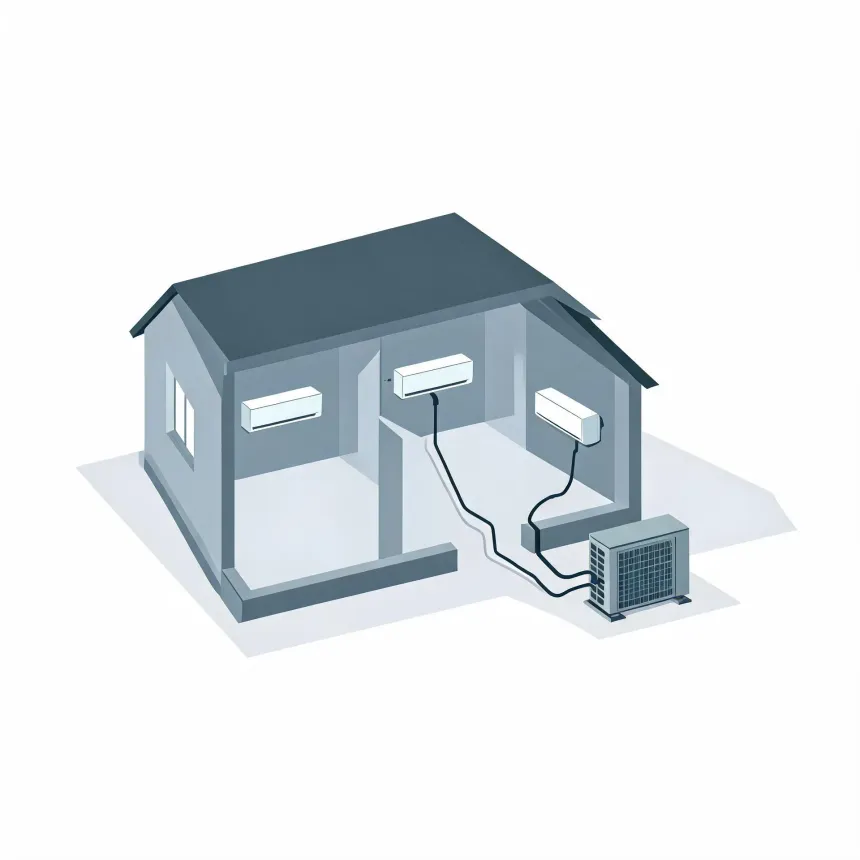
Isometric illustration of a cutaway single-story house with three wall-mounted indoor air conditioning units connected by lines to an outdoor condenser unit on the ground outside.
Your system heats October through April and cools May through September.

NOAA nClimDiv, 1991–2020 normals

Electricity heats 63.4% of homes in Wilson County, more than gas and propane combined.

A mini-split runs on that same electricity, so it fits the way most houses here are already set up.

May starts cooling season, so get it installed before then

Cooling runs May through September
Summer afternoons average 88°F
6 tropical storms and hurricanes from 2015 to 2024

A mini-split installed here runs cooling for about five months straight, May through September. June, July and August bring afternoon highs around 88°F, and the air itself holds more moisture than most of the country sees, with a dew point averaging 68°F. That combination keeps the compressor working longer hours just to pull the damp out of the air, not only cool it. A unit sized or installed for an easier climate will run harder than it was built for, year after year. That kind of load shows up early, in parts that wear sooner than the warranty expects.

Install it ready for the weather it will actually face

Wind, hail and winter storms show up here often enough that where the outdoor unit sits and how it's mounted are part of the install, not an afterthought. A mini-split also needs grid power to run, so it's worth asking what the system does when that power drops. Get it placed and installed with that in mind from the start.

Find a contractor
A beige split-system air conditioner outdoor condenser unit mounted on metal wall brackets atop a stucco wall.

Five months of running, start to finish

Five months of running without a break is a long stretch for a compressor to carry, longer than it gets in most of the country. The unit in this clip is working through all of it, day into night, from May to September. That run time is what to size for, not the worst afternoon in August. A unit picked to handle one hot day can still fall short across a full season of them.

Where the lines run sets the cost

The indoor head and outdoor condenser connect through a line set carrying refrigerant and wiring, run through a hole drilled in the wall. A short, straight run between the two is the cheapest path. Every extra foot of line, every turn around a corner, every floor the line has to climb adds labor and material. A condenser placed far from the indoor unit, or on the far side of the house, costs more to connect than one placed close.

The wall decides what the job takes

Before anyone runs a line, the installer has to get through the wall itself, and what's behind the drywall matters. Brick, block or stucco takes longer to core than wood siding, and running wire or line set through a finished wall takes more care than through an open stud bay. Electrical work adds to the job too. A mini-split needs its own dedicated circuit, and if the electrical panel has no open slot for it, that's its own piece of work before the unit ever gets mounted.

The efficiency rating on a mini-split, the SEER2 number, tells you how much cooling the unit delivers for the power it draws over a full season, not just at one setting. A higher number means the compressor is doing more work per unit of electricity, especially when it's running at a low, steady output rather than cycling on and off. That matters because a mini-split spends most of its time modulating, not running flat out, so the rating reflects real-world use better than a single peak measurement would. The number on the label is tested under set conditions, so two units with the same rating should perform close to the same if they're sized and installed correctly. Installation affects this as much as the equipment does. A unit that's oversized for the space will short cycle, and a line set that's too long or has too many turns makes the compressor work harder to move refrigerant, both of which pull the real efficiency below what the label promised.

Wilson County falls in climate zone 3A under the 2021 energy code, a warm zone with a long cooling season. Any split-system heat pump manufactured from 2023 onward has to meet a federal minimum here, 14.3 for cooling and 7.5 for heating, the same standard that applies to central systems. A ductless mini-split counts as a split system under that rule, so there's no lower bar for going ductless. That floor narrows the field before efficiency even becomes a selling point. A federal tax credit is available on top of that for units that qualify, which is worth asking about when comparing models.