Weather here does damage
Cleveland County logged 117 severe weather events between 2015 and 2024. That includes 70 damaging wind events, 28 hail events, and 9 tornadoes. An outdoor condenser sits outside through all of it.
Takes about a minute. No obligation.
Cleveland County logged 117 severe weather events between 2015 and 2024. That includes 70 damaging wind events, 28 hail events, and 9 tornadoes. An outdoor condenser sits outside through all of it.
A quarter of North Carolina households went at least 24 hours without power in 2024. A mini split that loses power loses heat and loses hot water if it's tied to the system, not just air conditioning.
NOAA nClimDiv, 1991–2020 normals
Electricity heats 74.4% of homes in Cleveland County.
A mini split fits a home already wired for electric heat, with no gas line to add.




Shelby falls in climate zone 3A, a warm zone with a long cooling season, under the 2021 energy code. Any mini split installed here has to meet the federal minimum for that kind of system, not a lower one for mild climates. For a unit manufactured from 2023 on, that means pulling at least 14.3 Btu of cooling from every watt-hour of power it uses over the summer, and delivering at least 7.5 Btu of heat per watt-hour over the winter. The standard doesn't set a separate, easier bar for ductless systems. That rules out older or stripped-down models that can't clear it.
Where the outdoor unit goes and how it's mounted is worth deciding before install day, not after. A unit set where wind-blown debris or falling limbs can reach it is a problem waiting to happen. If heat or hot water in this house runs through the mini split, ask what happens to both when the power drops, and what a backup option would take.
Find a contractor
Whatever is getting replaced doesn't need to come out before the new system goes in. An installer can run the new lines, mount the new indoor heads, and set the new outdoor unit while the old one still runs, then switch over and pull the old equipment out after. If the old system is ducted and the new mini split isn't, that ductwork doesn't have to stay. Sealed off or pulled out, it stops pulling conditioned air into an attic or crawlspace where it does no good. Old refrigerant gets recovered, not vented, and that part of the job falls to whoever is licensed to handle it. A mini split being installed next to an old window unit or a baseboard heater doesn't need that equipment gone first either. Plenty of homes run a mini split alongside what they already have for a season or two before deciding what stays and what goes.
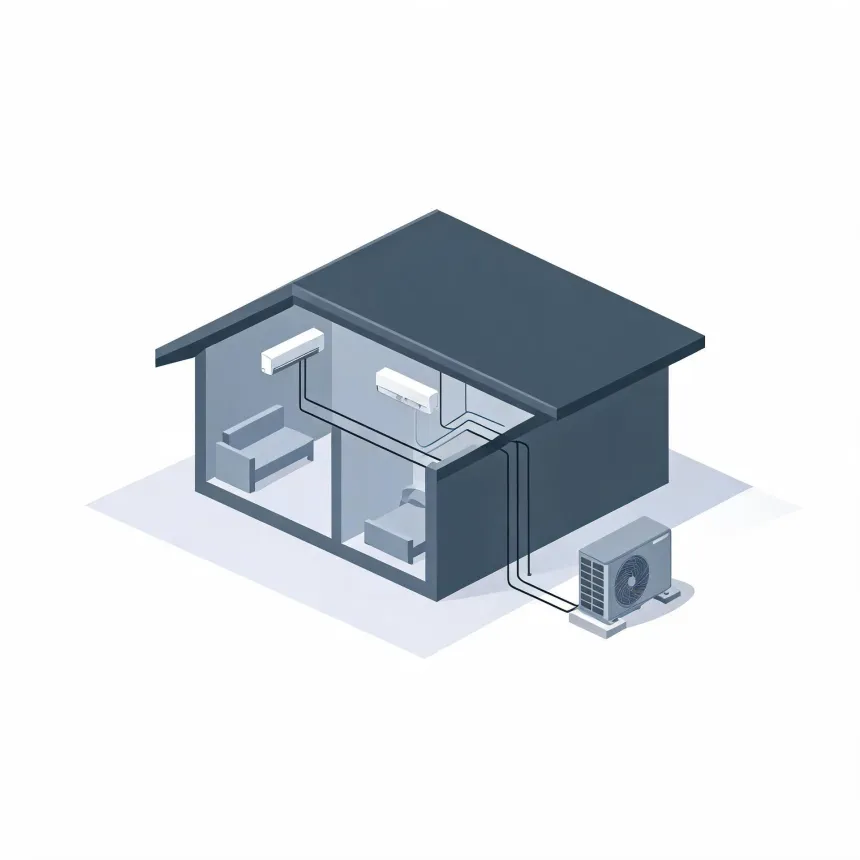
Every indoor head needs a line set run to the outdoor unit, carrying refrigerant lines, a condensate drain, and wiring through a hole in the wall. A head going up on an exterior wall close to where the outdoor unit sits is a short, simple run. A head going upstairs, or on the far side of the house, means a longer line set hidden in a wall cavity or run through a chase, more labor, and more refrigerant to charge the system with. The number of heads matters too. A single zone is one line set and one indoor head. Add zones and each one needs its own line run back to an outdoor unit sized to carry all of them.
A mounting pad or bracket has to go in wherever the outdoor unit lands, and that spot has to give the unit clearance to pull in air and drain condensate without freezing problems in winter. Electrical work is part of the job too. Most mini splits need a dedicated circuit, and if the panel doesn't have room or capacity for that, the panel work gets added to the install before the unit itself goes in.
Comparing systems means comparing more than the equipment itself. Ask what a contractor is sizing the system to, not just how many heads it comes with. A unit sized by square footage alone often ends up wrong, too big for some rooms and short for others, because a load calculation accounts for windows, insulation, and how rooms are laid out, and a square footage guess doesn't. Ask how many zones a given outdoor unit can run and whether adding a head later is possible or means replacing the outdoor unit entirely. Ask about the warranty on the compressor versus the warranty on parts and labor, since those are often different lengths and only one of them usually requires a licensed installer to keep it valid. Ask what routine upkeep each system needs, since a clogged indoor filter or a dirty outdoor coil cuts efficiency and run time no matter how good the unit was on install day.
Installation day starts outside, with the outdoor unit set on its pad or bracket and the line set run to wherever each indoor head is going. That means drilling through the wall, so the crew works room by room, mounting each indoor head and running its refrigerant lines, drain line, and wiring back out to the condenser. Once everything's connected, the system gets evacuated to pull moisture and air out of the lines before refrigerant goes in. That step matters. Charging a system that still has air or moisture trapped in the lines shortens its life before it's even started. After the charge, the installer runs the system, checks airflow and temperature at each head, and confirms the condensate drains the way it should. A clogged or poorly sloped drain line shows up fast as water where it doesn't belong, so that gets checked before the crew leaves, not after.