Three white clapboard houses with wraparound porches glow with warm interior and landscape lighting beneath Spanish moss-draped oak trees at dusk.

Mini Split Installation in Salisbury, NC

Tell us about the job

Takes about a minute. No obligation.

New system or replacementMini-splitRowan County, NC
Step 1 of 2

What ZIP code is the job in?

Rowan County sees its share of severe weather

Rowan County logged 128 severe weather events between 2015 and 2024, including 101 damaging wind events, 14 hail events, 3 tornadoes and 7 winter storms. A mini-split installed here needs to hold up to all of that, not just the heat and cold.

A quarter of North Carolina lost power for a day or more

In 2024, 25% of North Carolina households went at least 24 hours without electricity. A mini-split runs on electricity alone, so an outage that long takes it offline, along with whatever else in the house depends on power for heat or hot water.

7 months
October through April, your system heats
5 months
May through September, it cools
31°F
the average winter night it heats against
87°F
the average summer afternoon it cools against
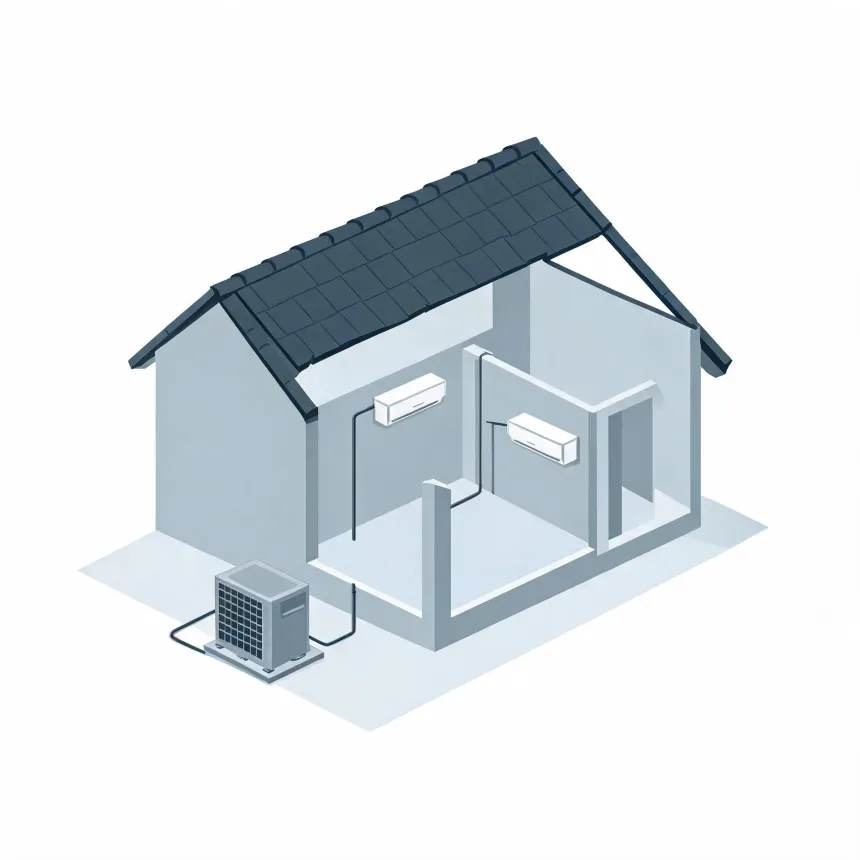
Isometric illustration of a cutaway house with a dark tiled gable roof, showing two wall-mounted indoor split air conditioning units connected by lines to an outdoor condenser unit on the ground outside.
Your system heats October through April and cools May through September.

NOAA nClimDiv, 1991–2020 normals

Cooling season in Rowan County starts in May.

April is the month to get a mini-split installed, before the first warm week sends everyone to the phones at once.

Most homes around Salisbury already heat with electricity, so a mini-split fits right in

67.9% of homes heat with electricity
Cooling runs May through September
Summer afternoons average 87°F

Rowan County falls in climate zone 3A, warm with a long humid summer and a short winter. Any mini-split installed here has to meet the federal minimum for that kind of system: at least 14.3 Btu of cooling for every watt-hour it uses, and at least 7.5 Btu of heat for every watt-hour in winter. That floor applies whether the house is small or large, old or new. It narrows what a contractor can legally install, so the unit quoted has to clear it, not just come close.

Plan the install around the outages, not just the heat

Get the outdoor unit placement and mounting right at install, and the indoor head wired for backup power if you plan to add a generator or battery later. That's easier to settle before the lines are run than after.

Find a contractor
A man in a cap, dark T-shirt and tan work pants walks up porch steps toward an orange front door, carrying a canvas tool bag filled with hand tools, with a potted shrub in a terracotta planter at left.
A beige split-system air conditioner outdoor condenser unit mounted on metal wall brackets atop a stucco wall.

Sizing it right is what makes it last

Sizing a mini-split is not about matching the room's square footage to a number on a brochure. A contractor works out how much heat the space gains in summer and loses in winter, looking at window area and orientation, ceiling height, insulation, and how many walls face outside. That calculation is what tells them which unit to install, not a rule of thumb. Oversize it and the unit short cycles, blasting cold air until the thermostat is satisfied, then shutting off before it has run long enough to pull moisture out of the air. The room ends up cool and clammy, and the compressor wears faster from starting and stopping so often. Undersize it and the unit runs constantly, struggling to hold the set temperature on the hottest and coldest days, which also shortens its life. A correctly sized system runs in long, steady cycles. That's what keeps the indoor coil cold enough to wring humidity out of the air and what keeps the compressor from wearing out before its time.

The outdoor unit and the indoor head are matched, not interchangeable

The compressor lives outside, sized and tuned to move a specific range of refrigerant. The indoor head is built to pair with it, same line, same capacity. A contractor can't swap in a bigger outdoor unit later to get more capacity, or drop in a smaller head to save money, without the whole system falling out of its design range. That pairing is picked once, at quote time, based on the load calculation.

Line set length and the wall it passes through add real work

Refrigerant lines run from the outdoor unit to each indoor head through a small hole drilled in the wall, insulated and sealed the whole way. A short, straight run is quick to fit. A long run, one that climbs a floor or snakes around framing to reach the right spot, takes more line, more insulation, and more time to pressure test before it's charged. The distance and the path through the house are part of what's being quoted, not an extra.

If this is replacing a window unit or a ducted system, that equipment doesn't just disappear. A contractor recovers the refrigerant from the old system before touching anything else, since it's illegal to vent it into the air, and that refrigerant gets weighed and logged. After that the old unit gets disconnected, the line set pulled, and the equipment hauled off. If a ducted furnace or air handler is being replaced by mini-split heads, the ductwork itself is a separate decision. Sometimes it stays in place to serve a part of the house the mini-split doesn't reach. Sometimes it gets capped or removed if the mini-split is taking over for good. Either way, that's worth settling before install day, not after, since it changes how much work the crew is doing and what the house looks like when they leave.

Install day starts with the outdoor unit. A contractor sets it on a pad or wall bracket, level and clear of anything that would block airflow across the coil, then runs the line set through the hole already drilled for it. Each indoor head gets mounted, leveled, and connected to its own line, with a condensate drain pitched so water runs out instead of pooling. Once everything's connected, the lines get pressure tested to check for leaks before any refrigerant goes in. Only after that test holds does the system get charged and the heads powered on, one at a time, to confirm each one is cooling and heating the way it's supposed to. The crew walks through the controls before they leave, since a mini-split's remote or thermostat works differently from a standard setup.