Single-story houses with beige siding and a brick building set on a mown lawn behind a trimmed hedge, framed by large oak branches draped with Spanish moss.

Mini Split Installation in Rocky Mount, NC

Tell us about the job

Takes about a minute. No obligation.

New system or replacementMini-splitNash County, NC
Step 1 of 2

What ZIP code is the job in?

Nash County sees its share of severe weather

Nash County recorded 135 severe weather events between 2015 and 2024, including 90 damaging wind events, 23 hail events and 5 tornadoes. Tropical storms and hurricanes reached the county 5 times in that span, and winter storms brought ice and snow another 10 times.

A mini split has to take what comes

An outdoor unit sits exposed to wind and hail, and a storm can knock out power along with it. A quarter of North Carolina households went at least 24 hours without electricity in 2024. A new system here is worth setting up with that in mind, not just with cooling and heating in mind.

7 months
October through April, your system heats
5 months
May through September, it cools
32°F
the average winter night it heats against
88°F
the average summer afternoon it cools against
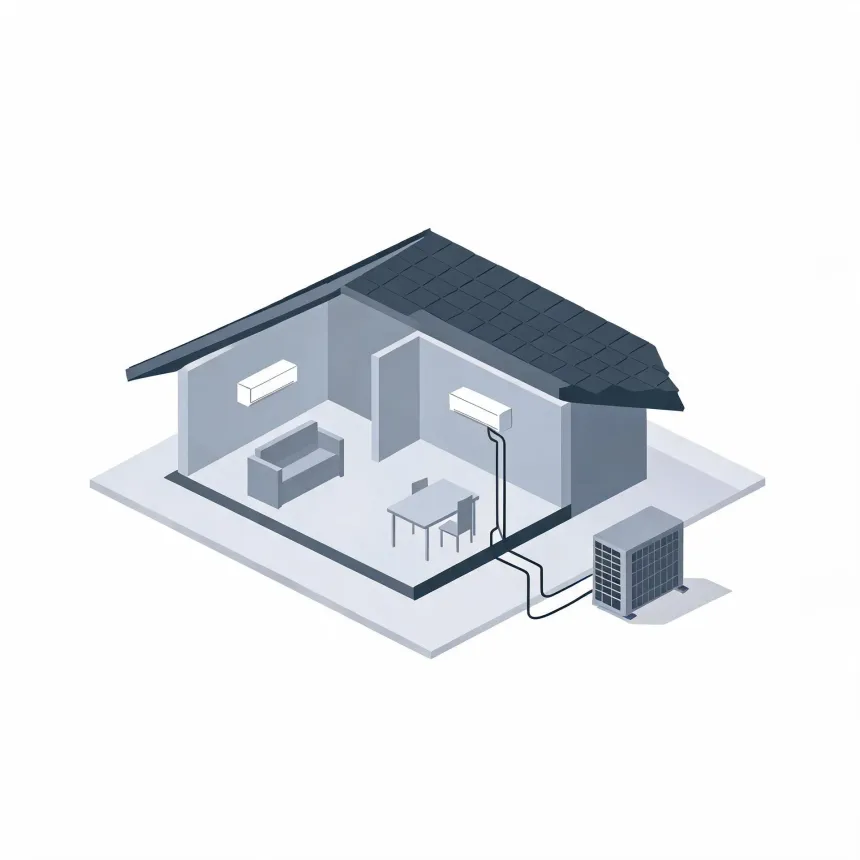
Isometric illustration of a cutaway house interior with sofa, table and chair, two wall-mounted indoor air conditioning units connected by lines to an outdoor condenser unit beside the building.
Your system heats October through April and cools May through September.

NOAA nClimDiv, 1991–2020 normals

Cooling season in Nash County starts in May.

April is the month to get a mini split installed, before the first hot stretch hits.

At 14.40 cents a kilowatt-hour, every bit of efficiency shows up on the bill

Power here costs 14.40 cents per kilowatt-hour
Cooling runs May through September
Summer afternoons average 88°F

Nash County sits in climate zone 3A, warm with a long cooling season and a mild winter. Any mini split installed here has to meet the federal minimum for that kind of system: at least 14.3 Btu of cooling for every watt-hour it uses, and at least 7.5 Btu of heating for every watt-hour in winter. That rule applies to split-system heat pumps built from January 2023 on, and a mini split counts as one. It sets the floor, not a target, so units on the market now clear it already. A system installed new here also qualifies for a federal tax credit, worth checking into before the work is scheduled.

Plan for the outage before the install, not after

Mount the outdoor unit where wind-driven debris and hail have less of a path to it, and work out now how the house keeps heat and hot water running if the power drops. That's a decision for the install, not something to work out once a storm has already knocked the lights out.

Find a contractor
A white outdoor air conditioner condenser unit mounted on metal wall brackets against gray horizontal siding, with a blue sky and white clouds behind it.

Five months a year, this unit doesn't get a break

This unit will run cooling five months straight, May through September. Afternoon highs average 88°F in June, July and August, and the dew point sits at 67°F those same months, higher than most of the country sees. That means the unit is pulling moisture out of the air just as hard as it's pulling heat, the whole stretch. A system that gets long breaks in mild weather has time to rest between runs. This one doesn't get that. Parts wear sooner under a steady load like that, and a unit sized wrong for the house shows the strain earlier than it would somewhere cooler.

The rating is measured with the power on

Every efficiency number on that label, the cooling rating and the heating rating both, assumes the unit is running on grid power the whole time. It says nothing about what happens when the power cuts out. A high rating lowers what the unit draws while it runs. It doesn't keep the unit running through an outage.

A well-sized unit earns its rating, a poorly sized one doesn't

The rating on the label is tested at a fixed capacity. If the indoor and outdoor units are matched to the space correctly, the system runs close to that number. Oversize it and it short cycles, switching on and off instead of running steady, and it never settles in long enough to hit the efficiency it's rated for. Sizing is part of getting what that label promises, not just a separate decision.

A few things separate systems beyond the efficiency number on the label. Ask what happens to the indoor head and the outdoor unit when the power cuts and comes back. Most will restart on their own and pick back up at the last setting, but some controls lose their programming and sit idle until someone resets them by hand. Ask how the line set and wiring run between indoor and outdoor units, since a longer run or extra elbows can cost some performance even on paper-identical equipment. Ask about the compressor type too. An inverter-driven compressor ramps up and down to match the load, while a fixed-speed one only runs full blast or not at all. That difference shows up in how steady the temperature feels and how often the system is cycling on and off. None of this shows up on the spec sheet, so it has to be asked.

Electricity heats 67.2% of the homes in Nash County, more than every other fuel combined. Gas, either utility or bottled, heats under a third. A mini split fits that pattern directly, since it runs on electricity for both heating and cooling and doesn't need a gas line brought in or maintained. For a lot of homes here, putting one in means replacing a system that already worked the same way. That makes the choice simpler. It doesn't change what the unit has to handle once it's running.