



A white wall-mounted split air conditioner on a blue-grey wall, with a moonlit night sky visible through a nearby window.

Mini Split Installation in Raleigh, NC

Tell us about the job

Takes about a minute. No obligation.

New system or replacementMini-splitWake County, NC
Step 1 of 2

What ZIP code is the job in?

Wake County saw 458 severe weather events between 2015 and 2024. Most of that was damaging wind, 308 instances, with 122 hail events mixed in. Five tornadoes touched down in the county in that same stretch, along with six tropical storms or hurricanes and seven winter storms bringing snow or ice. A mini split's outdoor unit sits exposed to all of it, taking wind-blown debris and hail the way any outdoor equipment does. And weather like this knocks out power. Statewide, a quarter of North Carolina households went at least a full day without electricity in 2024. A mini split won't heat or cool through an outage any more than a furnace or a central AC will.

7 months
October through April, your system heats
5 months
May through September, it cools
32°F
the average winter night it heats against
88°F
the average summer afternoon it cools against
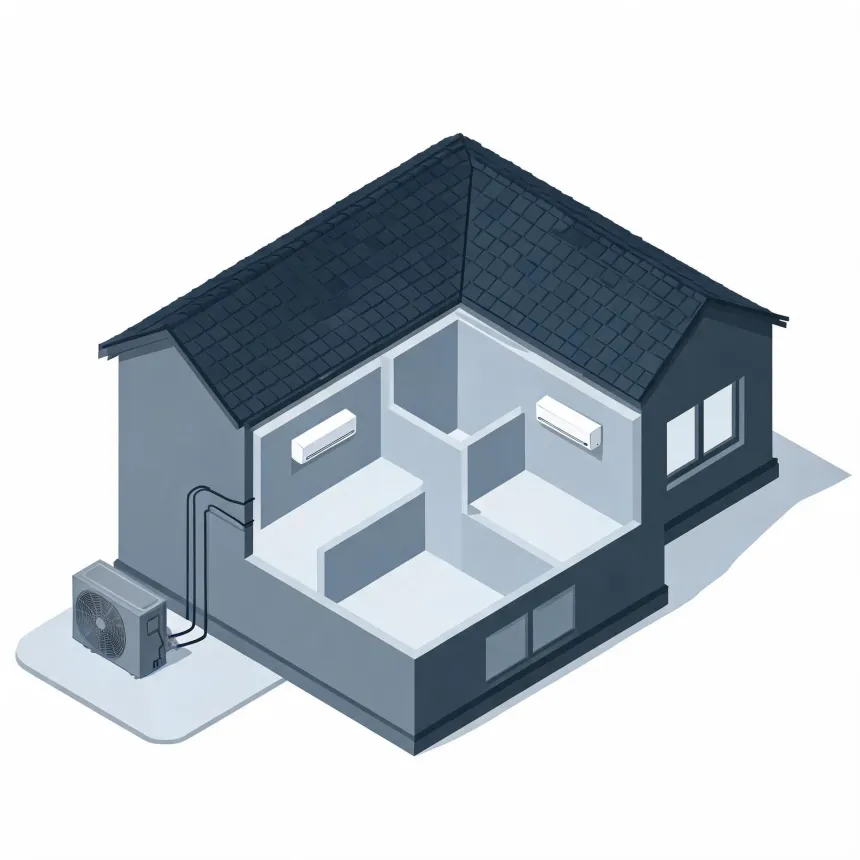
Isometric illustration of a cutaway single-story house with a dark shingled roof, showing two wall-mounted indoor air conditioning units connected by lines to an outdoor condenser unit on a pad beside the building.
Your system heats October through April and cools May through September.

NOAA nClimDiv, 1991–2020 normals

A mini split here runs cooling for five months straight, through afternoons averaging 88°F with dew points that sit higher than most of the country.

That load calls for a unit sized and installed to carry it, not just one with the lowest price tag.

At 14.92 cents a kilowatt-hour, every inch of efficiency shows up on the bill

Power here costs 14.92 cents per kilowatt-hour
Cooling runs May through September
Summer afternoons average 88°F

Electricity heats 54.8% of occupied homes in Wake County, well ahead of gas. That's part of why mini splits make sense here. They run on electricity already, so there's no gas line to tie into and no venting to work out. Utility gas still heats 41.7% of homes, and a mini split fits fine alongside a gas furnace too, usually added for a room or addition the furnace doesn't reach well. Either way, the installer is working with wiring and electrical capacity rather than gas piping, which is the more familiar job in this county.

Plan the installation around the weather it has to survive

Get the outdoor unit placed with this in mind, not as an afterthought. Where it sits, what protects it from wind-blown debris, and how the system handles the next outage are all decisions made at installation, not after. A contractor who installs mini splits in this county plans for that as a matter of course.

Find a contractor
A beige split-system air conditioner outdoor condenser unit mounted on metal wall brackets atop a stucco wall.

Get it in before May, not during it

Cooling here runs May through September, five months straight. April is the month before that starts, while the old system still works and there's no pressure to get it done fast. Install in a hot spell and there's no good option: run the failing unit while the work happens, or go without. Get it in during April and it's already tested before the first hot afternoon hits.

The old equipment comes out whole

If this is replacing a furnace or central AC, that system gets disconnected and hauled away. The refrigerant in an old AC or heat pump has to be recovered first, not vented, so the contractor removing it handles that as part of the job. Ductwork can usually stay in place even after the switch, since a mini split doesn't need it.
What stays behind can matter

A line set or a mounting pad from an old mini split sometimes gets reused if it's in good shape and sized right for the new unit. An electrical circuit that fed the old system might work for the new one too, or it might not, depending on what the new unit draws. The installer checks this rather than assuming either way.

Every mini split carries a SEER2 number for cooling and an HSPF2 number for heating, and both describe the same thing: how much heat it moves for the electricity it uses. A higher number means less power to do the same job. That matters most on the extreme days, the hottest afternoons and the coldest nights, when the unit runs longest and the rating has the most hours to work on. Two units can look alike and carry different ratings because of what's inside: compressor design, coil size, how well the system modulates instead of just switching on and off full blast. A unit that modulates, running at partial capacity most of the time instead of cycling on and off, tends to hold a higher real-world efficiency than the label alone suggests. The rating is tested under set conditions, so it's a way to compare units against each other, not a guarantee of what any one home will see.

Wake County falls in climate zone 3A, warm with a long cooling season and only a short mild winter. Federal rules set the floor for what can go in here. A split system heat pump manufactured from 2023 onward has to deliver at least 14.3 Btu of cooling for every watt-hour it draws, and at least 7.5 Btu of heat the same way. A ductless mini split counts as a split system under that rule, so it has to clear the same bar as any other heat pump sold here. That's a minimum, not a target, and it narrows the field before price or brand ever comes into it.