





A row of single-story houses with covered porches, the nearest clad in red brick, seen behind a trimmed hedge and lawn beneath large moss-draped oak branches.

Mini Split Installation in Lumberton, NC

Tell us about the job

Takes about a minute. No obligation.

New system or replacementMini-splitRobeson County, NC
Step 1 of 2

What ZIP code is the job in?

Electricity in Robeson County ran 14.46 cents per kilowatt-hour in 2025. That's the rate every kilowatt your mini-split draws gets billed at. A unit that moves heat efficiently uses less power to do the same job as one that doesn't. At that rate, the gap between an efficient system and a weak one doesn't stay small. It shows up on the bill, month after month, as long as you own the thing.

5 months
November through March, your system heats
5 months
May through September, it cools
35°F
the average winter night it heats against
90°F
the average summer afternoon it cools against
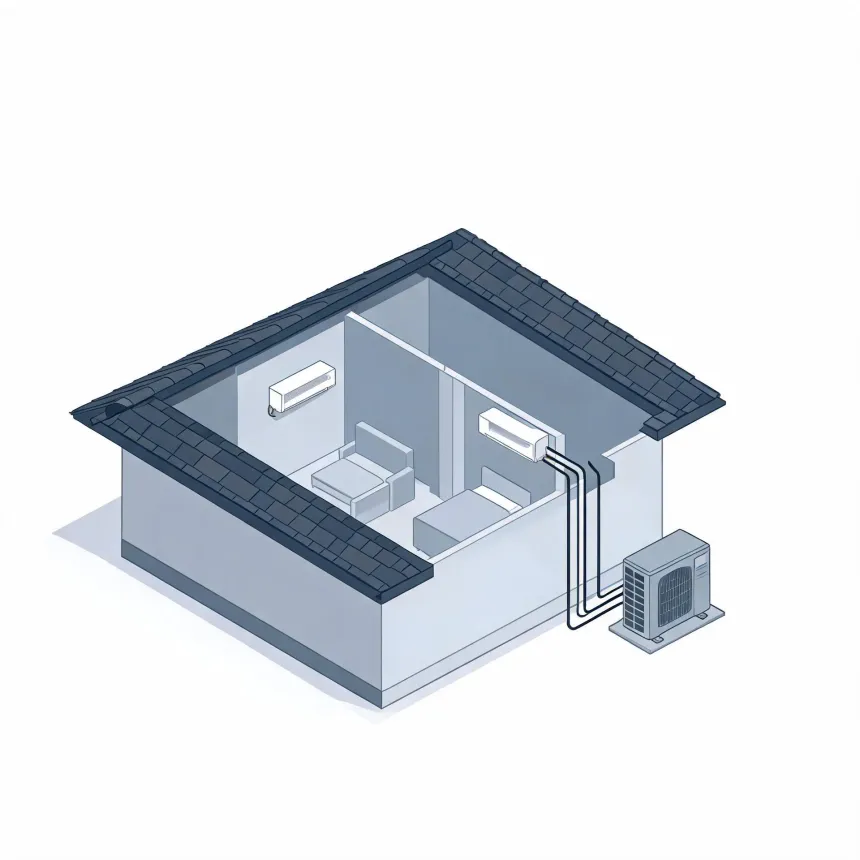
Isometric illustration of a cutaway house with tiled roof showing two wall-mounted indoor mini-split units connected by line sets to an outdoor condenser beside the building.
Your system heats November through March and cools May through September.

NOAA nClimDiv, 1991–2020 normals

Cooling starts in May here.

Get the mini-split in during April and it's running before the first humid week, not after.

Five months of 90 degree afternoons will find every weak spot in a mini-split

Cooling runs May through September
Summer afternoons average 90°F
6 tropical storms and hurricanes from 2015 to 2024
Electric heat already runs this county81.3 percent of homes in Robeson County heat with electricity, more than any other fuel.

Half the homes in Robeson County were built in 1986 or earlier. A house that age wasn't built with a mini-split in mind, and whatever heating and cooling it has now has likely been swapped out or added onto at some point. Mobile homes make up 37.5% of the housing here too, and those come with their own wall and ceiling structure for mounting a unit and running line sets. None of this means the installation is harder. It means the system has to be sized and placed for the house that's actually there, not a generic one.

The Right Install Is What Makes the Efficiency Real

Put in a system that's sized right and the efficiency rating holds up on every bill that follows, for as long as you own it. Get the install right the first time.

Find a contractor
A man in a cap, dark shirt and tan work pants walks up concrete steps toward a red front door, carrying a canvas tool bag with tools in its side pocket.
A white outdoor air conditioner condenser unit mounted on metal wall brackets against gray horizontal siding, with a blue sky and white clouds behind it.

The sizing happens before the install, not during it

A mini-split has to be sized against the house it's going into, which means someone needs to look at that house before the work starts, not after. The unit's size, where the line set runs, where the indoor head goes on the wall, all of that depends on the place being sized up first. For a house built decades back, with whatever changes have been made to it since, that walkthrough matters more than the brochure numbers on any unit.

The rating is measured over a whole season, not at one setting

A mini-split's efficiency rating comes from testing it across a range of outdoor temperatures, not at one fixed point. Run it right at the edge of its capacity, on the hottest or coldest days, and it won't perform the way the label suggests. Set it to work within its range most of the time, and it will.
Installation decides whether the rating means anything at all

That rating is measured in a lab, with the refrigerant charge exact and the line set at the length the unit was tested with. Add length to the line set, bend it too sharp, or get the charge slightly off, and the unit works harder to move the same heat. The label describes what the equipment can do. What it actually does depends on how it goes in.

A mini-split's price comes down to what the job actually requires, not just the unit itself. The size of the compressor and the number of indoor heads cost more as they go up, and so does the length of refrigerant line between the outdoor unit and each head. Running that line through a wall takes more labor than running it along an exterior surface, and every extra head means another spot that has to be mounted, wired, and connected back to the outdoor unit. The electrical work matters too. Some systems need a dedicated circuit, and if the panel doesn't have room for one, that's its own job before the mini-split goes in at all. None of this is optional or padding. It's what the system needs to run the way it's rated to.

Robeson County sees more severe weather than most places, 127 events between 2015 and 2024, and 87 of those were damaging wind. Twenty three hail events in that same stretch means an outdoor unit sitting exposed is going to take some hits over the years. Where it gets mounted and what's around it matters for that reason alone. Power loss is the other side of it. A quarter of North Carolina households went at least a day without power in 2024, and a mini-split with no power does not heat, cool, or run hot water back if that's part of what it's tied to. Worth asking at install time what backup options make sense for this place, before a storm makes the question urgent.