





Two white Southern-style homes with wraparound porches lit by landscape lighting at night, flanked by live oak trees hung with Spanish moss.

Mini Split Installation in Louisburg, NC

Tell us about the job

Takes about a minute. No obligation.

New system or replacementMini-splitFranklin County, NC
Step 1 of 2

What ZIP code is the job in?

Franklin County saw 115 severe weather events between 2015 and 2024. Most of that was wind, 85 events, with 13 hail events and 3 tornadoes mixed in, plus 4 tropical storms or hurricanes and 10 winter storms. A mini split's outdoor unit sits outside through all of it, exposed to wind-driven debris and hail. Across North Carolina, a quarter of households lost power for 24 hours or more in 2024. When the power goes, so does your mini split, for heat and for cooling both.

7 months
October through April, your system heats
5 months
May through September, it cools
31°F
the average winter night it heats against
88°F
the average summer afternoon it cools against
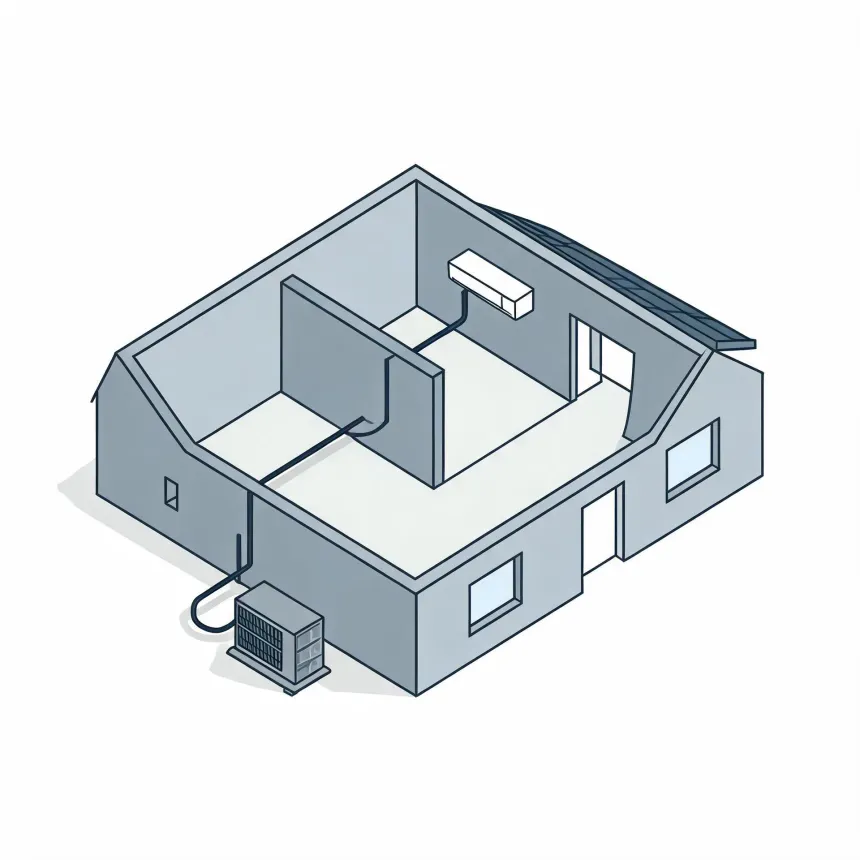
Isometric line illustration of a cutaway house showing an interior wall-mounted air conditioning unit connected by a line to an outdoor condenser beside the exterior wall.
Your system heats October through April and cools May through September.

NOAA nClimDiv, 1991–2020 normals

Electricity heats 71.5% of homes in Franklin County.

A mini split fits into that setup without asking you to add a gas line or rewire your panel.

Five months of 88 degree afternoons, and the unit outside has to take whatever the weather sends too

Cooling runs May through September
Summer afternoons average 88°F
85 damaging wind events from 2015 to 2024
Power here costs more than most places payElectricity in Franklin County runs 14.83 cents per kilowatt-hour, so an efficient mini split earns its keep on every bill

Franklin County falls in climate zone 3A, warm and humid with a long cooling season. Any mini-split installed here now has to meet the federal split-system heat pump minimums, 14.3 for cooling and 7.5 for heating. That rating measures how much heat it moves per watt-hour, not how much power it draws outright, so it narrows the field before you ever start comparing brands. A contractor sizing your install should be working from models that already clear that bar. There's also a federal tax credit available for qualifying heat pump installations, worth checking into alongside the quotes you get.

Where the outdoor unit goes matters here

Have the contractor walk the install site with wind and hail in mind, and plan now for how you'll manage heat and hot water if the power drops. A quarter of North Carolina households lost power for a day or more in 2024, and this is the point to ask what your mini split needs to get back running when it does.

Find a contractor
A white mini-split air conditioner outdoor condenser unit mounted on metal brackets against a beige stucco exterior wall, with a blue sky and scattered clouds in the background.

Get it in before the season needs it

Cooling starts in May here and runs through September, five months of the unit working every afternoon. Get it installed in April and it's broken in and running right before that first hot stretch. Wait until the heat is already on top of you and you're scheduling around whichever slot a contractor has open, not the one that works for you. Winter matters too. Overnight lows average 31 degrees across December, January and February, cold enough that the system is working on the heating side as well. Going in before either season starts means nobody is testing the unit for the first time on the hottest or coldest day of the year.

The rating is two numbers, not one

A mini split carries a cooling rating and a separate heating rating, since it runs the refrigerant cycle both directions. The cooling number tells you how it performs pulling heat out of the house. The heating number tells you how it performs pumping heat in. A unit can clear the bar easily on one and barely scrape it on the other, so both matter when you're comparing models, not just the bigger figure on the sticker.
The rating assumes the right size and a clean setup

That efficiency number is measured on a unit sized correctly for the space it's conditioning, with the refrigerant charge set exactly to spec and the line set run the way the manufacturer tested it. Oversize the unit and it short cycles, turning on and off instead of running steady, and the real efficiency drops below what's printed on the label. Undercharge it or kink the line set and the same thing happens. The rating is a ceiling a correct install reaches, not a guarantee any install delivers.

Sizing a mini split comes down to how much heat the space gains and loses, not how big the room looks. A contractor works through a load calculation, room dimensions, window area and orientation, insulation, how many people use the space, what else gives off heat in there. Skip that step and guess from square footage alone and you end up oversized more often than not, because it feels safer to round up. It isn't. An oversized unit cools the air fast and shuts off before it pulls the moisture out, so the room hits the set temperature and still feels damp. It cycles on and off all day instead of running long steady stretches, and that stop-start is harder on the compressor than letting it run. Undersized has its own problem, it runs flat out and never quite catches up on the hottest or coldest days. The right size is the one that runs long and steady most of the time, with enough reserve for the extremes. That's worth asking your contractor to walk through, not just quote.

Five months of 88 degree afternoons adds up to a unit running most of every day from May through September. That kind of duty cycle is exactly when a weak install shows itself, a bad charge or an undersized line set won't hold up to months of steady running the way it might in a milder climate. Wind hit this county 85 times between 2015 and 2024, and the outdoor unit takes that standing in one spot, bolted to a pad or a wall bracket. A sturdy mount and a clear line of sight away from falling limbs matters as much here as the specs on the unit itself. Buying the cheapest system on the list means betting against both of those, every summer, for as long as you own it.