





A tabby cat rests on a made bed in a dark modern bedroom equipped with a wall-mounted split air conditioner.

Mini Split Installation in Leland, NC

Tell us about the job

Takes about a minute. No obligation.

New system or replacementMini-splitBrunswick County, NC
Step 1 of 2

What ZIP code is the job in?

Electricity in North Carolina ran 14.13 cents per kilowatthour in 2024. A mini split runs on electricity for both heating and cooling, so that rate applies every time it kicks on. The draw of a mini split is how little it takes to move a degree of heat compared to baseboard heat or an old window unit. Sized right for the room it serves, it reaches temperature and holds it without working harder than it needs to. That efficiency matters more here than in a place where power is cheap, because every kilowatt it saves is worth more on the bill.

5 months
November through March, your system heats
5 months
May through September, it cools
37°F
the average winter night it heats against
88°F
the average summer afternoon it cools against
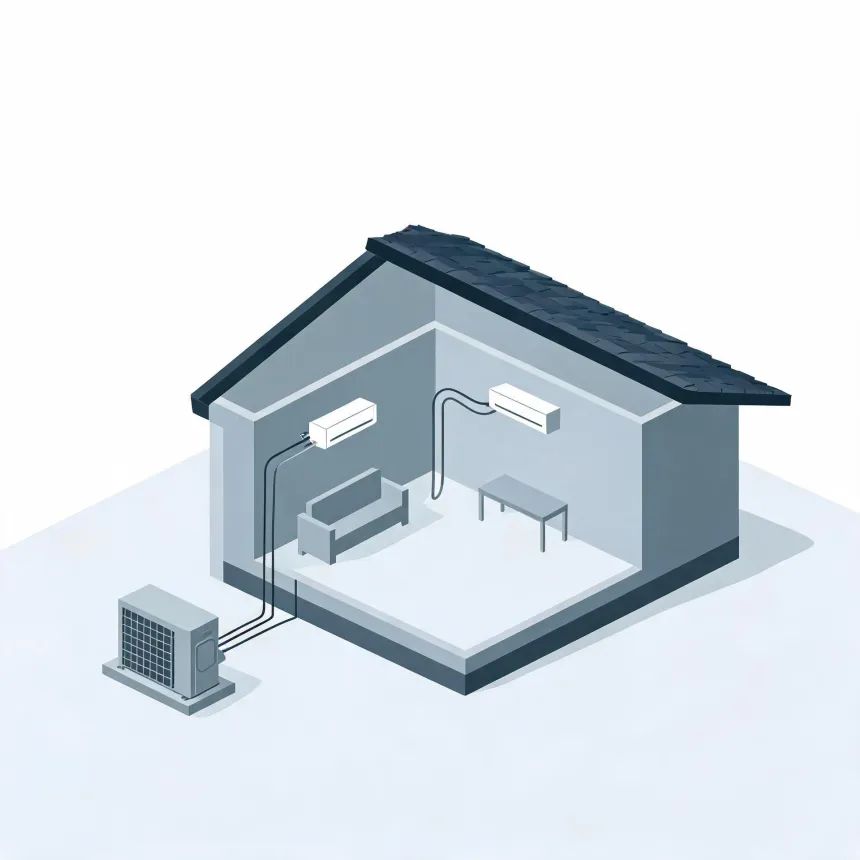
Isometric illustration of a cutaway house showing two wall-mounted indoor air conditioning units connected by line sets to an outdoor condenser unit, with a sofa and table inside the room.
Your system heats November through March and cools May through September.

NOAA nClimDiv, 1991–2020 normals

The cost comes down to how many zones you need and where the lines have to run.

A single head cooling one room costs a lot less than a multi-zone setup reaching into every bedroom.

Almost every home in Leland heats with electricity, so a mini split fits right in

86.7% of homes heat with electricity
Cooling runs May through September
Summer afternoons average 88°F
This county sees more than its share of storms90 severe weather events in Brunswick County between 2015 and 2024

Leland sits in climate zone 3A, warm and humid with a long run of hot months and a winter that barely counts as one. Any mini split installed here has to meet the federal minimum for split-system heat pumps. That means 14.3 SEER2 for cooling and 7.5 HSPF2 for heating. Ductless systems fall under that same rule, since the standard doesn't carve out a separate class for them. A new system has to clear that bar before it can be sold and installed, so the quote you get already reflects it. There's also a federal tax credit available if the install qualifies, worth asking about before you sign anything.

Install in April, before cooling starts in May

Cooling runs May through September here. Put the install in April and it's in place and tested before the first hot stretch, not during it.

Find a contractor
A man in a dark cap and shirt carries a worn leather tool bag up wooden porch steps toward an orange front door, with a potted shrub in a terracotta planter to the right.
A white mini-split air conditioner outdoor condenser unit mounted on metal brackets against a beige stucco exterior wall, with a blue sky and scattered clouds in the background.

The old equipment doesn't just get switched off

The old system comes out once the new one is ready to take over, not before. If a central system is being replaced by ductless heads, that means disconnecting the old refrigerant lines, recovering whatever refrigerant is still inside them rather than venting it, and capping or removing ductwork that no longer serves anything. An old window unit or baseboard heaters just get pulled and the wall or floor patched where they sat. Whatever comes out, the electrical side usually needs a look too. A mini split draws power differently than what it replaces, so the breaker or disconnect serving that spot may need to change to match it.

Sizing comes from a room by room load calculation, not square footage alone

A tech works out how much heat a room gains in summer and loses in winter by looking at window area, insulation, ceiling height and which way the walls face. Rooms the same size can need different size heads if one gets afternoon sun and the other doesn't. Skip that step and the number on the unit is a guess.
Oversized or undersized, the head struggles either way

A head too big for the room cools it fast, shuts off, then starts again soon after. It never runs long enough to pull moisture out of the air, so the room feels cool but damp. A head too small never catches up on the hottest afternoons and runs flat out trying. Both patterns put more wear on the compressor than steady, even running does.

When you're comparing quotes, ask each contractor to walk you through the load calculation, not just hand you a number of BTUs. Ask how many zones one outdoor unit can run and what happens to the other heads if one zone needs service. Ask about the line set length to each head, since longer runs can affect how the system performs and whether it needs extra refrigerant. Ask what happens during a power outage and whether the system restarts on its own once power is back. And ask who services the brand locally, because a system is only as good as the parts and technicians available when something needs attention down the road.

Install day starts with the outdoor unit and the indoor heads going up, then the line set connecting them, the refrigerant lines, power wire and condensate drain all run through a hole drilled in the wall. That hole gets sealed afterward so no air or water finds its way in around it. Once everything's connected, the line set gets pulled down to a vacuum before any refrigerant moves through it. That step pulls out the moisture and air trapped inside the lines, because either one left behind can damage the compressor once the system starts running. After that the refrigerant charge gets set to spec and the tech checks airflow and temperature at each head before calling it done. A system that skips the vacuum step might run fine for a while, but it won't hold up the way one that was evacuated properly will.