





Two illuminated white colonial-style houses with wrap-around porches, flanked by oak trees draped in Spanish moss, photographed at night.

Mini Split Installation in Hendersonville, NC

Tell us about the job

Takes about a minute. No obligation.

New system or replacementMini-splitHenderson County, NC
Step 1 of 2

What ZIP code is the job in?

Most homes in Henderson County heat with electricity, at 60.4%. Utility gas covers another 26.3%, with the rest split between propane and oil. A mini split fits an electric home without any new fuel line or venting to plan around. For a house already heated with baseboard or an electric furnace, swapping in a mini split means the same power source doing the job more efficiently, with cooling added in. Homes on gas heat usually keep the furnace for the coldest stretch and add the mini split for cooling and shoulder season.

7 months
October through April, your system heats
3 months
June through August, it cools
30°F
the average winter night it heats against
81°F
the average summer afternoon it cools against
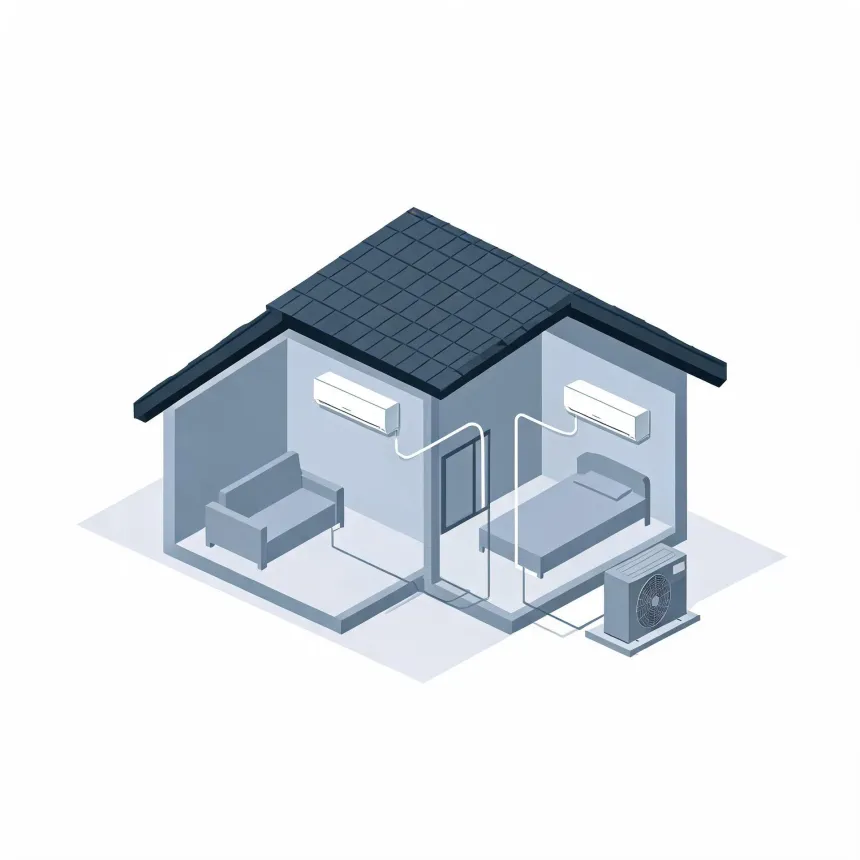
Isometric illustration of a cutaway house with two rooms, showing two wall-mounted indoor air conditioning units connected by lines to a single outdoor condenser unit outside the building.
Your system heats October through April and cools June through August.

NOAA nClimDiv, 1991–2020 normals

The efficiency rating on a mini split tells you how much heat it moves for the power it uses, not how strong it is.

A higher rated system costs less to run over the same job, so it earns that back in the power bill instead of in the first season.

Three months of real heat is all a mini split here has to handle

Cooling runs June through August
Summer afternoons average 81°F
42 damaging wind events from 2015 to 2024

North Carolina electricity ran 14.13 cents a kilowatt-hour in 2024, below what most states pay. That changes how to weigh an efficiency rating here. A higher rated mini split still costs less to run each month than a lower rated one, but with power this cheap, the gap between them shows up slower in your bill. Spending more up front for the top tier unit takes longer to pay you back. That doesn't make the rating meaningless, it just means it shouldn't carry the decision alone. How well the installer sizes the unit to your rooms and how long it holds up matter more to what you spend over the years.

Any mini split installed here has to hit 14.3 SEER2 and 7.5 HSPF2

Henderson County sits in climate zone 4A, which asks real work of both heating and cooling. A mini split put in since January 2023 has to meet 14.3 SEER2 for cooling and 7.5 HSPF2 for heating, the same minimums as any other split system. That floor narrows what can legally go in, and a federal tax credit is available on top of it for units that qualify.

Find a contractor
A man in a cap, dark work shirt and tan pants, seen from behind, climbs porch steps toward an orange front door while carrying a worn leather tool bag.
A beige split-system air conditioner outdoor condenser unit mounted on metal wall brackets atop a stucco wall.

Sized to the room, not the square footage

Sizing a mini split isn't about matching tonnage to square footage on a chart. The installer works out a heat load for each room. That means counting windows, checking which way they face, looking at how much wall and ceiling area is losing or gaining heat. Too big and the unit short cycles. It blasts cold air until the thermostat's satisfied, shuts off, then starts again a few minutes later. It never runs long enough to pull moisture out of the air, so the room feels cold and damp at once. Too small and it runs flat out all day without catching up on the hottest afternoons, and that strain wears on the compressor faster than normal cycling would. A correctly sized system runs long, steady stretches at partial output, which is where these units are most efficient and easiest on their own parts. The indoor head has to fit the room it's serving too. An oversized head covering more than one room off a single zone sounds simpler, but it gives up control room by room, and airflow suffers wherever sits farther from the head.

Baseboard heat or an electric furnace usually just stays put

A mini split handling daily heating and cooling doesn't require tearing out what's already there. Baseboard heat or an electric furnace can stay in place as backup, ready for the coldest nights. Taking the old system out is a separate job the homeowner can decide on later, not something the installer needs to do at the same time.
An old ductless system is the one that has to go

A window air conditioner just gets pulled and the opening closed up. A ductless system being replaced is different. The outdoor unit, the indoor head and the line set running between them all come out together, because a new system needs its own matched parts. An installer won't connect a new unit to an old line set.

What drives the price is how many rooms need their own head and how far the line set has to run to reach them. One zone cooling a single room costs less than a setup feeding several rooms off one outdoor unit, since each indoor head, each run of refrigerant line, and each spot where the line passes through a wall adds work. Where the outdoor unit can sit matters too. A straight run to a nearby exterior wall takes less time than routing line through an attic or across a long stretch of siding. The condensate line has to drain somewhere, and if gravity won't do it, a pump gets added to the job. Electrical work is its own factor. A mini split needs its own circuit, and if the panel has no room left, that's a separate piece of work before the system goes in at all.

Installation starts outside, with the installer picking a spot for the outdoor unit and checking what's between it and each room getting a head. Mounting brackets go up, the outdoor pad or bracket gets set, and the indoor heads get hung on the wall at the height and spot that gives even airflow. Then comes the line set, run through a small hole drilled in the wall and connected at both ends, carrying refrigerant between the heads and the outdoor unit. Once everything's connected, the system gets evacuated with a vacuum pump to pull out air and moisture before refrigerant ever flows, because trapped moisture in the lines ruins compressor life fast. The installer charges the system, checks the pressures match the unit's specs, and runs it in both heating and cooling to confirm each head is pulling the air it should. Electrical work and condensate drainage get tested at the same time, not as an afterthought.