Two illuminated white Southern-style houses with wraparound porches and staircases, framed by a Spanish moss-draped tree on a quiet street at night.

Mini Split Installation in Greenville, NC

Tell us about the job

Takes about a minute. No obligation.

New system or replacementMini-splitPitt County, NC
Step 1 of 2

What ZIP code is the job in?

Ask what happens to the outdoor unit in a storm

The outdoor unit sits exposed to wind and flying debris, so ask how it mounts and whether the pad or bracket holds it secure in high wind. Ask what the manufacturer warranty covers if the unit takes a hit. A unit bolted to a proper pad or wall bracket survives weather that would knock a loosely set one loose.

Ask how the system handles a power cut and comes back after

A mini split with a backup or battery option can keep running, or at least restart cleanly, once power returns. Ask whether the indoor head needs a manual reset after an outage or whether it resumes its last setting on its own. Also ask about surge protection, since a lightning strike or a rough restart on the grid can damage the control board.

5 months
November through March, your system heats
5 months
May through September, it cools
34°F
the average winter night it heats against
88°F
the average summer afternoon it cools against
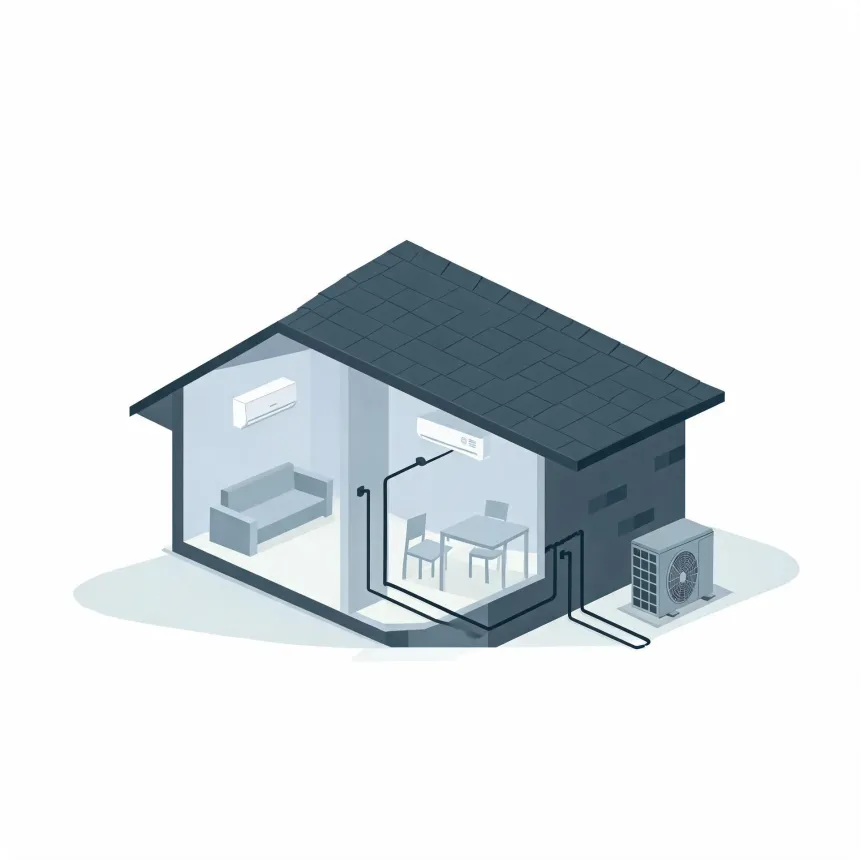
Isometric illustration of a cutaway single-story house showing two wall-mounted mini-split indoor units connected by line sets to an outdoor condenser beside the building, with a sofa, table and chairs inside.
Your system heats November through March and cools May through September.

NOAA nClimDiv, 1991–2020 normals

Electricity heats 79.9% of homes in Pitt County.

A mini split runs on electricity, so it fits the setup most homes here already have.

Five months of cooling, run hard, is what this system has to handle

Cooling runs May through September
Summer afternoons average 88°F
Power here costs 13.03 cents per kilowatt-hour
Get It In Before MayCooling starts in May here, so April is when this gets installed, not when it breaks down.

Pitt County falls under zone 3A in the 2021 energy code, a warm zone with a long cooling season and a short, mild winter. That classification sets the floor for what can be installed. A mini-split heat pump counts as a split system under the federal standard, and any unit built on or after January 1, 2023 has to remove at least 14.3 Btu of heat per watt-hour of electricity used over the summer, and deliver at least 7.5 Btu per watt-hour over the winter. Those are minimums, not targets, so a system sold here already clears that bar. Ask what rating the specific unit carries, since many run above the minimum.

Size it for how hard it works here

A new system here will work harder than most, every year. Size it right and don't buy on price alone.

Find a contractor
A man in a cap, gray t-shirt and brown work pants climbs porch steps toward an orange front door, carrying a canvas and leather tool bag.
A beige split-system air conditioner outdoor condenser unit mounted on metal wall brackets atop a stucco wall.

Five Months of This Load Means Sizing Comes First

From May through September this unit runs most afternoons, with highs averaging 88°F across June, July and August. That's the stretch it has to be built for. A unit sized to the house cycles on and off the way it should and holds that pace for five months. One sized off a price sheet instead of a load calculation either short-cycles or runs flat out trying to keep up, and either way it's working harder than it should from the first summer on.

What the layout of the job costs

A straightforward hookup near the panel and a clear path for the line set between indoor and outdoor units keeps the job simple. Running the line set through finished walls, up multiple floors, or far from the electrical panel adds labor and materials. The length and path of that line set, not just the equipment, shapes what the install takes to finish.

What the equipment itself costs

A single zone feeding one room costs less to install than a multi-zone system feeding several rooms off one outdoor unit, since each indoor head needs its own line set, its own mount, and its own spot on the wall or ceiling. Capacity matters too. An outdoor unit sized for the whole house costs more than one sized for a single addition, and a system built to also heat through winter costs more than a cooling-only unit.

If there's an old system coming out, whoever does the install has to deal with it. A window unit or a through-wall sleeve usually just gets pulled and capped. If there's an older central system being replaced alongside or instead of it, the refrigerant in that system has to be recovered into a tank, not vented, since release into the air is against federal law. Any ductwork that isn't being reused gets sealed off or removed rather than left open to the attic or crawlspace. The old line set, if one is being swapped out, comes out with the indoor and outdoor units rather than getting reused, since a line set is sized and cleaned for the specific refrigerant and equipment it was run for. None of this is complicated work, but skipping a step shows up later as a leak, a moisture problem, or a code issue at resale.

Installation day starts with the outdoor unit placement and the line set path, since everything else follows from those two decisions. A tech runs refrigerant lines and a condensate drain line from the outdoor unit to each indoor head, usually through a small hole drilled in the exterior wall. That hole gets sealed around the lines once they're through, so it isn't an opening to the outside afterward. The lines get connected, then the system gets evacuated with a vacuum pump to pull out air and moisture before any refrigerant is released into them, since either one left in the lines causes problems later. Once the vacuum holds, the tech charges the system, mounts the indoor head level on its bracket, and powers it on to check that it cools, heats, and drains the way it should. A straightforward single-zone job is often done in a day. Adding zones or running longer line sets stretches that out.