This county gets hit
Guilford County logged 214 severe weather events between 2015 and 2024. That includes 166 damaging wind events, 30 hail events, 3 tornadoes and 12 winter storms with snow or ice.
Takes about a minute. No obligation.
Guilford County logged 214 severe weather events between 2015 and 2024. That includes 166 damaging wind events, 30 hail events, 3 tornadoes and 12 winter storms with snow or ice.
A quarter of North Carolina households went at least 24 hours without power in 2024. A mini split that heats and cools this house depends on that power staying on, and here it doesn't always.
NOAA nClimDiv, 1991–2020 normals
May starts cooling season here, and once it hits, a new system is competing with every other installer's schedule.
Get the mini split in before April ends and the job moves at your pace instead of everyone else's.



Guilford County falls in climate zone 3A, warm with a long cooling season and a short, mild winter. Any mini-split installed here has to meet the federal minimum for that kind of system. For units built from 2023 on, that means pulling at least 14.3 Btu of cooling out of every watt-hour it uses over the summer, and delivering at least 7.5 Btu of heat per watt-hour over the winter. That standard applies to the whole system, not just one part of it. It narrows the field some, but it also sets a floor. Whatever gets installed won't fall below it.
Ask the installer where the outdoor unit will sit and what will shield it from wind and hail. Ask what the system does to your heat and hot water when the power drops. Those answers are part of the install, not an extra step after it.
Find a contractorFive months of cooling here means this system runs May through September without much of a break. Afternoons in June, July and August average 87°F, and the dew point sits around 65°F those same months, so the unit is pulling moisture as hard as it's pulling heat. That is the load it sees every summer, not just on the bad days. Add in 166 damaging wind events and 30 hail events on top of that, and the outdoor unit is taking weather on top of the work. A system sized and installed for this has a chance at holding up. One sized for an easier climate will show its weak points sooner.
A mini split's output drops as the outdoor temperature drops, and every manufacturer publishes a capacity curve showing how much heat the unit can still deliver in cold weather. Two systems with the same nameplate size can perform very differently at a low outdoor temperature. Ask for that cold-climate rating, not just the standard rating, so you know what the unit actually puts out on the coldest night, not just on an average one.
The right size comes from a load calculation on the house, room by room, looking at insulation, window area and layout. It does not come from matching the size of whatever was there before or eyeballing the square footage. An oversized system short cycles and struggles to pull moisture out of the air. An undersized one runs constantly and never quite catches up on the hottest or coldest days. Ask to see the calculation, not just a number.
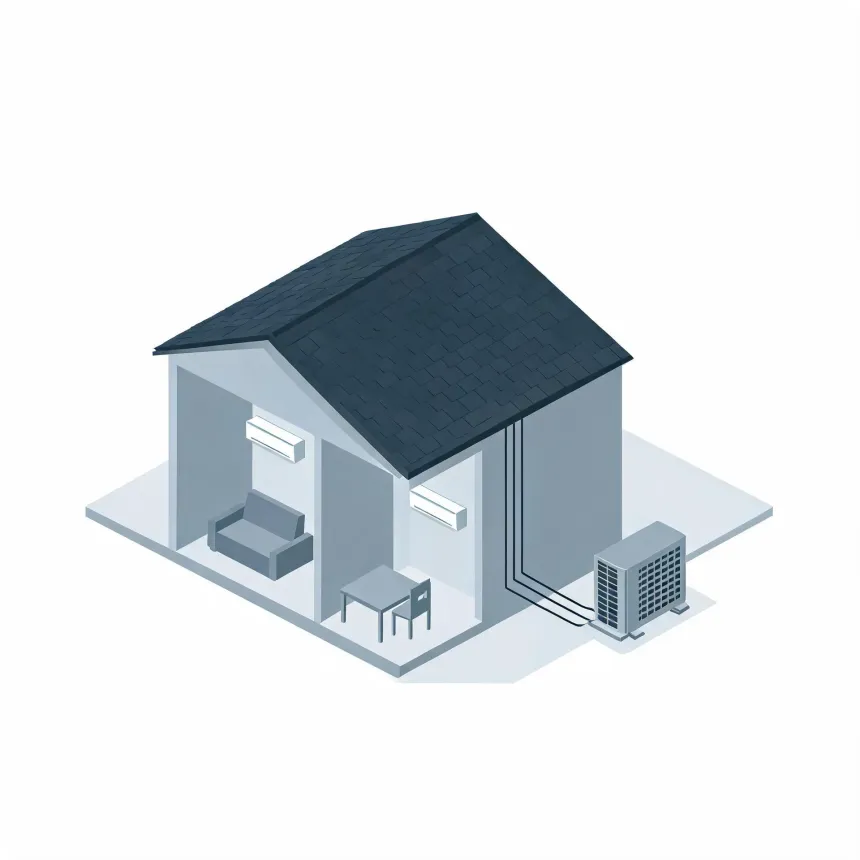
The cost of a mini split install comes down to more than the equipment itself. Line sets have to run between the outdoor unit and each indoor head, and the length and path of that line affects both labor and material. A single-zone system is simpler to install than a multi-zone one, since each added indoor head needs its own line set, its own mounting, and its own spot on the outdoor unit's capacity. Where the outdoor unit sits matters too. It needs clearance to pull air through the coil and a path for condensate to drain, and some locations take more work to prep than others. Electrical work is part of it as well. A dedicated circuit has to reach the outdoor unit, and if the panel doesn't have room or capacity for that circuit, the panel work becomes part of the job. None of this shows up on the sticker price of the equipment. It shows up in what it takes to put that equipment where it needs to go and run it correctly.
That load the system carries all summer is one thing to size for. The weather on top of it is another. A mini split's outdoor unit hangs on an exterior wall or sits on a pad, out where wind and hail reach it, and Guilford County sees both most years. Ask the installer what protects that unit and where it goes relative to trees, fences and the roofline. Mounting height and location are part of sizing the job right, not an afterthought once the equipment is picked. A system built for a hard climate accounts for what's going to hit it, not just what it has to produce.