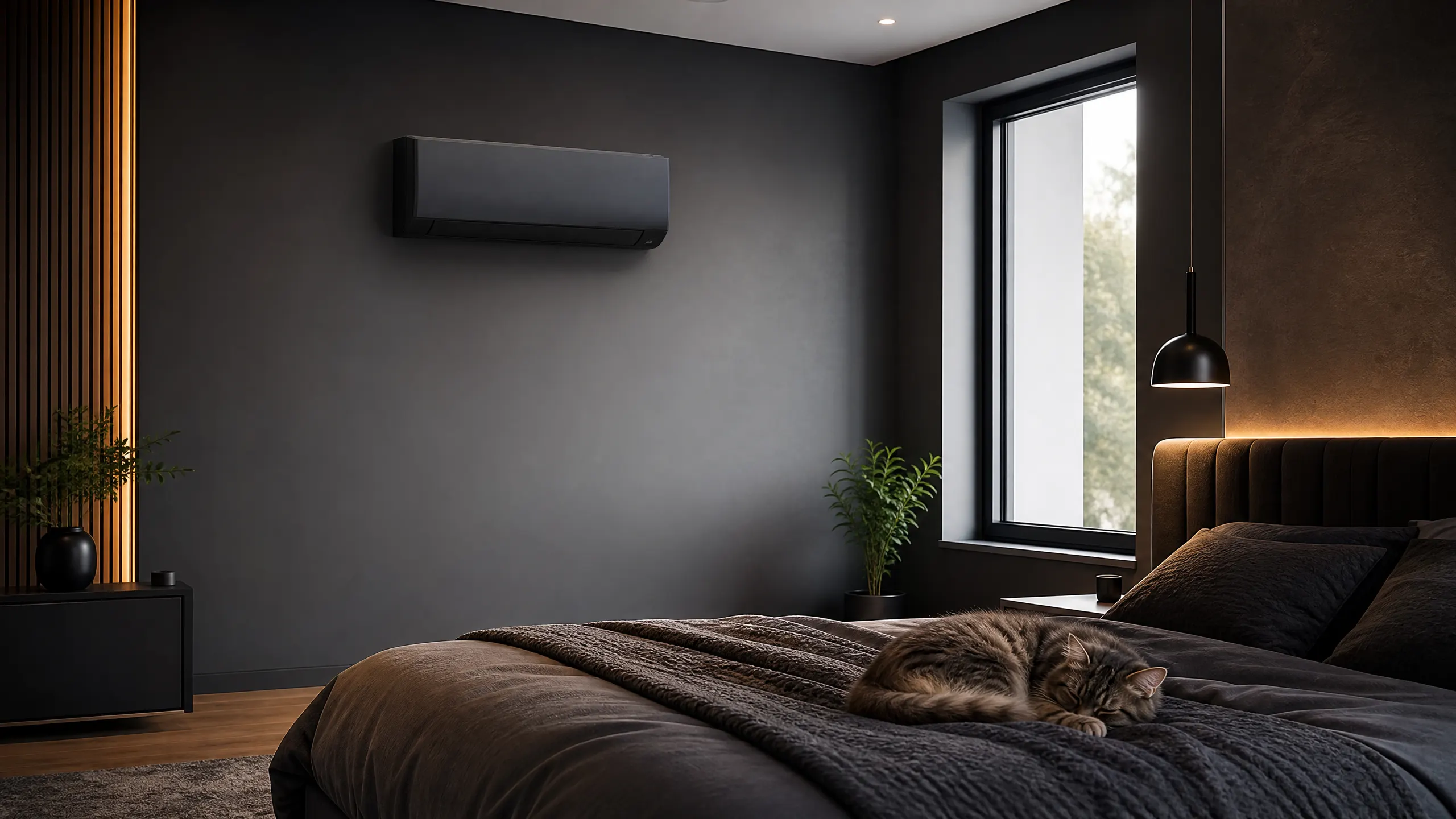






A tabby cat sleeps on a dark quilted bed in a moody, minimalist bedroom with a black wall-mounted air conditioning unit.

Mini Split Installation in Fayetteville, NC

Tell us about the job

Takes about a minute. No obligation.

New system or replacementMini-splitCumberland County, NC
Step 1 of 2

What ZIP code is the job in?

A mini split that's too big for the room cools it fast and shuts off before it pulls the moisture out of the air. The room feels clammy even though the thermostat says it's satisfied. One that's too small runs constantly, straining to catch up on the hottest or coldest days without ever getting there. Sizing isn't a guess. A contractor works it out from the square footage, how many windows the room has and which way they face, how well the space is insulated, and what else is nearby that adds heat, like a kitchen. Each indoor head is matched to the zone it serves, not just the house as a whole. Get it right and the system runs in long, steady stretches instead of short bursts, which is what actually keeps a room comfortable.

5 months
November through March, your system heats
5 months
May through September, it cools
34°F
the average winter night it heats against
89°F
the average summer afternoon it cools against
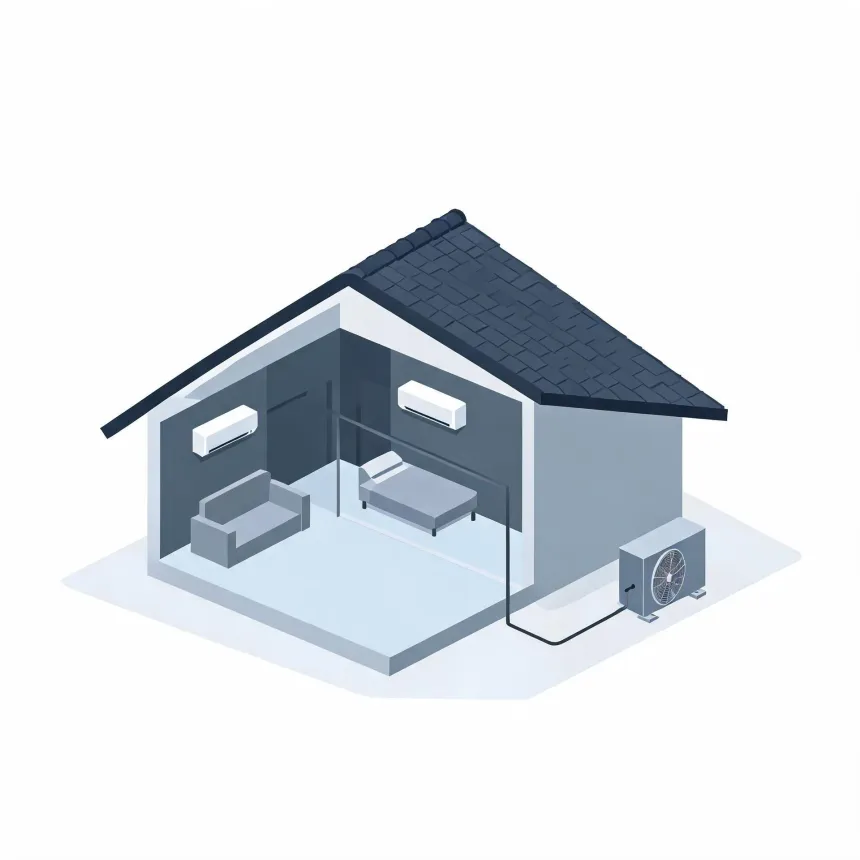
Isometric illustration of a cutaway house showing two wall-mounted indoor air conditioning units connected by a line to an outdoor condenser unit beside the building, with a sofa and bed inside.
Your system heats November through March and cools May through September.

NOAA nClimDiv, 1991–2020 normals

Cooling runs May through September here.

April is the month to get a mini split installed, before the first warm week fills up every contractor's schedule.

Five months of 89 degree afternoons means this system doesn't get a break

Cooling runs May through September
Summer afternoons average 89°F
103 damaging wind events from 2015 to 2024
Most homes here run on electricityElectricity heats 76.7% of homes in Cumberland County, and gas reaches another 17.4%.

Electricity here runs 14.13 cents per kilowatt-hour. A mini split earns that back by how it works, not just how long it runs. It moves heat instead of burning fuel to make it, so it puts out more cooling and heat per watt than a window unit or electric baseboard ever will. Pick a high-efficiency model and that gap in output per watt holds on every bill, through the cooling months and the winter after. On a system that runs this much of the year, the efficiency rating is worth comparing as closely as the price.

Any system installed here has to clear 14.3 SEER2, and a federal credit can offset a higher-efficiency one

Cumberland County falls in climate zone 3A. Any mini split installed here has to meet the federal minimum for a split system, 14.3 SEER2 for cooling and 7.5 HSPF2 for heating. That floor already applies to units built from 2023 on. A federal tax credit is available toward a qualifying high-efficiency system, on top of what it already earns back on the bill.

Find a contractor
A man in a cap, dark long-sleeve shirt and tan work pants walks up wooden porch steps toward an orange front door, carrying a canvas tool tote; an orange planter with ornamental grass stands to the right.
A beige split-system air conditioner outdoor condenser unit mounted on metal wall brackets atop a stucco wall.

Five months of running is where sizing earns its keep

Five straight months of 89 degree afternoons is a lot of hours on one compressor. An oversized mini split cools the room fast and shuts off, then kicks back on a few minutes later, and that start and stop is what wears a compressor down. One sized to the room instead runs in long, steady stretches through June, July and August. That's the system to ask for, and it's also where the unit itself matters. Something built to hold up through a full summer here, year after year, is worth more than whatever was easiest to find.

Where the condenser can go

The indoor head and the outdoor condenser connect through a line set, usually run through a wall. A condenser that sits close to that wall penetration, with a straight shot and few bends, is quicker to install. One that has to sit farther out because of a window, a walkway, or the electrical panel means a longer line set and more labor to run it.
How many rooms it has to cover

A single indoor head tied to one outdoor condenser is a simpler job than a multi-zone system feeding several rooms off one compressor. Each added head means another line set, another spot on the wall to mount it, and another zone to wire in, and the outdoor unit has to be sized to carry all of them running at once.

Ask what the unit's rated capacity is at a low outdoor temperature, not just on a mild day with full sun. A heat pump loses capacity as the air outside gets colder, and systems that look the same on a spec sheet can behave very differently once a cold snap hits. Ask how the warranty splits between parts and labor. A compressor covered for years doesn't help much if the labor to replace it isn't included. Ask what happens if one indoor head on a multi-zone system fails, whether the rest keep running or the whole system shuts down. And ask who services that brand locally. A manufacturer with no nearby parts supplier can leave a homeowner waiting on a part that a more common brand would have on the shelf.

Install day starts with the line set path, not the equipment. The crew runs refrigerant lines, a condensate drain and electrical through the wall between the indoor head and the outdoor condenser, usually through one small hole. The lines get connected, then the system is pressure tested to make sure there are no leaks before anything is charged with refrigerant. Once that holds, the system gets evacuated to pull out air and moisture, because either one left behind ruins the compressor over time. Only after that does the refrigerant go in, and the crew checks airflow and temperature at the head before calling it done. A single-zone job can wrap in a day. A multi-zone system with several indoor heads takes longer, since every zone needs its own line set, its own drain and its own mounting work.