A white wall-mounted split air conditioning unit in a dimly lit modern room, with a full moon visible through the window at night.

Mini Split Installation in Eden, NC

Tell us about the job

Takes about a minute. No obligation.

New system or replacementMini-splitRockingham County, NC
Step 1 of 2

What ZIP code is the job in?

Storms come through here regularly

Rockingham County recorded 209 severe weather events between 2015 and 2024, including 154 damaging wind events and 36 hail events. Four tornadoes touched down in that same stretch. A mini-split's outdoor unit sits outside year round, exposed to all of it.

Power doesn't always hold

A quarter of North Carolina households went at least a full day without power in 2024. A mini-split runs on electricity, so when the power goes out, it stops heating or cooling until the power is back.

7 months
October through April, your system heats
5 months
May through September, it cools
30°F
the average winter night it heats against
87°F
the average summer afternoon it cools against
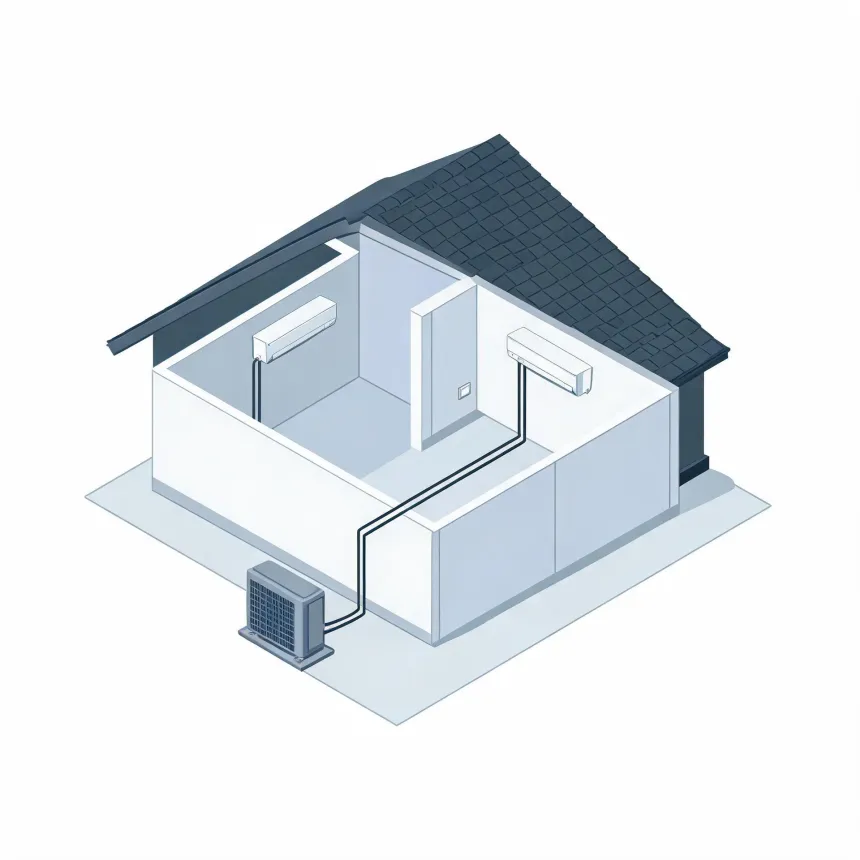
Isometric cutaway illustration of a small house with a dark shingled roof, showing two wall-mounted indoor air conditioning units in separate rooms connected by lines to an outdoor condenser unit on the ground outside.
Your system heats October through April and cools May through September.

NOAA nClimDiv, 1991–2020 normals

Rockingham County summers hold at 87°F for June, July and August, with a dew point around 64°F that keeps the air heavy.

A mini-split here runs about five months a year to keep up with that, so it needs to be sized for the load, not picked on price.

April is the month to get this done, before cooling starts in May

Cooling runs May through September
Summer afternoons average 87°F
154 damaging wind events from 2015 to 2024

Almost two out of three homes in Rockingham County heat with electricity, more than any other fuel here. A mini-split fits right into that. It runs on the same power your current system likely does, so there's no new gas line or fuel tank to add. That's also why the power going out matters so much here. When electricity is the only thing keeping a home warm or cool, a dead grid means no heat and no air, full stop. Gas and propane heat a smaller share of homes here, and those systems can sometimes limp along without power. An all-electric one can't.

Plan the installation around the power going out, not just the heat and cold

Where the outdoor unit goes, and how well it's protected, is part of this installation. So is a plan for an outage. A contractor who installs mini-splits here can talk through placement, surge protection, and backup options for the times the grid doesn't hold.

Find a contractor
A man in a dark t-shirt and tan work pants walks up concrete steps toward a red front door, carrying a worn canvas tool bag, with a potted shrub beside the entry.
A beige split-system air conditioner outdoor condenser unit mounted on metal wall brackets atop a stucco wall.

It runs most of the year. Ask how it's built to handle that.

A mini-split runs longer than most people expect once it's in, cycling on and off through the day rather than shutting off completely like a window unit might. That long duty cycle is normal, and a system sized right for the space handles it without strain. The question worth asking any installer is how they're sizing the unit for the rooms it covers, not just the square footage but the windows, the ceiling height, what's on the other side of the walls. A unit too small will run constantly and still fall behind. One too large cycles on and off too fast, which wears on the compressor and leaves the air clammy instead of dry. Ask what load calculation they're using and why they landed on the size they're recommending. Ask about the line set length too, since a longer run between the outdoor and indoor units changes how hard the compressor works to move refrigerant, and some systems handle long runs better than others. The outdoor unit is the one doing the heavy lifting day and night, so its build matters as much as the indoor head on the wall.

Sizing comes from a load calculation, not square footage

A proper sizing uses a room by room load calculation. It accounts for window area, ceiling height, insulation, and what's on the other side of each wall, not just the floor space. Two rooms the same size can need different capacity if one faces west with large windows and the other doesn't.

Guessing the size costs more than the unit itself

An oversized compressor cools or heats the air fast and shuts off before it pulls the moisture out, so the room feels cold and damp instead of comfortable. An undersized one never catches up and runs constantly trying. Either way the compressor wears faster, and the fix later means opening up the line set and swapping equipment, not just adjusting a setting.

A mini-split's price comes from more than the indoor and outdoor units themselves. The number of indoor heads matters, since a system covering several rooms needs more line set, more mounting work, and a larger outdoor unit than one covering a single space. Where the outdoor unit sits changes the labor too. A spot far from the electrical panel means a longer circuit run, and a long distance between indoor and outdoor units means more refrigerant line, more insulation on that line, and more time spent routing it cleanly through walls or framing. The electrical work itself is part of the job, not an add-on, since most mini-splits need a dedicated circuit and breaker sized for the equipment. Removing an old system, patching the wall where a line set used to run, or reinforcing a mounting surface for the outdoor unit all add time before the new equipment even goes in. None of this is padding. It's the work that determines whether the system runs the way it's supposed to for years, not just on the day it's installed.

Rockingham County falls in climate zone 3A, the warm, humid zone under the 2021 energy code. A mini-split installed here has to meet the federal split-system heat pump minimums, at least 14.3 Btu of heat removed per watt-hour over the summer and at least 7.5 Btu delivered per watt-hour over the winter, for any unit built from January 2023 on. That's the floor, not a model number to look for. It narrows the field some, but most of what a contractor would recommend here already clears it. A system sized right for the rooms it covers and built to meet that standard will run the way it's supposed to across both the long summers and the short winters here. The federal tax credit for qualifying heat pumps is worth asking about too, since it can offset part of the equipment cost.