A modern bedroom with dark furnishings, a wall-mounted air conditioning unit, and a cat resting on a large bed.

Mini Split Installation in Durham, NC

Tell us about the job

Takes about a minute. No obligation.

New system or replacementMini-splitDurham County, NC
Step 1 of 2

What ZIP code is the job in?

Storms come through often

Durham County logged 143 severe weather events between 2015 and 2024, including 104 damaging wind events, 22 hail events and 4 tornadoes. Three tropical storms or hurricanes reached the county in that same stretch, along with 7 winter storms.

Power doesn't always hold

A quarter of North Carolina households lost power for a day or more in 2024. A mini-split installed here needs a spot that keeps the outdoor unit clear of falling branches and hail, and a plan for heat and hot water when the power drops.

7 months
October through April, your system heats
5 months
May through September, it cools
31°F
the average winter night it heats against
88°F
the average summer afternoon it cools against
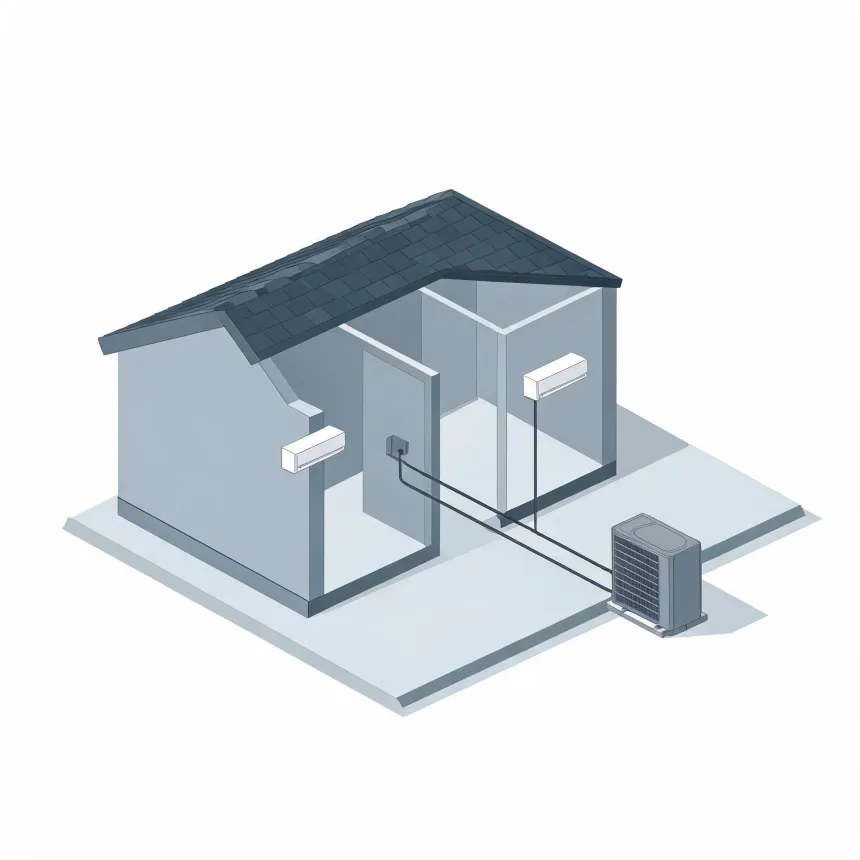
Isometric illustration of a cutaway gray house with a dark shingled roof, showing two wall-mounted indoor air handlers connected by line sets to an outdoor condenser unit on a pad outside.
Your system heats October through April and cools May through September.

NOAA nClimDiv, 1991–2020 normals

Electricity heats 59% of homes in Durham County, more than gas, propane and oil combined.

A mini-split runs on electricity already, so it fits the way most houses here are wired to heat.

Five months of heat this hard wears a system down fast

Cooling runs May through September
Summer afternoons average 88°F
104 damaging wind events from 2015 to 2024

Cooling starts in May here, so April is the month to get a new mini-split in place. Get it installed before the first warm week and you're the one setting the schedule, not scrambling once the heat has already settled in. Winter matters too. Overnight lows average 31°F across December, January and February, and a mini-split sized and installed correctly needs to carry that load as well as the summer one. Spring gives the system a stretch of mild weather to run before either extreme tests it.

Plan for the outage before you need it

Pick the outdoor unit's spot with storms in mind, clear of branches and away from where ice slides off the roof. Ask the contractor what the indoor head can run on if the power drops, and for how long. Settle that during installation and it's one less thing to work out when a line goes down.

Find a contractor
A man in a dark long-sleeve shirt and tan work pants, seen from behind, carries a canvas tool bag up wooden steps toward an orange front door with a potted plant beside it.
A white outdoor air conditioner condenser unit mounted on metal wall brackets against gray horizontal siding, with a blue sky and white clouds behind it.

Five months a year, every year

Five months of 88 degree afternoons is a long stretch for one outdoor unit to carry alone. When you size a mini-split for Durham, size it for the house, not for the sticker price of the smallest unit that technically cools it. An undersized system runs flat out all summer and still falls behind on the worst days. Ask the contractor to walk you through the load calculation for your house, not a rule of thumb based on square footage. Get that right once and the system spends the summer working hard instead of working too hard.

The rating tells you about the unit, not the install

The efficiency number on a mini-split's label is measured in a lab, with the indoor and outdoor units matched and the lines run to a fixed length. That number holds up only if the contractor sizes the system for the house and sets the line length and refrigerant charge the way the manufacturer calls for. A high rating on the sticker doesn't carry over to the wall if the job is done loose.

A higher rating earns back less on a short run

The gap between a mid-efficiency and a high-efficiency mini-split shows up most on long runs at steady load, the kind a system sees over many months of weather. A unit sized right and installed clean will run efficiently no matter what's printed on the label. Weigh the rating against what the install itself costs to get right, not just against the price difference between two units.

The cost of a mini-split job comes from what it takes to move refrigerant and air between two points, not from the box itself. Line length matters: the farther the indoor head sits from the outdoor unit, the more copper line set and labor it takes to connect them, and a long vertical run through tight framing costs more than a short straight shot. The number of indoor heads matters too, since each one needs its own line run, its own mounting work and its own spot on the electrical circuit. Where the outdoor unit goes affects the job as well. A pad on open ground is a simple set, but a wall bracket or a tight side yard takes more time to get right. Electrical work can add to the job if the panel doesn't already have the capacity or the dedicated circuit the system needs. None of this shows up on the unit's price tag, but all of it shows up in what the contractor has to do to make the system work.

Durham sits in climate zone 3A, warm with a long cooling season and winters that stay mild and short. Any mini-split installed here, ductless or not, has to meet the federal minimum for a split-system heat pump: at least 14.3 Btu of cooling for every watt-hour it draws over the summer, and at least 7.5 Btu of heat for every watt-hour over the winter. That's the floor for any unit manufactured from 2023 on. It doesn't single out ductless systems, the same minimum applies to the whole split-system category, so it narrows the field before you even start comparing brands. A contractor can show you which models on the market clear that bar for a house in this zone.