




A golden retriever sleeps on a neatly made bed in a minimalist bedroom equipped with a wall-mounted air conditioning unit.

Mini Split Installation in Concord, NC

Tell us about the job

Takes about a minute. No obligation.

New system or replacementMini-splitCabarrus County, NC
Step 1 of 2

What ZIP code is the job in?

Cabarrus County saw 100 severe weather events between 2015 and 2024. Sixty of those were damaging wind, and hail showed up 26 times. A mini-split's outdoor unit sits outside through all of it, so where it goes and what shields it matters as much as the model you pick. Power loss is the other half of this. Across North Carolina, a quarter of households went at least a day without power in 2024. When the power's out, a mini-split doesn't heat or cool, and if your water heater runs on electricity too, that's out along with it.

7 months
October through April, your system heats
5 months
May through September, it cools
32°F
the average winter night it heats against
88°F
the average summer afternoon it cools against
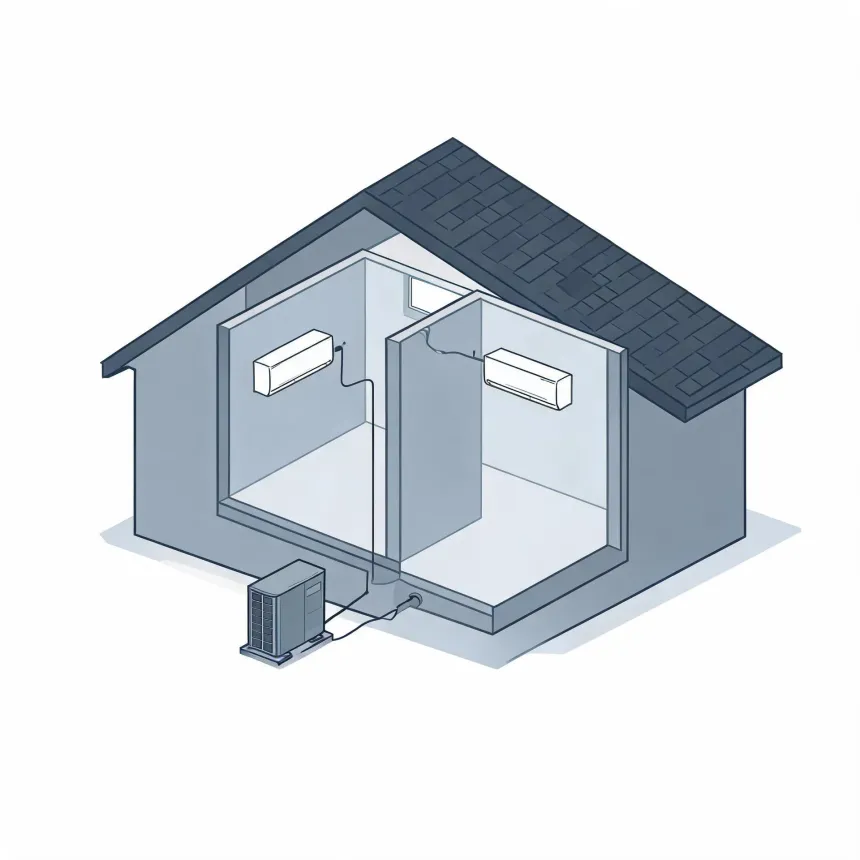
Isometric line illustration of a cutaway house with two rooms, each with a wall-mounted indoor air conditioning unit connected by lines to an outdoor condenser unit on the ground outside.
Your system heats October through April and cools May through September.

NOAA nClimDiv, 1991–2020 normals

Most homes in Cabarrus County heat with electricity, at 55.9%.

A mini-split fits right into that setup, since it runs on electricity like the rest of the house.

May is five months off. April puts the install behind you before it starts.

Cooling runs May through September
Climate zone 3A
Power here costs 12.78 cents per kilowatt-hour

Cabarrus County falls under zone 3A in the 2021 energy code, warm with a long cooling season and a short mild winter. That rating sets a floor on what a contractor can legally install here. A mini-split heat pump counts as a split system under the federal standard, so any unit manufactured on or after January 1, 2023 has to pull at least 14.3 Btu of heat for every watt-hour it uses in summer, and deliver at least 7.5 Btu of heat for every watt-hour in winter. Those numbers aren't a sales pitch. They're the minimum the equipment has to clear before it can go in your wall. Ask where the model you're considering lands against them.

Decide where the unit sits and how you'll manage an outage before the install, not after

Ask the installer to walk the yard with you before the outdoor unit goes in. Where it sits and what shields it from wind and hail is a decision made now, not after. Ask too what happens to heat and hot water if the power drops, and plan for that while the install is still open to it.

Find a contractor
A white mini-split air conditioner outdoor condenser unit mounted on metal brackets against a beige stucco exterior wall, with a blue sky and scattered clouds in the background.

Sizing Is a Calculation, Not a Guess

A mini-split is sized by the heat loss and heat gain of the room it serves, not by the square footage alone. A contractor works out how much heat the room loses in winter and gains in summer by looking at the walls, the windows, the insulation, and which way the room faces, then matches the indoor head to that load. Too big and the unit short cycles, reaching the set temperature fast and shutting off before it pulls the moisture out of the air, so the room feels cool but clammy. Too small and it runs flat out without ever catching up on the hottest or coldest days, and the compressor wears from constant strain instead of normal cycling. The right size runs longer at a lower output, which is exactly what keeps the temperature steady and the humidity down. This is also why a contractor does a room by room load calculation instead of going by the size of the last system or a rule of thumb. A room with a lot of west facing glass carries a different load than one with none, even if the two rooms are the same size, and the head has to be picked for the room it actually serves.

The Outdoor Unit Isn't the Whole Cost

A mini-split install prices out around the line set, not just the two boxes on each end of it. The refrigerant lines, the wiring, and the condensate drain all have to run between the outdoor compressor and the indoor head, and the distance and path between them changes how much material and labor that takes. A straight run through an exterior wall costs less than one that has to go up through an attic or across a long stretch of siding. Every extra foot of line set and every bend it has to take adds to the job.

The Number of Heads Changes the System, Not Just the Price

A single room needs one indoor head and a compressor sized to match it. Cover more rooms and you move to a multi-zone system, where one outdoor compressor runs several indoor heads at once, each on its own thermostat. That compressor has to be sized for the combined load of every zone running together, not just the biggest room, and the installer has to balance refrigerant flow across all of them. More zones means more control over each room, but it also means more line set, more mounting work, and a larger compressor to drive the whole system.

The efficiency number on a mini-split's label tells you how much heat it moves for the electricity it draws, not how powerful it is. A higher rated unit pulls more heat out of the air per watt-hour than a lower rated one, so two systems that cool or heat a room equally well can still cost different amounts to run. That rating is measured under set lab conditions, so it's a way to compare models against each other, not a promise of what you'll see on your own power bill. It also isn't fixed for the life of the equipment. A dirty filter, a coil caked with dust, or a refrigerant charge that's drifted low all make the unit work harder to do the same job, so it draws more than the label suggests even though nothing about the rating itself has changed. Keeping the filter clean and the coils clear is what keeps the unit running close to the number it was rated for.

Installation starts with the line set path already decided, so the first work of the day is often opening a hole through the wall where that path was marked. The indoor head goes up on a mounting plate, level and away from direct sun or a doorway draft, since either one throws off the thermostat reading inside it. Outside, the compressor goes on a pad or wall bracket set above grade, with clearance on all sides for airflow and for service access later. Once both units are mounted, the refrigerant lines run between them and get connected at both ends, then the whole line gets pulled down to a vacuum to clear out air and moisture before any refrigerant is released into it. A line with moisture left in it corrodes from the inside and loses charge over time, so this step gets checked, not assumed. After the vacuum holds, the system gets charged, powered on, and run through both heating and cooling to confirm the head responds to the thermostat and the compressor cycles the way it should.