A dark modern bedroom with grey bedding, a wall-mounted air conditioning unit, and a cat resting on the bed.

Mini Split Installation in Charlotte, NC

Tell us about the job

Takes about a minute. No obligation.

New system or replacementMini-splitMecklenburg County, NC
Step 1 of 2

What ZIP code is the job in?

This county sees real storms

Mecklenburg County logged 178 severe weather events between 2015 and 2024, including 122 damaging wind events, 38 hail events and 5 tornadoes. Tropical storms reached the county 4 times in that span, and winter storms hit 6 times.

Power doesn't always hold

A quarter of North Carolina households went at least 24 hours without power in 2024. A mini-split only heats or cools while it has power, and an outdoor unit sitting through hail or high wind needs a spot that keeps it out of the way.

7 months
October through April, your system heats
5 months
May through September, it cools
32°F
the average winter night it heats against
88°F
the average summer afternoon it cools against
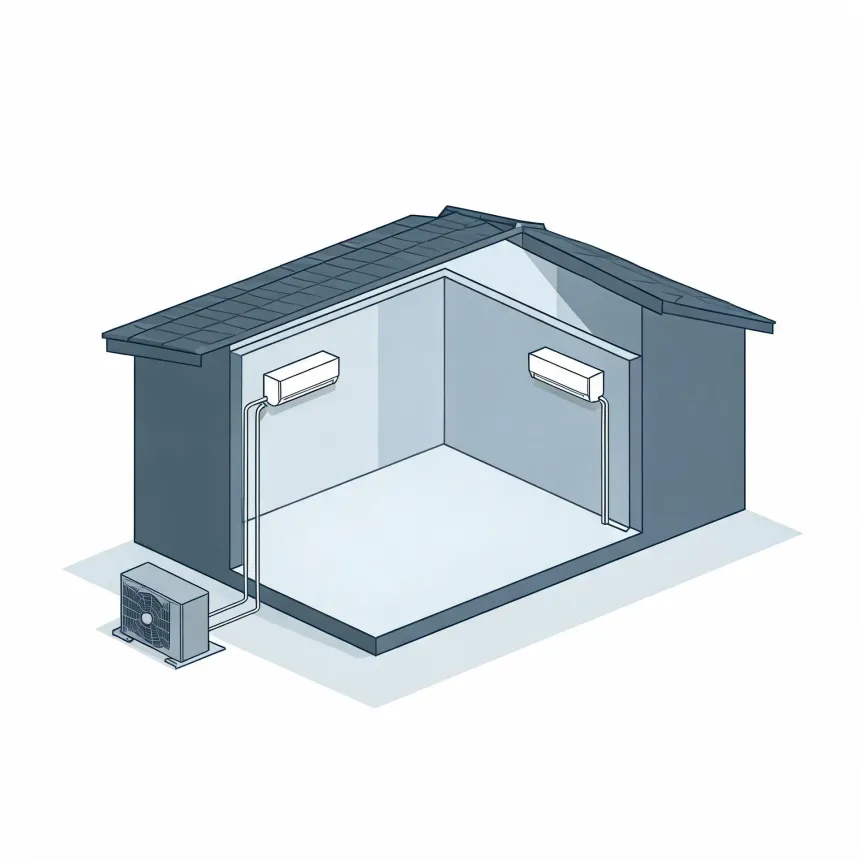
Cutaway isometric illustration of a small building interior showing two wall-mounted indoor air conditioning units connected by line sets running down to a single outdoor condenser unit on the ground outside.
Your system heats October through April and cools May through September.

NOAA nClimDiv, 1991–2020 normals

A mini-split in Mecklenburg County runs cooling five months a year, with afternoon highs averaging 88°F through June, July and August.

That long a stretch at that heat means sizing it right matters more here than in milder places.

Electricity already heats most homes here

52.4% of homes heat with electricity
Cooling runs May through September
Summer afternoons average 88°F

April is the month to get this done. Cooling starts in May and runs through September, five months of the system working every day, and once that stretch begins, finding time on a contractor's schedule gets harder. Installing before the first hot week means the work happens when it's convenient to shut off power to a room or clear a path to the outdoor unit, not when the house is already uncomfortable. It also means the system gets tested under real conditions before the months that matter most, so anything wrong with the install surfaces while there's still room to fix it without sweating through the wait.

Pick the outdoor unit's spot before the next storm does

Decide where the outdoor unit goes with hail and high wind in mind, somewhere clear of falling limbs and loose debris. If the power goes out, the mini-split stops with it, so this is also the time to talk through backup heat and hot water with the contractor.

Find a contractor
A man in a cap, dark work shirt and tan pants, seen from behind, climbs porch steps toward an orange front door while carrying a worn leather tool bag.
A white outdoor air conditioner condenser unit mounted on metal wall brackets against gray horizontal siding, with a blue sky and white clouds behind it.

Five months a year, every year

Five months of running every day adds up to real hours on this system, and 88 degree afternoons mean it rarely gets a break once it starts. A unit sized too small for the space will run that whole stretch without ever catching up, and one sized too large will cycle on and off more than it should. Either way wears parts down faster. Get the load calculated for the actual room or rooms instead of going by square footage alone, and don't let price be the only thing that decides which contractor gets the job.

The install decides most of the cost

Running a line set through an existing wall, mounting the outdoor unit on a pad or bracket, and routing the condensate drain somewhere it can actually drain all take time before the system ever turns on. A straightforward wall mount with a short line run to the outdoor unit costs less labor than a ceiling cassette or a run that has to snake through finished space. The equipment is only part of the bill. What it takes to get refrigerant lines and wiring from indoor to outdoor unit is the other part.

More zones means more of everything

Each indoor head needs its own line set, its own power whip in some setups, and its own spot on the outdoor unit's distribution. A single-zone system is one indoor unit talking to one outdoor unit. A multi-zone system asks the outdoor unit to manage several indoor heads at once, which means a larger compressor and more refrigerant line run throughout the house. Adding a zone later costs more than planning for it up front, since the outdoor unit has to be sized for the total load from the start.

If there's an old system coming out, whoever runs the line set and mounts the new units can usually pull the old ones at the same time. A window unit or a through-wall sleeve comes out easily enough. An old ducted system is a different job: the air handler, the ducts and the outdoor condenser don't just get unplugged, especially if the house is keeping some of that ductwork for another part of the house. Refrigerant in the old system has to be recovered, not vented, so that part of the teardown isn't optional. Ask up front whether removal and disposal of the old equipment is included or billed separately, since contractors handle that differently.

Mecklenburg County falls under zone 3A in the 2021 energy code, warm with a long cooling season and winters mild enough that they're short by comparison. That classification sets a floor for what can be installed. A mini-split here is a split system under the federal standard, and any unit built from January 1, 2023 onward has to pull at least 14.3 Btu of cooling from every watt-hour it uses over the summer, and deliver at least 7.5 Btu of heat per watt-hour over the winter. Those numbers aren't a sales pitch, they're the legal minimum for this region. The standard doesn't carve out a separate rule for ductless systems, so a mini-split has to clear the same bar as any other split-system heat pump sold here.