





White two-story houses with wraparound porches and Spanish moss-draped oak trees photographed along a residential street at night.

Mini Split Installation in Asheville, NC

Tell us about the job

Takes about a minute. No obligation.

New system or replacementMini-splitBuncombe County, NC
Step 1 of 2

What ZIP code is the job in?

A mini split that's too big will short cycle, kicking on, cooling or heating the room fast, then shutting off before it pulls moisture out of the air or settles the temperature evenly. One that's too small runs constantly and still can't keep up on the coldest or hottest days. Sizing it right isn't a guess. A contractor works out the heat loss and heat gain for each room by looking at square footage, window size and placement, insulation, and ceiling height, then matches that load to the capacity of the indoor unit going in that space. For a multi-zone system, each zone gets sized on its own, since a bedroom and an open living room rarely need the same output. Done right, the system runs long, steady cycles instead of short bursts, which is also what keeps it quiet.

7 months
October through April, your system heats
3 months
June through August, it cools
28°F
the average winter night it heats against
80°F
the average summer afternoon it cools against
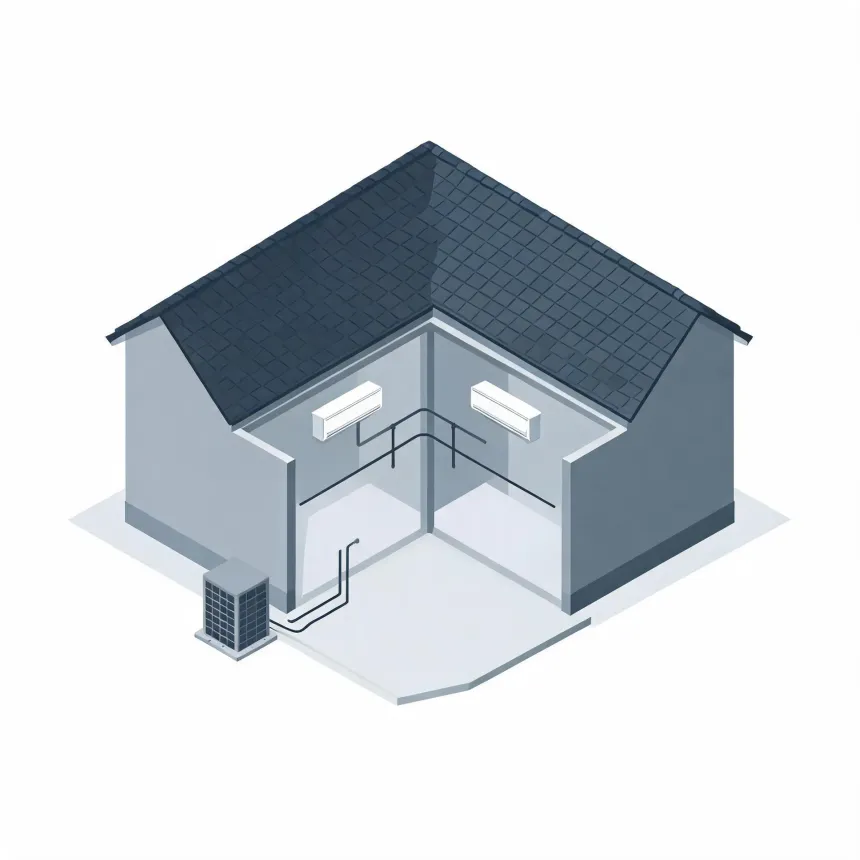
Isometric illustration of a cutaway gray house with a dark shingled roof, showing two wall-mounted indoor air conditioning units connected by piping to an outdoor condenser unit on the ground outside.
Your system heats October through April and cools June through August.

NOAA nClimDiv, 1991–2020 normals

North Carolina electricity ran 14.13 cents per kilowatt-hour in 2024, cheaper than in most states.

A mini split in Asheville earns its keep through fit and reliability, not through shaving a power bill that's already low.

May is the month to put a mini split in, before June asks it to run

Cooling runs June through August
Summer afternoons average 80°F
55 damaging wind events from 2015 to 2024
Most homes here run on electric heatElectricity heats 64.7% of homes in Buncombe County, more than gas, propane and oil combined.

Asheville sits in climate zone 4A, which asks real work of both heating and cooling through the year. A mini split installed here still counts as a split system under federal rules, so any unit made from 2023 on has to clear 14.3 SEER2 for cooling and 7.5 HSPF2 for heating. That floor applies the same way to a ductless system as to any other heat pump, since the standard doesn't carve out a separate class for ductless. Most mini splits sold today clear it without trouble, but it narrows the field to units built for this. A federal tax credit is available for qualifying heat pump installations, worth checking against whatever system you're considering.

Summer here is mild, so fit matters more than top-end power

Summer here runs about three months, June through August, with afternoon highs averaging around 80 degrees. That's a light load next to most of the country, so the mini split going in now won't be working hard against extreme heat. It still has to be sized and built right. A reliable, properly matched system is worth more here than one built for strain it won't see.

Find a contractor
A white outdoor air conditioner condenser unit mounted on metal wall brackets against gray horizontal siding, with a blue sky and white clouds behind it.

The old system doesn't just get switched off

Whatever heated or cooled those rooms before, it doesn't stay in once a mini split goes in. If it was window units, those come out, and the wall or window they sat in has to be sealed back up properly. If it was a furnace or a boiler tied to ductwork, that system is usually left in place rather than torn out, especially if it still handles backup heat or serves part of the house the new zones don't reach. Baseboard heaters get disconnected and removed, and the wiring that fed them either gets capped or repurposed. Whatever the old equipment was, a contractor should tell you plainly what stays, what goes, and what happens to the wiring or venting left behind once it's gone.

Ask what the warranty actually covers

A mini split's warranty usually splits into parts coverage from the manufacturer and labor coverage from whoever installs it. The parts warranty often only stays valid if the system gets registered within a set window after install, and it can require proof that a licensed contractor did the work. Ask what's covered, for how long, and whether labor is included or billed separately if something fails down the road.
Ask where the outdoor unit will sit and why

The refrigerant line running between the outdoor unit and each indoor head has a maximum length it can run, and every bend or change in height along the way cuts into how well the system performs. Where the outdoor unit sits matters just as much. It needs clear airflow on all sides and a spot that won't trap it against a wall or fence. A contractor should be able to walk you through where both ends go and why, not just where there's room.

What you pay for comes down to how much work the installer has to do beyond mounting the indoor head and running a line set to it. A single zone feeding one room is the simplest version of this job. Add zones and the cost climbs with each additional indoor head, since each one needs its own line set, its own mounting, and its own connection back to the outdoor unit. Distance and access matter too. A line set that has to cross an attic, drop through a chase, or route around framing takes longer to run than one going straight through the wall behind the indoor unit. The electrical side can add a step of its own if the panel needs a new dedicated circuit to carry the outdoor unit's load. None of this shows up in the price of the equipment itself. It shows up in labor, and it's worth asking a contractor to walk through where every line set and wire will actually go before the number gets set.

Install day starts outside, with the outdoor unit getting set on a pad or bracket in the spot worked out ahead of time. From there the crew runs the line set, the refrigerant lines and wiring that connect it to each indoor head, through whatever wall, attic or chase the job calls for. Each indoor head gets mounted, leveled, and tied into that line set, then the whole system gets evacuated with a vacuum pump to pull out air and moisture before refrigerant ever moves through it. Skip that step and moisture trapped in the lines causes problems the system will carry for years. Once it's charged and powered on, a tech checks each zone for proper airflow, confirms the temperature split between the air going in and out, and walks through the controls with you before calling it done.