







An outdoor air conditioning condenser unit mounted on a concrete pad next to a blue-sided residential house at sunset.

AC Repair in Mooresville, NC

Tell us about the job

Takes about a minute. No obligation.

RepairCentral ACIredell County, NC
Step 1 of 2

What ZIP code is the job in?

Iredell County recorded 146 severe weather events between 2015 and 2024. Most of that was wind, 105 events strong enough to count as damaging, along with 22 hail events and 7 tornadoes. Hail dents coil fins and bends them shut, and flying debris can nick a fan blade or tear a wire loose without stopping the unit outright. A system can keep running for weeks after a storm like that and still be losing capacity the whole time. If a storm has come through and your outdoor unit took a hit, it's worth having someone look even while it's still blowing cold air.

5 months
May through September, your air conditioner is on duty
86°F
the average summer afternoon it cools against
22 hail events
in ten years, and hail bends the fins on outdoor coils
105 wind events
in ten years, and wind drives debris into outdoor units
Isometric line illustration of a cutaway single-story house showing interior rooms, attic ductwork and an air handler, connected by a line to an outdoor condenser unit on a pad.
Your air conditioner works hardest from June through August.

NOAA nClimDiv, 1991–2020 normals

A capacitor wears down slowly and gives out all at once.

If your AC won't start or the fan just hums, that's usually the part to check first.

Half the homes here were built in 1997 or later, and the AC in them is worth fixing

Half the homes here were built by 1997
Cooling runs May through September
Summer afternoons average 86°F
Cooling starts in May hereAC load hits hardest in the first weeks of the season, right where a weak part gives out

If your house falls on the newer side of that line, a repair call is the right instinct. A unit put in when the house was built still has years of work left in it, even after a storm or a hard summer. Replacing it outright because one part failed usually isn't necessary. The exception is a mobile home. Those make up a share of the housing here, and the AC in one wears on a different schedule than a unit set on a slab outside a site-built house, so age alone tells you less there. Outside of that, get the broken part fixed and keep the system running.

Storm hit your AC? Get it checked before summer tests it

If your outdoor unit has taken hail or wind-blown debris this year, get it looked at now, even if it is still cooling the house. A bent fin or a nicked blade will not stop the unit right away, but it will keep losing capacity until someone opens it up and checks.

Find a contractor
A man in a gray long-sleeve shirt and work pants carries a canvas tool bag as he climbs porch steps toward an orange front door of a gray clapboard house, with a potted shrub to the right.
An outdoor air conditioning condenser unit mounted on a concrete pad beside a house, with electrical conduit running to a wall-mounted disconnect box.

What to check before you pick up the phone

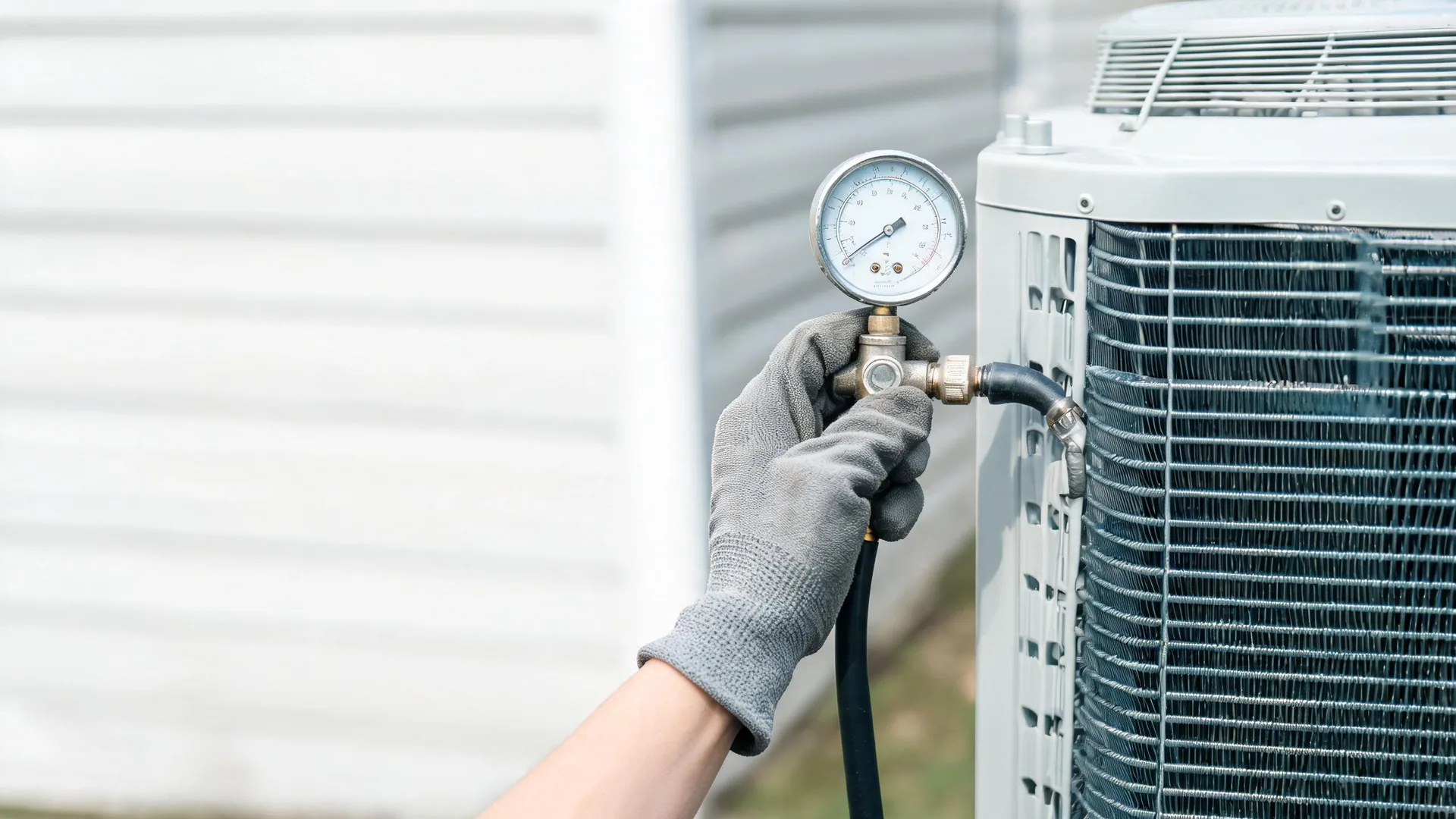
Before you call anyone, there are a few things worth checking yourself. Go to the thermostat first. Make sure it is set to cool and the set point is actually below room temperature, and check the batteries if it has a screen that looks dim or blank. Next, check the breaker box. A tripped breaker will shut the whole system down and it is a flip of a switch to find out. Look at the outdoor unit. If leaves, grass clippings or a fallen branch are packed against the side of it, clear them away so air can move through the coil. While you are out there, look at the fan on top. If it is not spinning and the unit is humming, turn it off at the breaker and leave it off, that sound usually means a part is trying and failing to start, and letting it keep trying can burn something out. Last, check the filter. A filter clogged with dust chokes airflow across the whole system, and the fix is just a new one. If you have done all that and the system still will not cool, or it is tripping the breaker again once you reset it, stop troubleshooting and get a tech out. Repeated trips mean something is drawing too much current, and running it that way risks turning a simple repair into a bigger one.

Weak cooling and short cycling are different problems

An AC that runs fine but never quite cools the house is usually low on refrigerant or losing airflow across the coil. One that shuts off and restarts over and over, never finishing a cycle, is a different animal, often a thermostat sensor gone bad or a compressor overheating and tripping its own safety switch. Both are worth a call, but the second one wears the compressor down faster the longer it goes unfixed.

Noise and smell tell you where to look

A grinding or screeching sound usually points to a motor bearing giving out. A hissing sound near the lines can mean a refrigerant leak. A burning smell is electrical, something overheating at a connection or a motor winding, and that one means shutting the system off until a tech checks it rather than waiting to see if it gets worse.

An outdoor central air conditioning unit mounted on a concrete pad beside a blue-sided house at sunset.

A new air conditioner would cut about $40 a year off cooling for a typical Iredell County home.

  • A new one at the federal minimum, 14.3 SEER2$270 a year
  • An older air conditioner$310 a year

Estimates for a typical Iredell County home, compared with an older unit built to the previous federal minimum, from EIA household energy data, North Carolina fuel prices and NOAA climate normals. Your home will differ.

Repair makes sense when a part like a capacitor or contactor has failed.

Replacement makes sense when the compressor has failed or the system uses R-22 refrigerant, which is no longer made.

A repair call makes sense when the fix is a single part and the rest of the system is sound. A capacitor, a contactor, a fan motor, these wear out on their own schedule and swapping one out doesn't shorten the life of anything else in the unit. What tips the decision toward replacement is a compressor failure. That part sits at the center of the system, it costs the most to replace on its own, and a tech will often tell you straight that putting a new compressor in an old unit doesn't make sense next to replacing the whole thing. Age matters too, not because a number on a calendar means anything by itself, but because a system near the end of its working life tends to fail in one part shortly after another gets fixed. If you've had two or three different repairs in as many years, that pattern is worth paying attention to. One repair on a system that's otherwise been reliable is just a repair.