






Aerial view of a gray outdoor air conditioning condenser unit mounted on a concrete pad next to a house with vinyl siding.

AC Repair in Clayton, NC

Tell us about the job

Takes about a minute. No obligation.

RepairCentral ACJohnston County, NC
Step 1 of 2

What ZIP code is the job in?

Johnston County saw 202 severe weather events between 2015 and 2024. Damaging wind caused most of them, 164 times in that span, with 14 hail events and 3 tornadoes mixed in. Hail dents coils and bends fins on an outdoor unit. Wind throws branches and debris into it. A unit can take a hit like that and keep running for months before it shows up as a refrigerant leak or a system that struggles to keep up. If your outdoor unit has been through a storm, it's worth having it looked at even while it's still cooling the house fine.

5 months
May through September, your air conditioner is on duty
89°F
the average summer afternoon it cools against
14 hail events
in ten years, and hail bends the fins on outdoor coils
164 wind events
in ten years, and wind drives debris into outdoor units
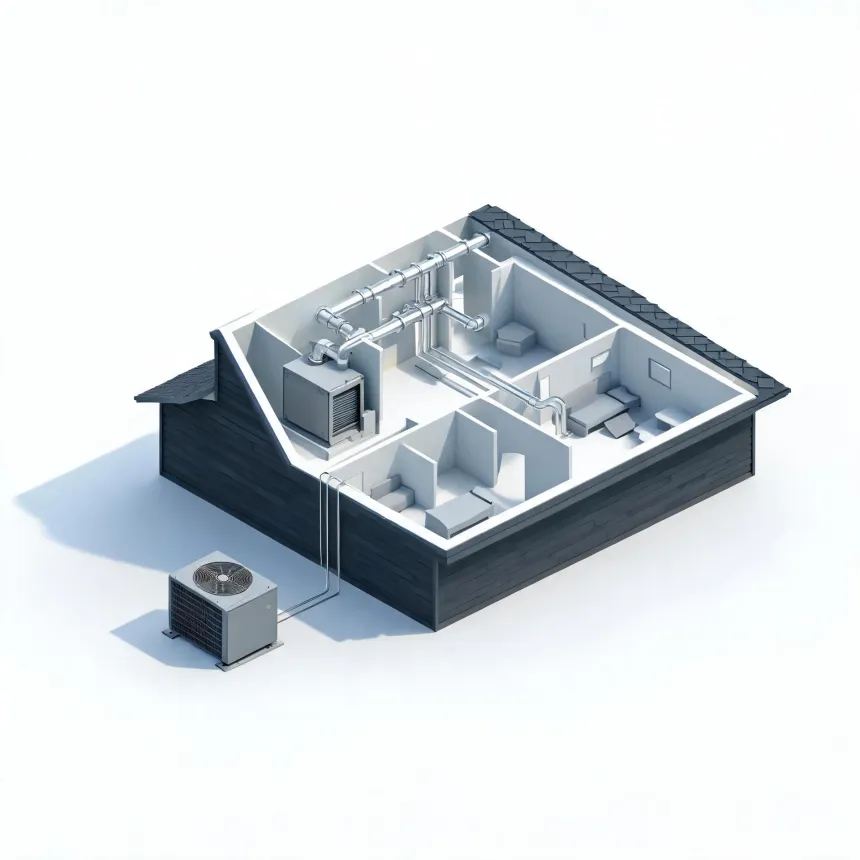
Isometric 3D cutaway render of a house with dark siding showing interior rooms, ductwork and an air handler, connected by lines to an outdoor condenser unit on a white background.
Your air conditioner works hardest from June through August.

NOAA nClimDiv, 1991–2020 normals

Half the homes in Johnston County were built in 2000 or later.

A system that came with a newer house still has years left in it, and that's worth knowing before you replace instead of repair.

At 14.67 cents a kilowatt-hour, a struggling AC runs up your bill every one of those afternoons

Power here costs 14.67 cents per kilowatt-hour
Cooling runs May through September
Summer afternoons average 89°F
May Is When a Weak AC Gives OutCooling starts in May here, and the load that week finds whatever was already wrong.

Cooling here runs May through September, five months straight. Afternoons average 89°F across June, July and August, so the unit isn't cycling on and off for a bit of relief, it's holding steady against real heat most of the day. The dew point averages 68°F those same months, which is high for this country, and that means the system is wringing moisture out of the air on top of cooling it. That combination wears on a unit faster than people expect, a capacitor weakens, a contactor pits, a coil loses airflow it needs. None of that means the system is failing. It means there's a specific cause behind whatever it's doing, and finding that cause is what makes a repair hold through the rest of the summer instead of calling someone back out in August.

If Your Outdoor Unit Has Been Through a Storm, Get It Checked Now

A bent fin or a dent from hail doesn't always show up right away. Have the outdoor unit looked at before the next storm finds the weak spot it left behind.

Find a contractor
A man in a cap, dark shirt and tan work pants, seen from behind carrying a worn canvas tool bag, steps up onto a porch toward an orange front door beside a potted shrub.
A gray residential air conditioning condenser unit mounted on a concrete pad outdoors, surrounded by green grass under a partly cloudy blue sky.

Ask Whether It's Worth Fixing Before You Replace It

That's worth knowing before a repair gets talked up into a replacement. A technician can usually tell within a few minutes whether a breakdown is normal wear on a unit that still has years in it, or something that points to a system actually at the end. Ask them which one yours is before you agree to anything. If the system came with the house, the paperwork or the condenser's own label will have a build date on it, and that's worth checking too.

A Refrigerant Leak Doesn't Stay Small

A slow leak starts as a system that takes a little longer to cool. Keep running it low on refrigerant and the compressor starts pulling liquid instead of vapor, and that's the one part in the system that's expensive to replace. What would have been a simple leak repair turns into a compressor job because the unit kept running instead of getting shut off.

A Frozen Coil Needs to Thaw, Not Run

Ice on the indoor coil usually means airflow is restricted or the charge is off. Either way, running the system harder doesn't melt that ice, it just blocks more airflow and drops the pressures further. Shutting it off and calling someone beats letting it run while water backs up and the compressor keeps trying to do a job it can't finish.

An overhead view of a residential air conditioning condenser unit mounted on a concrete pad next to a house with vinyl siding.

A new air conditioner would cut about $60 a year off cooling for a typical Johnston County home.

  • A new one at the federal minimum, 14.3 SEER2$340 a year
  • An older air conditioner$400 a year

Estimates for a typical Johnston County home, compared with an older unit built to the previous federal minimum, from EIA household energy data, North Carolina fuel prices and NOAA climate normals. Your home will differ.

Repair makes sense when a part like a capacitor or contactor has failed.

Replacement makes sense when the compressor has failed or the system uses R-22 refrigerant, which is no longer made.

A diagnostic visit starts outside at the condenser, checking that the fan spins freely and the coil isn't caked with dirt or blocked by anything that landed on it. The technician checks refrigerant pressures on a set of gauges, which show whether the charge is right or whether something's leaking out. Inside, they'll check the indoor coil and the airflow moving across it, since weak airflow shows up as the same symptoms as a low charge. Electrical parts get tested under load: the capacitor, the contactor, the wiring at the disconnect. Most failures trace back to one part that's worn out or one measurement that's off, and once that's found, the technician can tell you straight whether it's a quick fix or something bigger. A visit like this usually takes less time than people expect, because the gauges and a few tests narrow it down fast.