

9 months of runtime a year
Cooling from May through September and heat the rest of the year means the fan motor and compressor barely get a break, which is why worn parts show up as noise first.
Send the request today and stop worrying about who to call.
Hand off my repairA noisy mini split usually isn't something you can ignore for long, especially once it starts interrupting sleep or getting louder by the week. In Clayton, these units run hard through long, muggy summers and then again through the cold months, since most homes here heat with electricity and lean on the same system. A new rattle, click, or hiss is the unit telling you something changed.
A clicking sound when the unit starts or stops is usually normal, just the parts expanding and contracting as they change temperature. A buzzing or rattling noise often means something has worked loose, like a fan blade or a panel, or debris has gotten into the outdoor unit. A hissing sound can mean refrigerant is leaking, which also shows up as weaker cooling or heating. A gurgling noise points to refrigerant moving somewhere it shouldn't, or a problem with the line set. With Clayton summers running long and the unit working for months without a break, loose parts and worn components get exposed faster than they would somewhere the system ran less often.
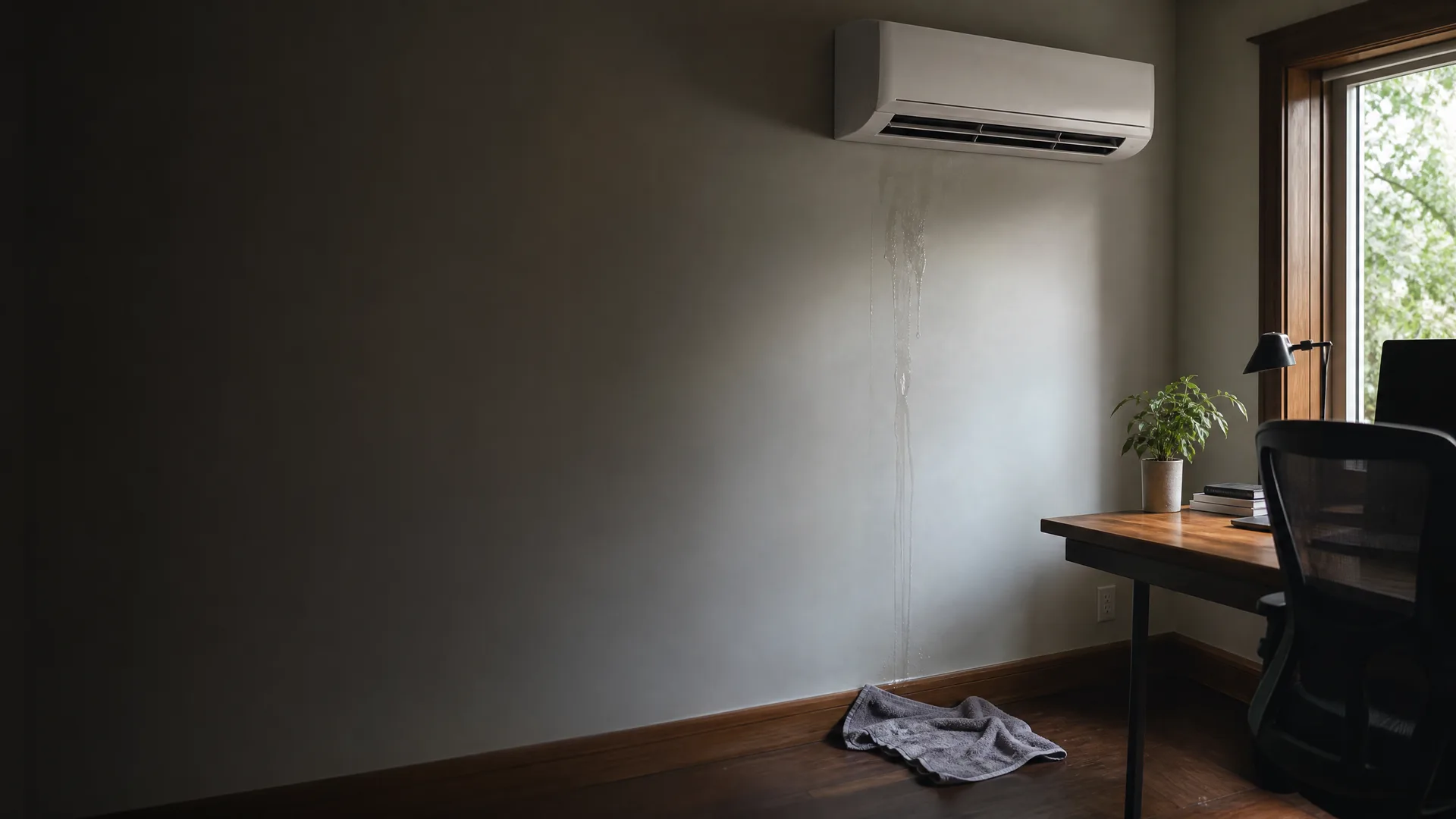
You're on a work call in the home office when you notice the wall under the indoor unit has gone dark and wet, a streak running down toward the baseboard. It's late July, the kind of muggy Johnston County afternoon that keeps the system running almost nonstop, and the unit's been humming louder than usual for a few days now. You grab a towel and lay it down before the water reaches the carpet, then stand there listening. The noise you'd been putting off calling about suddenly feels like the smaller problem. The wall paint has started to bubble slightly where the water sat longest.
Cooling runs May through September
Cooling runs May through September, so the compressor and fan motor rack up months of runtime before a strange noise even starts.
Heat runs October through April
Heat runs October through April, which means your mini split barely gets a break before the next long stretch begins.
Power here costs 14.67 cents per kilowatt-hour
Power here runs 14.67 cents per kilowatt-hour, so a unit straining to keep running costs you more every month it goes unfixed.
NOAA nClimDiv 1991-2020 · EIA-861 2025
Some sounds are worth watching before you act. A faint click when the compressor cycles on, or a soft whoosh of air at startup, is normal operation. If the noise is quiet, steady, and the unit still cools the room the way it should, you can give it a few days and see if it changes. Keep an eye on the wall near the indoor unit and the area below the outdoor unit for anything wet. If nothing gets louder and nothing leaks, it's reasonable to wait.
Grinding, a metal-on-metal screech, or a buzz that gets louder by the hour is the fan motor, the compressor, or a loose part working against something it shouldn't. Shut the unit off at the thermostat or the breaker and leave it off. Running it through a Clayton afternoon in July while it makes that sound can turn a repair into a replacement. A mini split that's screaming at you is telling you plainly, not quietly, and it means the same thing whether it's June or January.
Stand near the indoor unit and listen for where the sound starts. A clicking or ticking from the wall unit as it cycles is usually the housing expanding, nothing to worry about. A rattle or buzz that gets louder with the fan speed often means something loose inside, a panel, a blade, a mount bracket. A high-pitched squeal from the outdoor unit points toward the fan motor or compressor. Gurgling can mean refrigerant moving somewhere it shouldn't, or a drain line that's clogged and backing up condensate. If you've noticed water stains near the indoor unit along with the noise, that drain problem has likely been going on for a while, and it can mean damage to the wall or ceiling around it if it sits much longer.




Explain the mini split problem once instead of to every shop in Johnston County.
Asking costs nothing, and the choice to hire stays yours.
A mini split is really two machines joined by refrigerant lines and wiring, and tracking a noise to one half or the other tells you most of what you need to know. Start outside. The compressor sits on rubber feet or a small pad, and those feet break down after a few years of vibration. Once one cracks, the whole unit shakes against whatever it's mounted to, and that shows up as a steady buzz or rattle that gets louder over weeks. Ice on the outdoor coil does something different. It blocks airflow across the coil, so the fan motor has to work harder to move the same amount of air, and a strained motor sounds like grinding, not humming. Inside, the blower wheel behind the wall unit spins constantly through a Johnston County summer, and dust or mold buildup throws it out of balance the same way an unbalanced tire does in a car. That usually sounds like a whistle or a hum that wasn't there before. Where the line set passes through the wall, worn foam insulation lets the copper tubing touch the sleeve around it, which can rattle with every cycle. And each time the system switches between cooling and heat, the reversing valve inside shifts position, and a sharp clunk at that exact moment is the valve doing its job, not a part coming loose.


The outdoor unit and the indoor head each fail in their own way, and the sound usually tells you which one to check. A bang on startup is often just the compressor mount working loose from vibration, not the compressor giving out. Scraping or grinding is a fan blade catching on something, maybe a bent guard or a leaf pulled in through the housing. Where the line set passes through the wall, a hiss can mean refrigerant easing out slowly at a flare fitting. Gurgling after shutdown is normal, refrigerant settling in the lines, but that same sound while the system runs points to a charge that has dropped. A squeal that shows up every time the outdoor fan starts is usually a bearing going bad, and it won't get quieter on its own. Dripping or splashing from the indoor unit has nothing to do with refrigerant at all. That's a condensate line backing up, and left alone it's what stains the wall underneath.


Cooling from May through September and heat the rest of the year means the fan motor and compressor barely get a break, which is why worn parts show up as noise first.
A dark, wet streak under the indoor unit usually means condensate isn't draining right, and the noise you're hearing may be tied to the same problem.
That muggy summer air in Johnston County carries a dew point around 68°F, according to regional weather data, and your mini split has to pull that moisture out of the air before the room ever feels dry or comfortable. That's extra work on top of cooling, every single day from May through September. A unit already straining to wring out that much humidity is a unit running its fan motor and compressor longer per cycle, and parts under that kind of steady load tend to announce wear with noise well before they fail outright.
NASA POWER T2MDEW
A mini split that's making noise is telling you where to look, whether that's a loose compressor mount, a dirty blower wheel, or a fan blade hitting something it shouldn't. The sound won't fix itself, and running the unit through another Clayton summer or winter on a worn part usually means the noise gets worse before it gets better. What you don't have to do is figure out which contractor to call, sit on hold explaining the same rattle three different times, or weigh quotes against each other while the noise keeps going. Send the form once and that work is off your plate. You'll know what the sound was, what it takes to fix it, and your mini split will run the way it did before any of this started.
Hand off the search today