




Two single-story houses, one of red brick with a white-columned porch and one with pale siding, sit behind a mown lawn and a trimmed hedge, beneath large moss-draped oak trees.

Mini Split Installation in Winston-Salem, NC

Tell us about the job

Takes about a minute. No obligation.

New system or replacementMini-splitForsyth County, NC
Step 1 of 2

What ZIP code is the job in?

Forsyth County logged 211 severe weather events between 2015 and 2024. That includes 174 damaging wind events, 20 hail events, 4 tropical storms or hurricanes, and 12 winter storms bringing heavy snow or ice. A mini-split's outdoor unit sits outside through all of it, taking wind and hail straight on with no wall around it. Power doesn't always hold up through that kind of weather. A quarter of North Carolina households went at least 24 hours without power in 2024. For a home that depends on a mini-split for both heat and cooling, a day without power is a day without either.

7 months
October through April, your system heats
5 months
May through September, it cools
30°F
the average winter night it heats against
86°F
the average summer afternoon it cools against
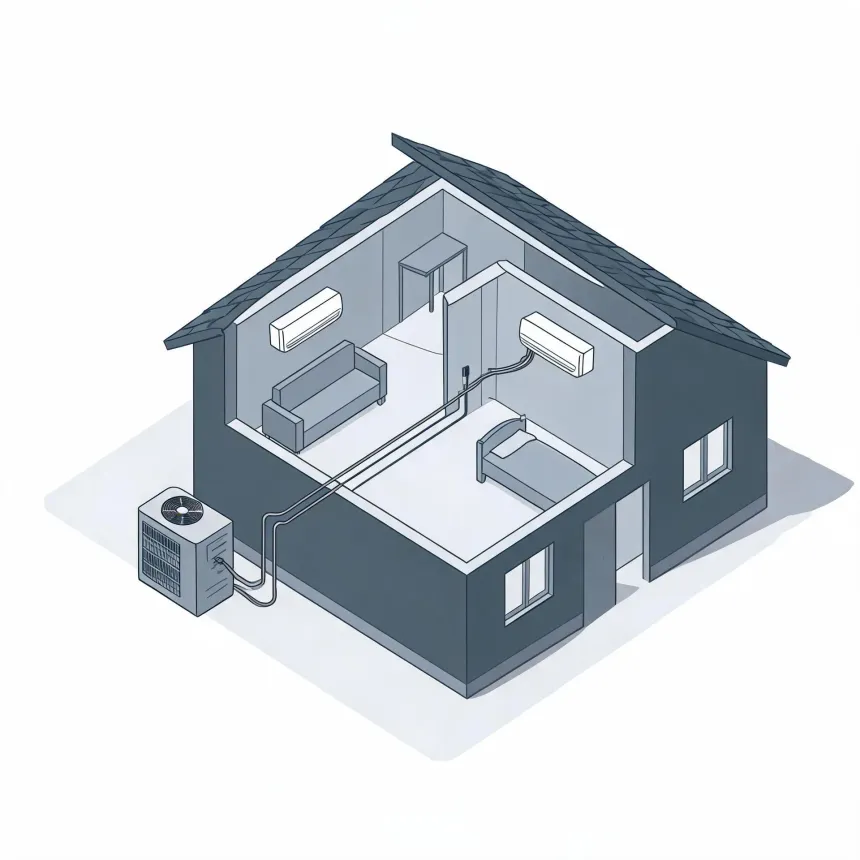
Isometric cutaway illustration of a small house showing two wall-mounted indoor air conditioning units connected by line sets to an outdoor condenser unit beside the exterior wall, with a sofa in one room and a bed in another.
Your system heats October through April and cools May through September.

NOAA nClimDiv, 1991–2020 normals

Electricity heats 63.3% of the homes in Forsyth County, more than gas, oil and propane combined.

A mini-split running on electricity fits right into how this county already heats its homes.

May is close. Get it in before cooling season starts.

Cooling runs May through September
Summer afternoons average 86°F
174 damaging wind events from 2015 to 2024

The crew starts outside, picking a spot for the outdoor unit that gives it clearance on all sides for airflow and service access later. Inside, each indoor head needs a stretch of wall near the ceiling, clear of studs and wiring, with a straight enough shot to the outside for the line set. That line set carries refrigerant lines, a condensate drain and electrical wiring through a hole drilled in the wall, usually hidden behind a cover once the work is done. After the lines are run and connected, the system gets evacuated with a vacuum pump to pull out air and moisture before refrigerant goes in, since either one left behind can ruin the compressor over time. Once it's charged and powered up, the tech checks refrigerant pressure at each head and confirms the condensate drain is actually draining before calling the job finished.

Plan for the weather before the install, not after

Install day is when the outdoor unit's spot gets decided. Pick ground that drains, clearance on all sides, and a mounting height that keeps it out of standing water if a storm sits over the county. Ask what happens to heat and hot water here if the power goes out, since this county goes through outages more than most, and a mini-split only runs when the power does.

Find a contractor
A man in a cap, gray t-shirt and brown work pants climbs porch steps toward an orange front door, carrying a canvas and leather tool bag.
A white mini-split air conditioner outdoor condenser unit mounted on metal brackets against a beige stucco exterior wall, with a blue sky and scattered clouds in the background.

Five months of heavy air, every year

Cooling runs about five months here, May through September. June, July and August average 86°F in the afternoon, with the air sitting heavy at a 65°F dew point. That combination keeps the outdoor unit working through most of the day, not just a few peak hours. More running time means the compressor and fan motor log more hours every year than they would somewhere drier or cooler. Damaging wind has hit this county 174 times between 2015 and 2024, and that outdoor unit sits outside taking it. None of this means trouble right away. It means parts wear on a shorter clock here, and a system sized too small for the heat will run even harder trying to keep up.

The number on the label is efficiency, not size

A mini-split's rating tells you how much heat it moves per unit of electricity it uses, nothing about how much heating or cooling power it has. Two systems can carry the same rating and come in very different capacities. The rating matters for what the system costs to run once it's in. It says nothing about whether it's the right size for the space it's heating and cooling.
A higher rating only pays off if the system is sized right

An oversized system cycles on and off too fast to run efficiently no matter what the label says, and an undersized one runs constantly trying to keep up, wearing down the compressor faster than it should. The rating on the box assumes the unit is matched to the room or the zone it serves. Sizing that right is what the load calculation during installation is for, not something to guess at from the label alone.

A mini-split system is really several parts sold together, and not every contractor quotes the same combination. Ask how many indoor heads the quote includes and whether the outdoor unit is sized to run all of them at once, not just on paper. Ask about the warranty on the compressor separately from the warranty on labor, since those often run different lengths and come from different places, the manufacturer and the installer. Ask what happens to the line set and wiring already in place if something needs replacing later, since a system installed with a single brand's parts throughout is usually easier to service than one mixing components. Ask who handles warranty work if the installer isn't available down the road. A system is only as good as the parts list behind the quote, and a lower price sometimes means a smaller outdoor unit or fewer heads than the comparison implies.

Forsyth County falls in climate zone 3A under the 2021 energy code, warm with a long cooling season and only a short mild winter. Any mini-split put in now has to meet the federal minimum for that kind of system. A split-system heat pump built on or after January 1, 2023 has to pull at least 14.3 Btu of cooling from every watt-hour it uses, and deliver at least 7.5 Btu of heat per watt-hour in the winter. That floor is the same whether the unit sits in a mild zone or a brutal one. It sets a baseline, not a ceiling, and a system sized right for this county's long cooling months will often run well past it. A federal tax credit is available for qualifying equipment, worth checking against whatever unit ends up on the quote.