





A grey outdoor HVAC unit mounted on a concrete pad beside the beige-sided exterior wall of a suburban house.

Heat Pump Repair in Waynesville, NC

Tell us about the job

Takes about a minute. No obligation.

RepairHeat PumpHaywood County, NC
Step 1 of 2

What ZIP code is the job in?

Waynesville asks a heat pump to work in both directions, heating through winter and cooling through summer, but it doesn't ask for much at the extremes. Winter nights average 26°F here, cold enough to run the system hard but not cold enough to push it past what it's built for. That's a steadier load than a lot of places see, and it means a heat pump here usually isn't fighting the kind of wear that shortens its life. So when one starts short cycling, blowing cold air in heating mode, or tripping its breaker, the cause is more often a failed part than a system worn out from strain. A capacitor, a defrost sensor, a contactor. Those are worth fixing. The unit around them has usually had an easier time than you'd think.

8 months
October through May, your system heats
1 months
July through July, it cools
26°F
the average winter night it heats against
76°F
the average summer afternoon it cools against
Isometric cutaway illustration of a single-story house showing interior rooms with furniture, an attic duct network connected to a furnace or air handler, and an outdoor condenser unit linked by lines outside the wall.
Your system heats October through May and cools July through July.

NOAA nClimDiv, 1991–2020 normals

Heat in Waynesville runs October through May.

September is when a weak part gets found, before the first cold night asks the system to carry the load.

Half these homes were built by 1983. That's not why your heat pump is acting up.

Half the homes here were built by 1983
18 damaging wind events from 2015 to 2024
7 hail events from 2015 to 2024

Electricity here runs 14.13 cents a kilowatt-hour, close to the national average. That matters because a heat pump leans on electricity for everything it does, no gas backup splitting the load. A failing part doesn't just make noise or run rough, it makes the system pull more power to do the same job. A weak capacitor forces the compressor to work harder to start. A dirty coil makes the whole unit run longer to hit the same temperature. Neither failure is dramatic, but both show up on the power bill before they show up as a full breakdown.

Fix what broke, not what you think wore out

This heat pump hasn't been fighting the weather here, so a failed part is usually worth fixing rather than replacing. A technician can confirm which part it is and get it done.

Find a contractor
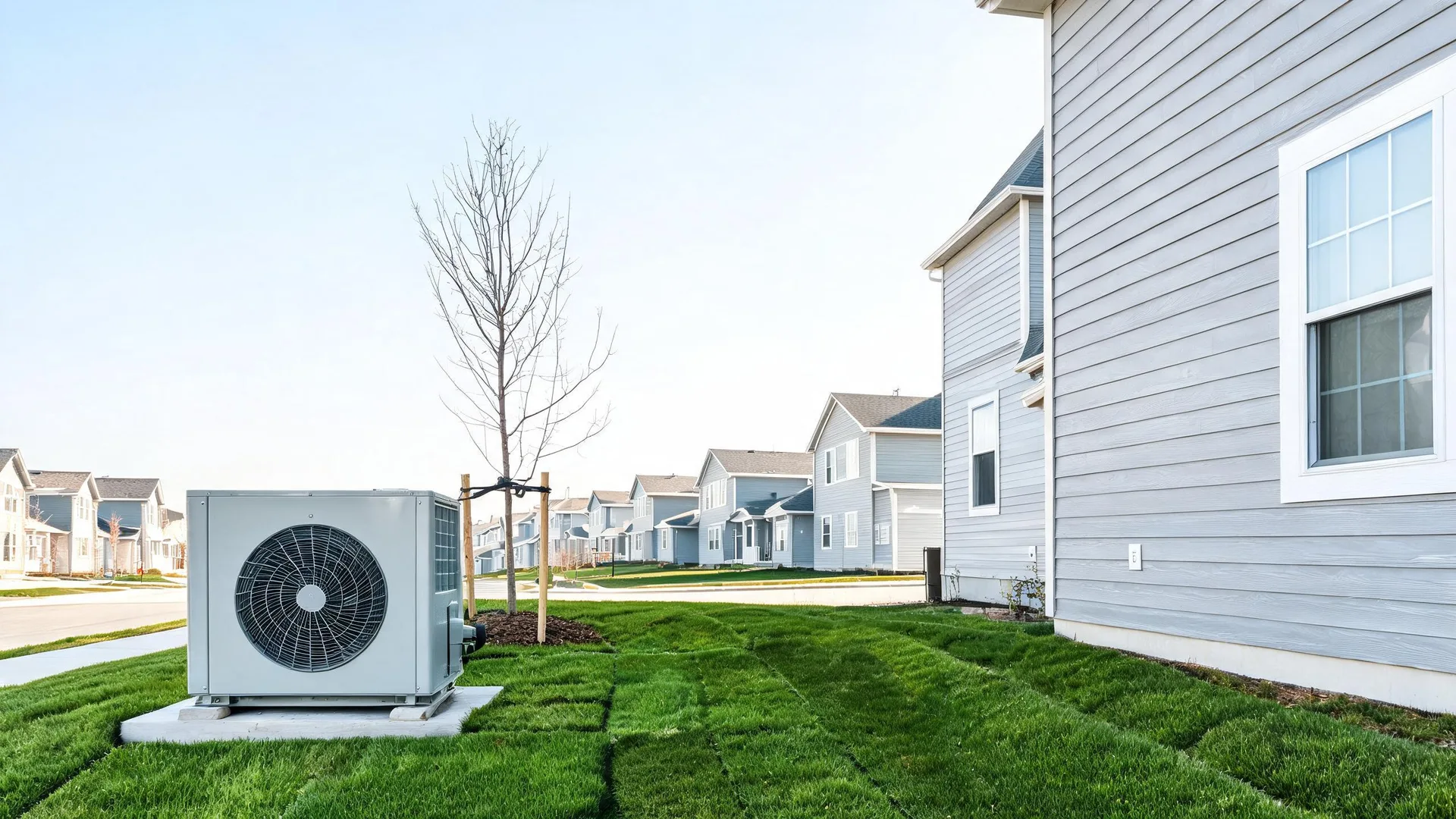
A residential heat pump outdoor unit mounted on a concrete pad next to a house with gray vinyl siding.

What to check before you pick up the phone

Start with the thermostat. Make sure it's set to heat or cool, not just fan, and that it's actually calling for a different temperature than the room. A dead thermostat battery will take the whole system down and look like a much bigger problem than it is. Go outside next. Leaves, pine straw, anything packed against the outdoor unit makes it work harder and can shut it down on its own. Clear what you can reach. Inside, pull the air filter and hold it to a light. If you can't see through it, change it. A clogged filter starves the system of airflow, and that alone explains a good share of calls that turn out to be nothing mechanical. Watch the outdoor unit while it runs. Ice on the coil during the day, not just overnight, means the defrost cycle isn't doing its job, and that's worth a call rather than a wait. Last, check the breaker. A heat pump that won't start at all sometimes just needs a reset. If it trips again right away, stop there. That's the system telling you something is actually wrong.

Cold air from the vents in heating mode

The reversing valve tells the system whether to heat or cool. When it sticks, the heat pump keeps running but delivers the wrong temperature air, so you get a system that sounds fine and blows wrong. The valve won't un-stick on its own, and running it this way doesn't fix anything.
Short cycling, on and off every few minutes

A heat pump that won't stay running long enough to finish a cycle is usually protecting itself from a bad capacitor, a low refrigerant charge, or a sensor giving it a false reading. Each start puts a hard load on the compressor, so a unit doing this repeatedly is wearing down the one part a technician can't swap in a hurry.

Most heat pump failures trace back to a handful of parts, and the same few show up again and again. The capacitor gives the compressor and fan motors the jolt they need to start. It weakens slowly, so the system starts hesitating before it quits outright. The contactor is the switch that sends power to the outdoor unit, and its contacts pit and burn with every cycle until they stop making a clean connection. Sensors drift out of calibration and tell the defrost board it's warmer or colder outside than it actually is, which throws off heating and cooling both. The reversing valve can stick from age or from debris, leaving the system stuck in one mode. None of these are failures of the whole machine. They're small parts doing a lot of work, cycling on and off thousands of times a season, and eventually one of them wears out before the rest.

A heat pump rarely fails all at once. One part goes, and the rest of the system keeps running around it, which is why a system that's acting up is usually worth fixing rather than replacing outright. The compressor is the exception. It's sealed, it's expensive to get at, and if it's the thing that failed, that's a different conversation than a capacitor or a sensor. A technician can tell you which kind of problem you have by checking how the system is failing, not just that it is. A unit that starts hard, runs loud, or trips a breaker is usually telling you something specific broke. A unit that can't hold a temperature no matter what gets replaced in it is telling you something else.