
A row of single-story houses, one brick and others with pale siding and covered porches, behind a trimmed hedge and lawn, under large oak trees draped with Spanish moss.

Heat Pump Repair in Mount Airy, NC

Tell us about the job

Takes about a minute. No obligation.

RepairHeat PumpSurry County, NC
Step 1 of 2

What ZIP code is the job in?

Check the thermostat and the breaker first

Make sure the thermostat is set to heat or cool as needed and the batteries aren't dead. Then check the breaker panel for your outdoor unit and your air handler. A tripped breaker or a thermostat stuck on the wrong mode gets mistaken for a failed system more often than people expect.

Look at the outdoor unit and the filter

Walk outside and see if the outdoor unit is caked in ice or buried under leaves and debris. Clear anything blocking the sides and the top. Inside, pull the air filter and hold it to the light. A clogged filter starves the system of airflow and can make a heat pump run constantly without ever catching up.

7 months
October through April, your system heats
4 months
June through September, it cools
29°F
the average winter night it heats against
85°F
the average summer afternoon it cools against
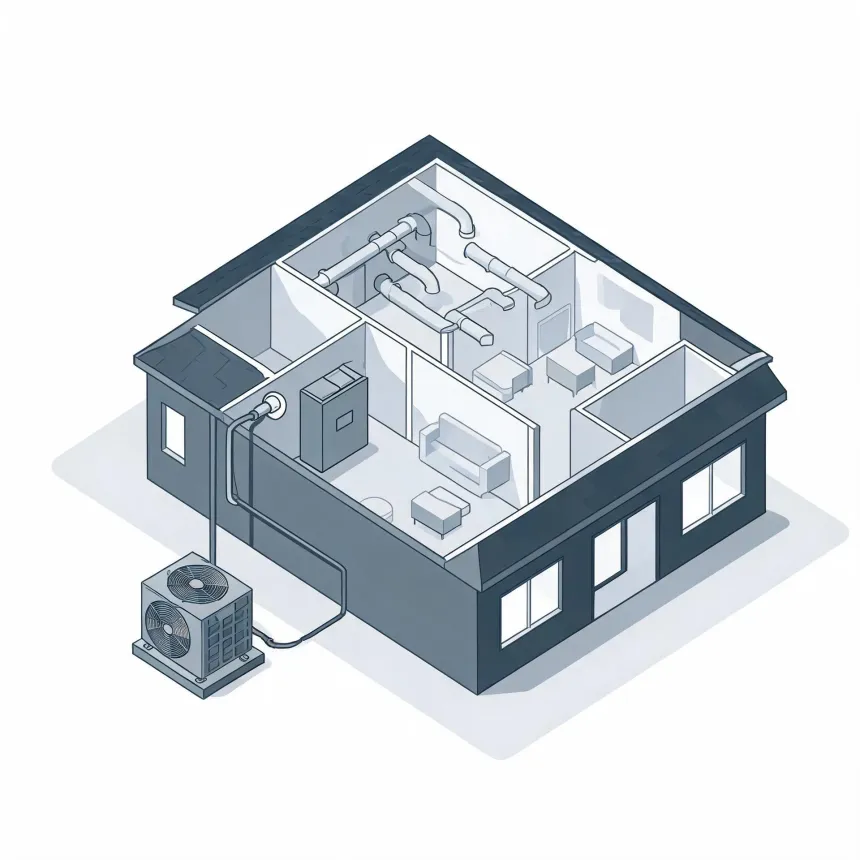
Isometric line illustration of a cutaway single-story house showing interior rooms, ceiling ductwork and an indoor air handler, connected by a line to an outdoor condenser unit on a pad beside the building.
Your system heats October through April and cools June through September.

NOAA nClimDiv, 1991–2020 normals

A heat pump that blows cool air in heating mode isn't always broken; it may just be running a defrost cycle.

If the air stays cool for more than a few minutes after defrost ends, something else is wrong and it needs a look.

This county gets hit hard, and your outdoor unit sits right in the weather

202 severe weather events from 2015 to 2024
25% of homes statewide lost power a day or more in 2024
158 damaging wind events from 2015 to 2024
Built for weather this hardHeat runs here October through April, with overnight lows averaging 29°F in December, January and February.

A repair is usually worth it if the system is still running fine most of the time and the problem is one part acting up: a capacitor, a contactor, a defrost board. Those are straightforward fixes and they don't mean anything else is close to failing. It's a different question when the compressor itself is going, or when the refrigerant lines have a slow leak that keeps coming back. Those point to a system near the end of what it can do, and sinking money into one part just means the next part fails a season later. Age matters too, but less than how the system has been maintained. A heat pump that's had its coils cleaned and its refrigerant charge checked every year holds up longer than one left alone, regardless of how many winters it's seen.

Get it checked after a storm

Storms hit hard here. If the outdoor unit took hail or debris, have it checked even if it still runs.

Find a contractor
A gray heat pump outdoor unit mounted on a concrete pad next to the stone-accented exterior wall of a house.

What a Tech Actually Checks

A diagnostic starts outside at the unit itself, checking the fan motor, the compressor, and the coil for ice, dirt, or physical damage. The tech hooks up gauges to check refrigerant pressure, since too little or too much points to different problems. Electrical testing comes next: the capacitor, the contactor, the control board, checking for burnt wires or a reading that's off from what it should be. Inside, the air handler gets the same attention, looking at the blower motor and the coil there too. A reversing valve gets tested on its own, since that's the part that lets a heat pump switch between heating and cooling, and a bad one shows up as the system running one mode when it's set to the other. Most of this comes down to taking a reading, comparing it to what the part should show when it's healthy, and following the difference back to a cause rather than guessing at one.

A unit that still runs can still be hurt

Hail dents a cabinet and bends fins without stopping the fan. A branch can nick the coil and the system keeps blowing air for weeks before it quits. If the outdoor unit took a hit, that's reason enough to have it looked at, whether or not you've noticed a problem yet.

What a tech looks for after a storm

Bent fins restrict airflow across the coil, so the tech checks the coil first for dents or debris packed inside the cabinet. They'll check the fan blade for cracks and make sure it spins true, since a wobble now means a failed motor later. Refrigerant lines get a look too, since a hard enough hit can start a slow leak that won't show up on your power bill until it's already cost you a season of efficiency.

A heat pump that's struggling will keep trying to hit the temperature on the thermostat, and that's the part that causes damage. A weak capacitor makes the compressor work harder to start each cycle, and every extra cycle wears it down faster. Low refrigerant means the compressor runs hotter than it's supposed to, and heat is what kills a compressor over time. Ice on the coil blocks airflow, so the system runs longer to move the same amount of air, and that longer runtime is what turns a coil problem into a compressor problem. None of this fixes itself by waiting. The part causing the strain stays broken, and the parts absorbing that strain wear out faster than they should have.

Most heat pump failures start small and get worse because the system keeps running while something in it is already struggling. A capacitor weakens over months, not days, and the first sign is usually a compressor that hums before it starts or an outdoor fan that spins slow. Contactors wear from the arcing that happens every time they close, until one day the points are too pitted to make contact at all. Refrigerant doesn't get used up, so if the charge is low, it's leaving somewhere, usually a slow leak at a fitting or a rubbed-through line. The reversing valve fails less often, but when it sticks, the system gets stuck in one mode no matter what the thermostat asks for. A defrost board or sensor going bad lets ice build up on the outdoor coil until the unit can't move enough air to do its job. None of these start as emergencies. They start as a sound or a cycle that's a little off, and they end as a no-heat call.