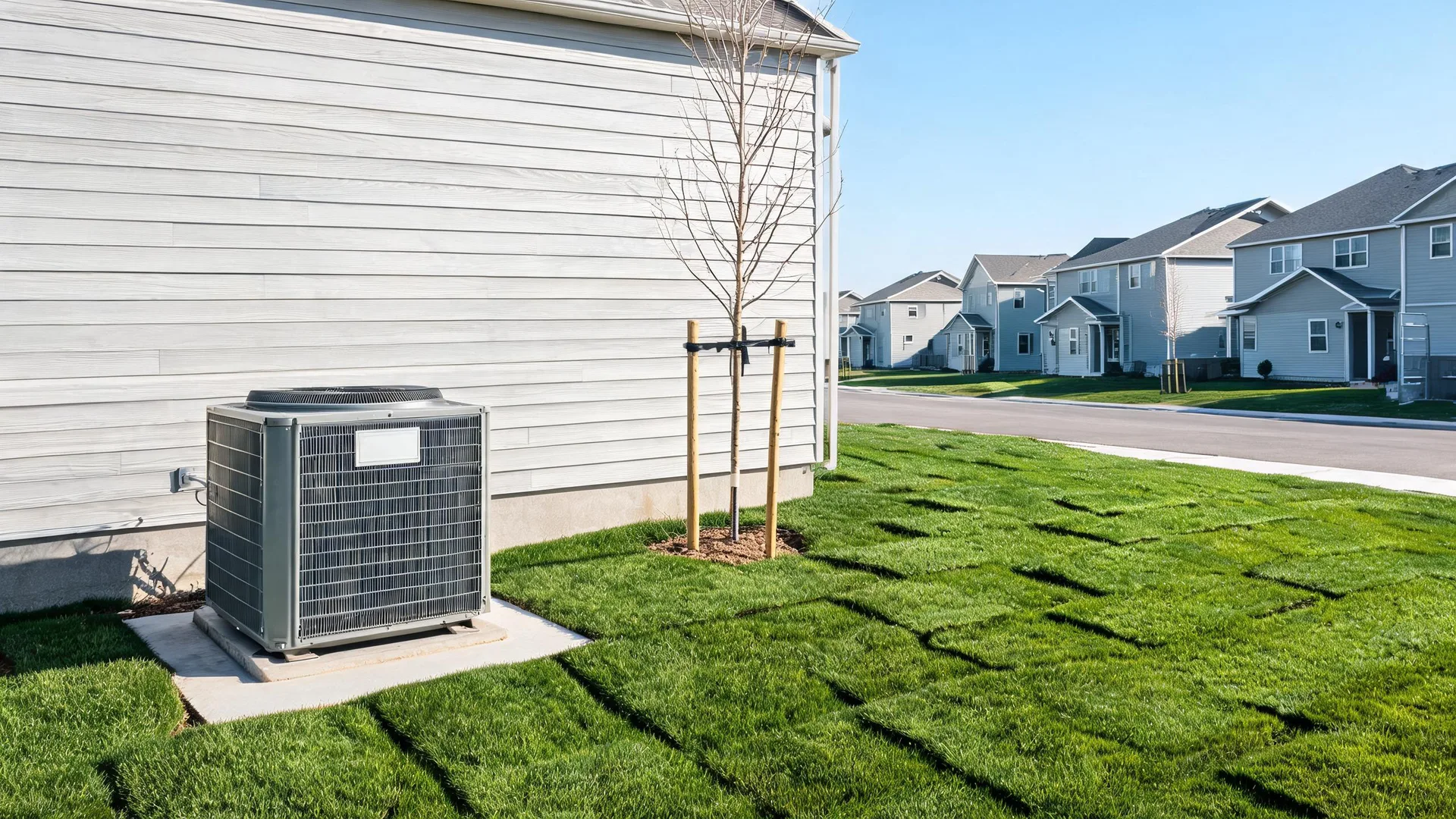
An outdoor heat pump unit mounted on a concrete pad in front of a single-story suburban house with beige siding.

Heat Pump Repair in Jacksonville, NC

Tell us about the job

Takes about a minute. No obligation.

RepairHeat PumpOnslow County, NC
Step 1 of 2

What ZIP code is the job in?

Check the thermostat and the breaker first

Make sure the thermostat is set to heat or cool as needed and the temperature is actually past the current indoor reading. Then check the breaker panel for your outdoor unit and your air handler. A tripped breaker or a thermostat bumped into the wrong mode causes a lot of calls that have nothing wrong with the heat pump itself.


Look at the outdoor unit and the filter before you call

Walk outside and see if the outdoor unit is caked in ice or buried in leaves and debris. Pull the filter and hold it up to light. A frozen coil or a clogged filter chokes airflow and can look like the whole system has failed when the fix is simple. If the outdoor unit is running but the air inside is blowing cold during heating mode, that's worth mentioning to whoever comes out, since it points to the reversing valve rather than the compressor.

5 months
November through March, your system heats
5 months
May through September, it cools
35°F
the average winter night it heats against
88°F
the average summer afternoon it cools against
Isometric cutaway illustration of a small house showing interior rooms with furniture, an indoor air handler with ductwork, and lines running to an outdoor condenser unit beside the building.
Your system heats November through March and cools May through September.

NOAA nClimDiv, 1991–2020 normals

Jacksonville winters are short and mild, and the heat pump here never has to work against real cold.

A unit that hasn't been pushed hard is usually a unit worth fixing instead of replacing.

November and May are when a weak part finally gives out

Cooling runs May through September
Heat runs November through March
68 damaging wind events from 2015 to 2024

A technician starts outside, checking the outdoor unit's refrigerant pressures and the temperature of the air coming off the coil. From there they check the reversing valve, since that's the part that tells the system whether to heat or cool, and a stuck valve causes a lot of the complaints that sound like the whole unit quit. They'll check the defrost board and sensor too, since a heat pump that can't sense ice building up on the coil will run itself into a bigger problem. Inside, they check the air handler, the capacitor, and the contactor, the small parts that fail on their own long before the compressor does. Most of this gets diagnosed with gauges and a multimeter, not by guessing and swapping parts until something works.

Half the homes here were built in 1998 or later

Half the homes in Onslow County were built in 1998 or later. If your house falls on that side of the line, your heat pump is probably newer than you'd guess, and a system that age is usually worth repairing rather than replacing.

Find a contractor
A man in a cap, dark T-shirt and tan work pants walks up porch steps toward an orange front door, carrying a canvas tool bag filled with hand tools, with a potted shrub in a terracotta planter at left.
A gray air-source heat pump mounted on a concrete pad next to a house with gray vinyl siding, surrounded by gravel and flanked by green shrubs and white hydrangea flowers.

A newer system has had less time for anything to wear out

A system installed new runs on factory parts that haven't been through a summer yet. The capacitor, the contactor, the reversing valve all start out at full strength, and in a newer house that's often still the case. Years on a part matter more than years on the house itself, so if you know when the heat pump was actually put in, that number is worth more than the year on the deed. A part failing early in a system's life is usually a one-off, not a sign of what's coming.

Most failures start with a part, not the compressor

Capacitors weaken with age and stop giving the compressor and fan motor the jolt they need to start. Contactors pit and burn from constant arcing until they stop making contact. The defrost sensor can fail and leave the coil to ice over unchecked. All of these are common, all of them are replaceable, and none of them mean the compressor is at risk yet.

The reversing valve fails in a specific way

When a heat pump blows cold air during heating mode, or warm air during cooling mode, the reversing valve is usually stuck in one position. It's a single part doing one job, telling the refrigerant which way to flow, and it can stick from a weak solenoid or years of wear on the valve body. It's a common repair on its own and rarely means anything else is wrong.

A heat pump that needs attention usually tells you before it quits outright. Short cycling is one of the clearest signs. The system kicks on, runs a couple minutes, shuts off, then starts again shortly after. That's not the unit being efficient. That's a sign it's struggling to satisfy the thermostat. Warm air that doesn't feel warm enough, or a system that runs constantly without ever quite getting the house to temperature, points to the same kind of problem. Listen for noise too. A hum with no fan movement usually means a capacitor. Clicking that repeats without the system starting usually means a contactor. Any burning smell or a breaker that trips when the unit starts is not something to wait out.

Repair and replacement come down to how many parts are already worn versus how many are still good. A heat pump has one expensive part, the compressor, and a handful of cheaper parts that fail far more often and protect the compressor when they're working right. Replacing a capacitor or a contactor or a reversing valve brings the system back to normal and leaves the compressor exactly as it was. That's a repair worth doing almost every time, because you're fixing the part that actually broke. The harder call is a compressor itself failing, or failing a second time after an earlier repair. At that point you're not deciding whether to fix a part anymore, you're deciding whether to put new money behind a compressor that already showed it can fail. A system that's needed a few small repairs over its life isn't a system in decline. A system where the same kind of failure keeps coming back is telling you something different.