An outdoor heat pump unit mounted on a concrete pad in front of a two-story suburban house.

Heat Pump Repair in Hendersonville, NC

Tell us about the job

Takes about a minute. No obligation.

RepairHeat PumpHenderson County, NC
Step 1 of 2

What ZIP code is the job in?

Neither extreme here is severe

Henderson County asks real work of a heat pump in both directions, but it never asks for much at once. Summer humidity sits around a 62°F dew point, sticky but not the kind of heavy air that pushes a system to its limit all day long. That middle ground keeps the compressor from grinding away under constant strain.


So a repair is usually the right call

A heat pump that hasn't been run hard for years is more likely to have one bad part than a system wearing out all over. Whatever's acting up on your unit, a tired capacitor, a stuck reversing valve, low refrigerant, it's more likely a fix than a reason to replace the whole thing.

7 months
October through April, your system heats
3 months
June through August, it cools
30°F
the average winter night it heats against
81°F
the average summer afternoon it cools against
Isometric line illustration of a cutaway single-story house showing interior rooms with furniture and attic ductwork connected to an outdoor condenser unit beside the building.
Your system heats October through April and cools June through August.

NOAA nClimDiv, 1991–2020 normals

A heat pump fails one part at a time, not all at once.

Most repair calls come down to a single part: a capacitor, a reversing valve, a contactor.

A newer house usually means a newer system

Half the homes here were built by 1990
Climate zone 4A
Power here costs 14.18 cents per kilowatt-hour
The first cold snap in October is when weak parts give outHeat stays off from May to September, so a part that's already failing won't show it until the system has to run again.

Short cycling is one of the clearest signs something's wrong. The unit kicks on, runs for a minute or two, then shuts off before it's done any real work. That usually points to a thermostat sensor out of place, a dirty filter choking airflow, or a refrigerant charge that's lower than it should be. Ice on the outdoor coil in weather that isn't cold enough to explain it is another one. A heat pump defrosts itself on a schedule, and if that cycle isn't working right, frost builds up and never clears. Air coming out of the vents that's cool instead of warm during heating season often means the reversing valve is stuck, still telling the system to act like it's in cooling mode. None of these mean the whole system is done. They mean one part isn't doing its job, and that part can be found and replaced.

A system that hasn't been pushed hard is worth fixing

Your heat pump has had an easier run than most, so one bad part is a likely explanation and a fair reason to call someone out. Get the actual problem named before you decide anything else about it.

Find a contractor
A man in a dark shirt and tan work pants, seen from behind, carries a canvas tool bag up concrete steps toward an orange front door flanked by gray siding and a potted shrub.
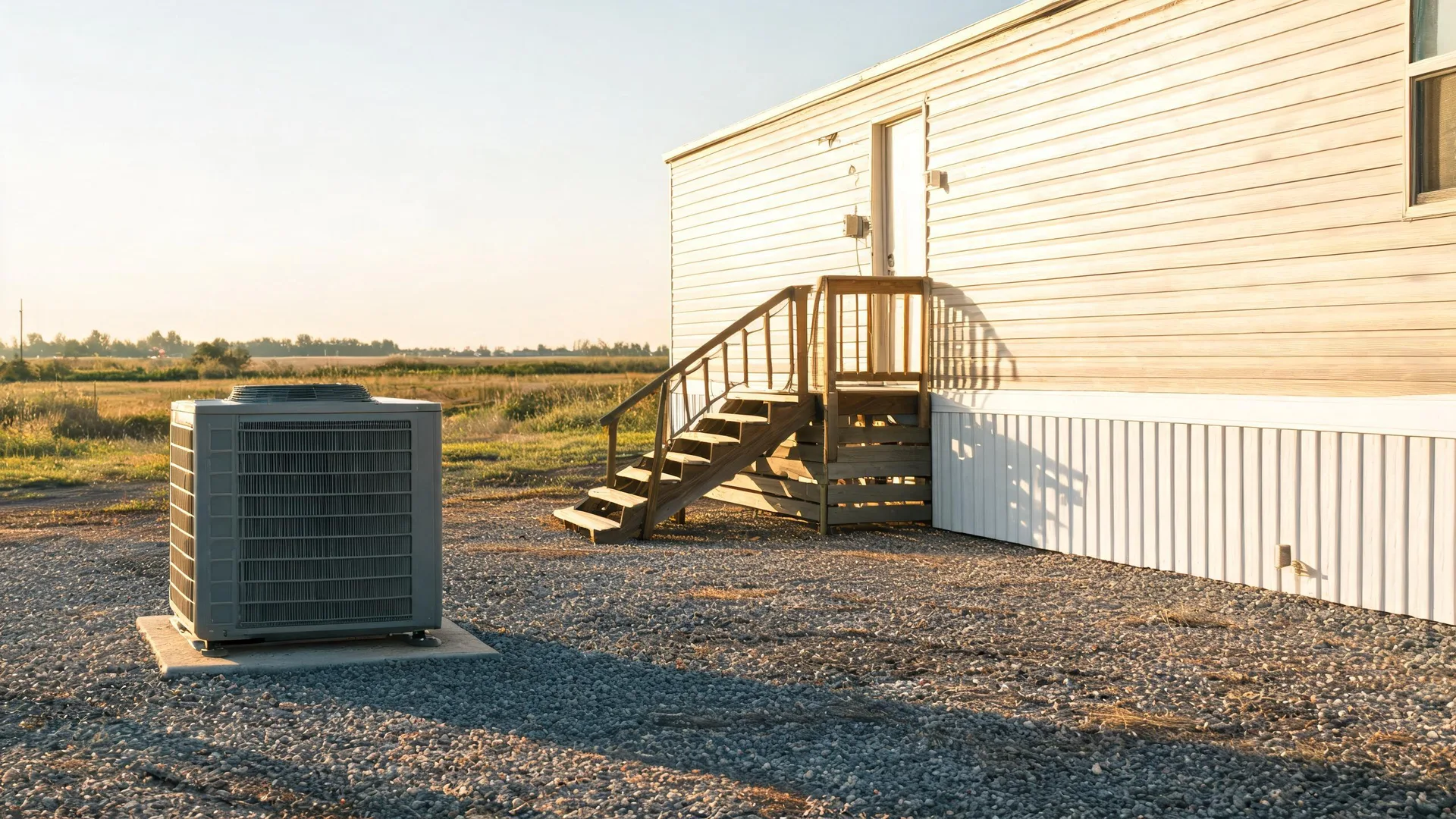
A residential heat pump outdoor unit mounted on a concrete pad next to a house with gray vinyl siding.

This system has time left on it

Half the homes in Henderson County were built in 1990 or later. If yours is one of them, the heat pump likely isn't that old either, even if it's not the original unit. A system with years left on it is worth getting looked at rather than replaced outright. Tell whoever comes out how old the unit is if you know it, and if you don't, that's worth finding out before anyone talks replacement.

What you can check yourself

Look at the outdoor unit and see if it's running at all, and if the fan is spinning. Check the thermostat batteries and make sure it's set to the mode you want, heat or cool, not just on. Go to the breaker panel and look for anything tripped, there are usually two breakers tied to a heat pump, one for the outdoor unit and one for the air handler. Pull the filter and hold it up to a light. If you can't see light through it, that's enough to choke the airflow and cause real problems on its own.

What to leave alone

Don't take the panels off the outdoor unit or touch anything inside it. Don't try to chip ice off the coil, it'll come back the same way if the defrost cycle isn't working, and forcing it can bend the fins. If you smell something burning or hear a new grinding or clicking sound, shut the system off at the thermostat and leave it off until someone looks at it. Running a unit through a bad sound or smell usually turns a small repair into a bigger one.

Running a heat pump that's already struggling usually costs more than the service call. A compressor low on refrigerant keeps working the same hours regardless, and it runs hotter than it should the whole time. That heat breaks down the oil that lubricates it, and a compressor is the one part that's rarely worth fixing on its own once it's damaged. A reversing valve stuck halfway can cause something similar, because the compressor ends up fighting pressure it wasn't built to handle. Letting a system short cycle for weeks does its own damage too. Every start draws a hard hit of current through the compressor windings, and parts that would have lasted years under normal runtime wear out much sooner under repeated starts. Catching the problem early almost always means replacing less.

There's a point where repair stops making sense, and it's not about the age of the part that broke. It's whether the rest of the system is in decent shape around it. A compressor still running quiet and cooling fine is worth protecting with a new capacitor or contactor. A compressor that's been overheating for months because of a slow leak is a different conversation, even if the leak itself is a simple fix. The question worth asking isn't just what broke, but what else that failure was doing to the system while it sat unfixed. A technician can check refrigerant pressures and run the unit through a full cycle to see if anything else was dragged down with it. That answer matters more than how old the unit is.