A lit antebellum-style two-story house with white columns and a wraparound porch at night, framed by live oak trees draped in Spanish moss.

Heat Pump Repair in Greenville, NC

Tell us about the job

Takes about a minute. No obligation.

RepairHeat PumpPitt County, NC
Step 1 of 2

What ZIP code is the job in?

The tech checks the whole system, not just the symptom

A heat pump that won't heat or cool right can have more than one thing going on at once. The tech will check refrigerant charge, the reversing valve, the contactor and capacitor, and airflow across both coils before settling on an answer. A system that short cycles or runs constantly can point to a few different causes, so ruling things out matters more than guessing right the first time.

What they find decides whether it's a repair or a replacement call

Age and condition of the compressor weigh heavily once a diagnosis is made. A failed capacitor or a bad fan motor is a straightforward swap. A compressor on its way out, or a refrigerant leak in the coil itself, changes the conversation toward whether the unit is worth putting more money into. The diagnostic visit is what tells you which situation you're actually in.

5 months
November through March, your system heats
5 months
May through September, it cools
34°F
the average winter night it heats against
88°F
the average summer afternoon it cools against
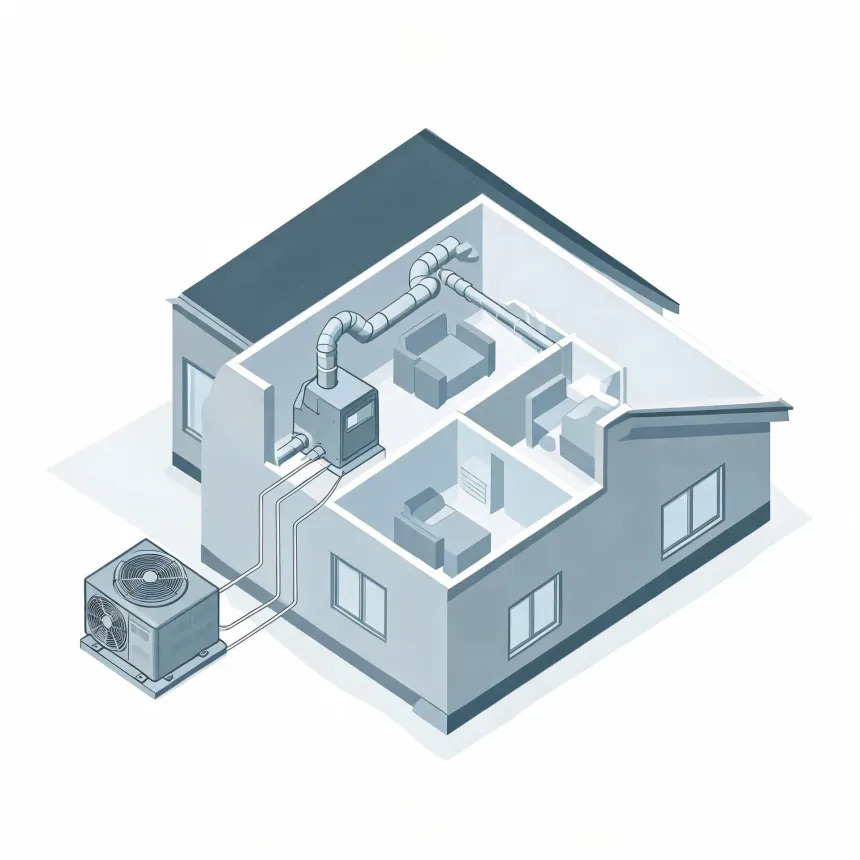
Isometric cutaway illustration of a two-room house showing an indoor air handler with ductwork connected by lines to an outdoor condenser unit on a pad.
Your system heats November through March and cools May through September.

NOAA nClimDiv, 1991–2020 normals

A compressor straining against a bad run capacitor draws more current than it was built for.

Shut it down at the first sign of trouble and a capacitor swap fixes it. Keep running it and you may be buying a new compressor.

Half the homes here were built by 1994, so the system is often younger than the house's reputation

Half the homes here were built by 1994
67 damaging wind events from 2015 to 2024
25 hail events from 2015 to 2024

Repair it

If your system came with a newer house, it likely has plenty of life left. Repair is usually the right call.

Find a contractor
A man in a cap, gray long-sleeve shirt and brown pants carries a worn canvas tote bag up porch steps toward an orange front door beside a potted olive tree.
A gray air-source heat pump mounted on a concrete pad next to a house with gray vinyl siding, surrounded by gravel and flanked by green shrubs and white hydrangea flowers.

A Machine Working Both Sides of the Year

A heat pump switches between heating and cooling more than a furnace or an air conditioner ever has to, and the reversing valve is what makes that switch happen. Every time it moves, it's wearing a little. The outdoor fan motor and the compressor carry the load on both sides of the year, so they rack up run hours that a system doing only one job never would. Contactors pit and wear from the constant cycling on and off. Capacitors lose their charge slowly over years of starting the compressor and fan, so the failure usually shows up as a weak start or a hard start, not a clean break. Refrigerant lines flex a little with every cycle too, and a slow leak at a joint or a coil can take a long time to show up as weak heat or weak cooling. None of this is damage from one bad day. It's wear that adds up in a machine that works both sides of the year instead of just one.

What you can check yourself

Look at the outdoor unit first. If it's caked in leaves, grass clippings or ice, clear it off and see if the system responds. Check your thermostat batteries and make sure it's set to call for heat or cool, not just fan. Go to your breaker panel and look for a tripped breaker, both for the indoor air handler and the outdoor unit. Check your air filter. A filter clogged with dust chokes airflow and can make the whole system struggle even when nothing else is wrong.

What to leave alone

Don't pull panels off the outdoor unit or touch anything inside the electrical compartment. Don't try to add refrigerant or guess at a leak location. If you see ice built up on the coil or lines, turn the system off and let it thaw rather than chipping at it. None of this is worth the risk, and a tech needs to see the system in its actual state to diagnose it right.

A heat pump in trouble doesn't always announce itself with silence. Air coming out of the vents that feels barely warm, or barely cool, usually means it's running but not doing its job, and that's different from not running at all. Listen for the outdoor unit too. A hum with no fan movement points to a motor or capacitor. A hard clunk when it switches between heat and cool often means the reversing valve is sticking. Ice on the outdoor coil during a heating cycle is never normal, and it won't clear on its own. If the system cycles on and off in a few minutes rather than running a full stretch, something is cutting it short before it finishes the job. Any of these is worth a call before the part that's struggling takes another one down with it.

A heat pump that's limping along is still doing some of its job, and that matters when you're deciding how fast to act. If it's keeping up most of the time and just struggling at the extremes, a scheduled repair visit is usually fine. If it's lost the ability to heat or cool at all, that's different, especially once outdoor temperatures swing hard in either direction. Letting a small problem run is how it turns into a big one. A weak capacitor makes the compressor work harder to start every single cycle, and that strain doesn't stay contained to the capacitor forever. The same goes for a system low on refrigerant. It'll keep running, but the compressor runs hotter and wears faster the whole time it's short. None of that means panic. It means the gap between noticing a problem and getting it looked at is where you either save a part or lose it.