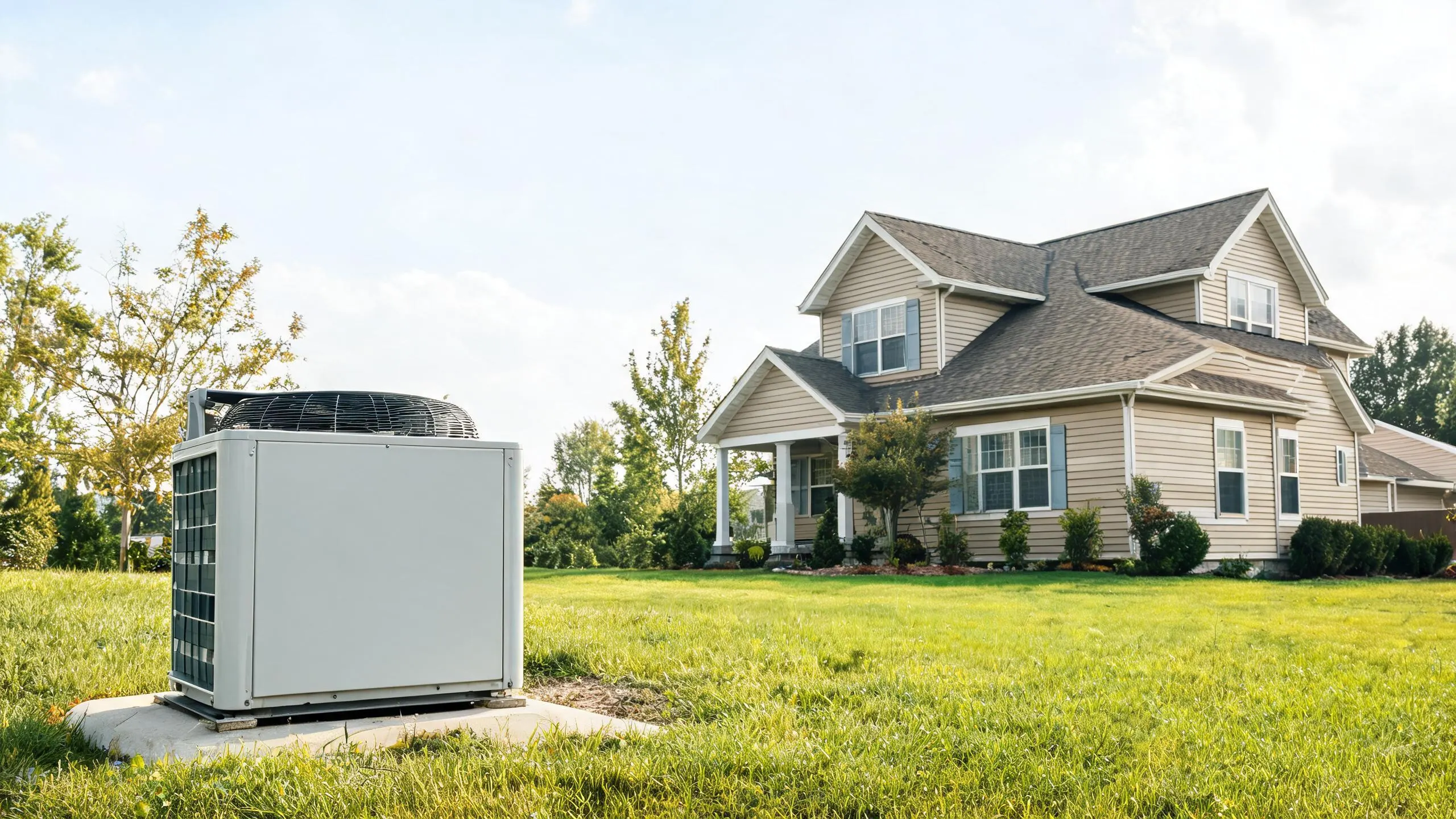
An outdoor HVAC condenser unit on a concrete pad in front of a two-story suburban house.

Heat Pump Repair in Greensboro, NC

Tell us about the job

Takes about a minute. No obligation.

RepairHeat PumpGuilford County, NC
Step 1 of 2

What ZIP code is the job in?

Check the thermostat and the breaker first

Make sure the thermostat is set to heat or cool and the setpoint is actually past room temperature, since a setting bumped by accident looks just like a dead system. Then check the breaker panel and any disconnect box next to the outdoor unit. A tripped breaker that resets and trips again means something is drawing too much current, and that's a sign to stop and call rather than keep resetting it.


Look at the outdoor unit and the filter

Walk outside and see if the fan is spinning and if ice has built up on the coil, which happens even in cooling mode when airflow is blocked. Pull the filter and hold it up to light. If you can't see light through it, replace it, since a clogged filter can cause icing, poor heating, and short cycling all on its own, and it's the one fix you can do yourself before anyone comes out.

7 months
October through April, your system heats
5 months
May through September, it cools
31°F
the average winter night it heats against
87°F
the average summer afternoon it cools against
Isometric illustration of a cutaway single-story house showing interior ductwork and an air handler connected by lines to an outdoor condenser unit on a pad beside the building.
Your system heats October through April and cools May through September.

NOAA nClimDiv, 1991–2020 normals

Winters in Guilford County stay mild, with overnight lows averaging 31°F through December, January and February.

A heat pump here isn't fighting deep cold most of the year, so a repair usually has a sound machine underneath it.

October is when a weak heat pump shows itself

Cooling runs May through September
Heat runs October through April
Climate zone 3A

A mild climate means your heat pump is probably still worth repairing

A heat pump that's spent most of its life around 31-degree lows hasn't been under much strain. If it's acting up now, the problem is more likely a part wearing out than a system that's been overworked, and that's usually worth fixing rather than replacing.

Find a contractor
A man in a dark long-sleeve shirt and tan work pants walks up concrete steps toward an orange front door, carrying a waxed canvas tool bag in his right hand, with a potted shrub beside the gray-sided house.
A gray heat pump outdoor unit mounted on a concrete pad next to a residential house with lap siding and stone accents.

A newer house usually means a younger system

Half the homes in Guilford County were built in 1987 or later. If yours is one of them, the heat pump may not be the original, and even if it is, it hasn't been running for decades. A system with plenty of working life left usually just needs the broken part fixed. The age of the unit is worth checking before you decide anything, since a young system with one failed part is a different situation than an old one nearing the end.

Warm air instead of cold, or cold instead of warm

A heat pump moves heat one direction or the other depending on a reversing valve. When that valve sticks, the system runs but puts out air that feels wrong for the mode you set, sometimes barely different from room temperature at all. If the outdoor unit is running and the indoor fan is blowing but the air isn't doing what the thermostat says it should, that valve is a likely reason.

Short cycling or a system that won't stop running

A heat pump should run a steady stretch and then shut off until the house calls for it again. If it's kicking on and off every few minutes, something is tripping it early, often a refrigerant or airflow problem, and that wears on the compressor each time it happens. A system that runs constantly and never seems to catch up is usually losing the fight against a low charge or a failing part, not just working hard.

Most heat pump failures come down to a handful of parts wearing out, not the whole system giving up. The capacitor that kicks the compressor and fans on is a common one. It weakens over time, and when it goes, the outdoor unit may hum but not start, or the fan may spin slow. The reversing valve is another, since it's always working to switch directions and the coil inside it can stick or burn out. Refrigerant doesn't get used up, so if a system is low, it's leaking from somewhere, usually a fitting or a worn line. Outdoor coils take a beating too, sitting outside year-round collecting dirt and debris that blocks airflow and makes the whole system work harder than it should. None of these mean the unit is done. They mean one part failed while the rest of the system is still fine.

A diagnostic call starts with gauges, not guesses. The tech hooks up a manifold to the outdoor unit and checks refrigerant pressure on both sides. That reading points toward a low charge, a bad valve, or a compressor struggling under load. They'll run the system in both heating and cooling if they can, since a reversing valve that works fine one way can still stick the other. Electrical testing comes next. The capacitor gets checked against its rating, because a weak one can still spin the fan without putting out enough to start the compressor. They'll also pull the filter and look at the outdoor coil while they're out there, since blocked airflow can look just like a refrigerant problem and send the whole call in the wrong direction. The goal is finding the one part that failed, not swapping parts until something works.