




Low-angle view along a red brick wall with trimmed shrubs and a mulch bed beside a mown lawn, with a single-story house with a garage door and tall pine trees under an overcast sky in the background.

Heat Pump Repair in Eden, NC

Tell us about the job

Takes about a minute. No obligation.

RepairHeat PumpRockingham County, NC
Step 1 of 2

What ZIP code is the job in?

Rockingham County recorded 209 severe weather events between 2015 and 2024. Most of that was wind, 154 events strong enough to count as damaging, plus 36 hail events and 4 tornadoes. An outdoor heat pump unit sits outside through all of it, exposed to whatever the wind throws at it. Hail can bend the fins on the coil, and flying debris can nick the fan blades or dent the cabinet. A unit can take a hit like that and keep running for weeks before it shows up as a problem. If a storm has come through and rattled the unit, it's worth having someone look at the coil and fan before you assume it's fine.

7 months
October through April, your system heats
5 months
May through September, it cools
30°F
the average winter night it heats against
87°F
the average summer afternoon it cools against
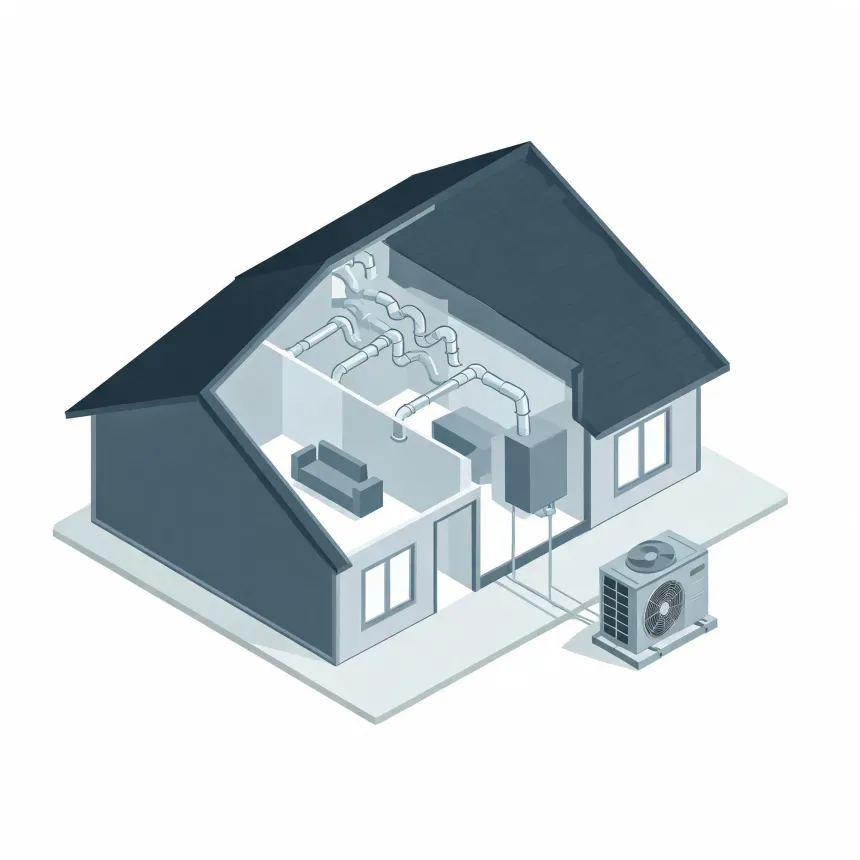
Isometric cutaway illustration of a house showing interior ductwork, an indoor air handler unit, and an outdoor condenser unit beside the building.
Your system heats October through April and cools May through September.

NOAA nClimDiv, 1991–2020 normals

A heat pump that's struggling still tries to meet the thermostat setting, so it just runs longer and harder.

That strain is what turns a bad capacitor into a burned-out compressor if nobody looks at it soon.

The first cold snap in October and the first hot stretch in May are when a weak heat pump fails

Cooling runs May through September
Heat runs October through April
Climate zone 3A

A tech starts by asking what the system is doing: short cycling, running nonstop, blowing air that isn't warm or cool, tripping a breaker. That tells them where to look first. Outside, they'll check the refrigerant charge and the pressures, check that the fan spins freely, and look at the coil for bent fins or anything blocking airflow. Inside, they'll test the capacitor, the contactor and the defrost board, and check the reversing valve since that's the part that lets a heat pump switch between heating and cooling. They'll also pull the air handler cover to look at the coil and blower wheel for dirt buildup, since a dirty coil makes the whole system work harder than it should. Most of this gets diagnosed with gauges and a multimeter, not guesswork, and a tech can usually tell you what's wrong before they start taking anything apart.

After a storm, get the unit looked at before it fails

If your outdoor unit has been through a storm, have the coil and fan checked before you decide it's fine. A unit that took a hit from hail or flying debris can keep running for weeks before it shows what's wrong.

Find a contractor
A man in a dark t-shirt and tan work pants walks up concrete steps toward a red front door, carrying a worn canvas tool bag, with a potted shrub beside the entry.
A gray outdoor HVAC unit mounted on a concrete pad beside a house with gray lap siding and a stone foundation.

What you can check yourself before it's a service call

Before calling anyone, check the thermostat first. Make sure it's set to the right mode and the temperature is actually past where the system should kick on. A dead thermostat battery can look exactly like a dead system. Next, go to the breaker box. A heat pump that trips a breaker and stays off isn't a small problem, but it's worth resetting once to see if it holds. If it trips again, stop and leave it off. Outside, look at the unit itself. Make sure nothing is blocking airflow around it, no leaves, no debris, nothing pressed up against the cabinet. The fan on top should be able to spin freely. Don't reach into the unit or try to clear anything near the fan blade. Inside, check the air filter. A filter clogged with dirt chokes off airflow and can make the whole system struggle, and it's the one part a homeowner can safely pull and look at. If it's gray and packed with dust, that alone can explain weak airflow or ice forming on the outdoor coil. Speaking of ice, look at the outdoor unit for frost or a solid sheet of ice on the coil. Some frost in cold weather is normal and clears on its own during the defrost cycle. A heavy coat of ice that doesn't go away is not normal and means the system needs a real diagnosis. Don't chip at the ice or pour water on it. Last, listen to the system. Grinding, screeching or a loud clicking that keeps repeating without the system starting are all reasons to shut it off and wait for a tech rather than let it keep running.

Most failures start small

A heat pump rarely quits without warning. A capacitor weakens over months before it finally fails outright. A contactor's points pit and burn a little more every cycle until they stick or stop making contact. Refrigerant leaks out slowly through a pinhole, so the system loses capacity gradually rather than all at once. By the time the unit won't run at all, something has usually been wearing out for a long while.
What that means for repair

Catching the early signs matters more than reacting to the full failure. A system that's icing up, short cycling, or running long without warming or cooling the house is telling you a part is already struggling, not that it's about to start. Waiting through that stage is what turns a cheap part into a compressor replacement, since the compressor is what absorbs the strain when something upstream isn't doing its job.

A heat pump usually tells on itself before it quits. The air coming out of the vents feels lukewarm instead of warm or cool, like the system is running but not really working. It cycles on and off more than it used to, or it runs and runs without ever satisfying the thermostat. You might hear it kick on with a hard clunk, or hear a hum where the fan or compressor should be starting up and isn't. Some units start smelling faintly burnt around the air handler, which usually points to an electrical part overheating rather than anything in the ductwork. None of these mean the system is done. They mean a part is already failing and the system is working around it, which is exactly the point where a repair is still just a repair.

Age on its own doesn't tell you much. What matters is whether the unit has been reliable up to now or whether it's been back on the schedule every season. A heat pump that's needed one repair in years of running is still a good bet to fix again. One that's had a string of service calls, each for something different, is telling you the whole system is wearing out at once, not just the part that failed this time. A compressor or reversing valve failure is usually the one that forces the question, since those are expensive enough that it's worth asking what else on the unit is tired before paying to replace just the one part. A tech who's already inside the cabinet can tell you honestly whether the rest of the system has life left in it or whether this repair is just the first of several. That answer matters more than how old the unit is on paper.