







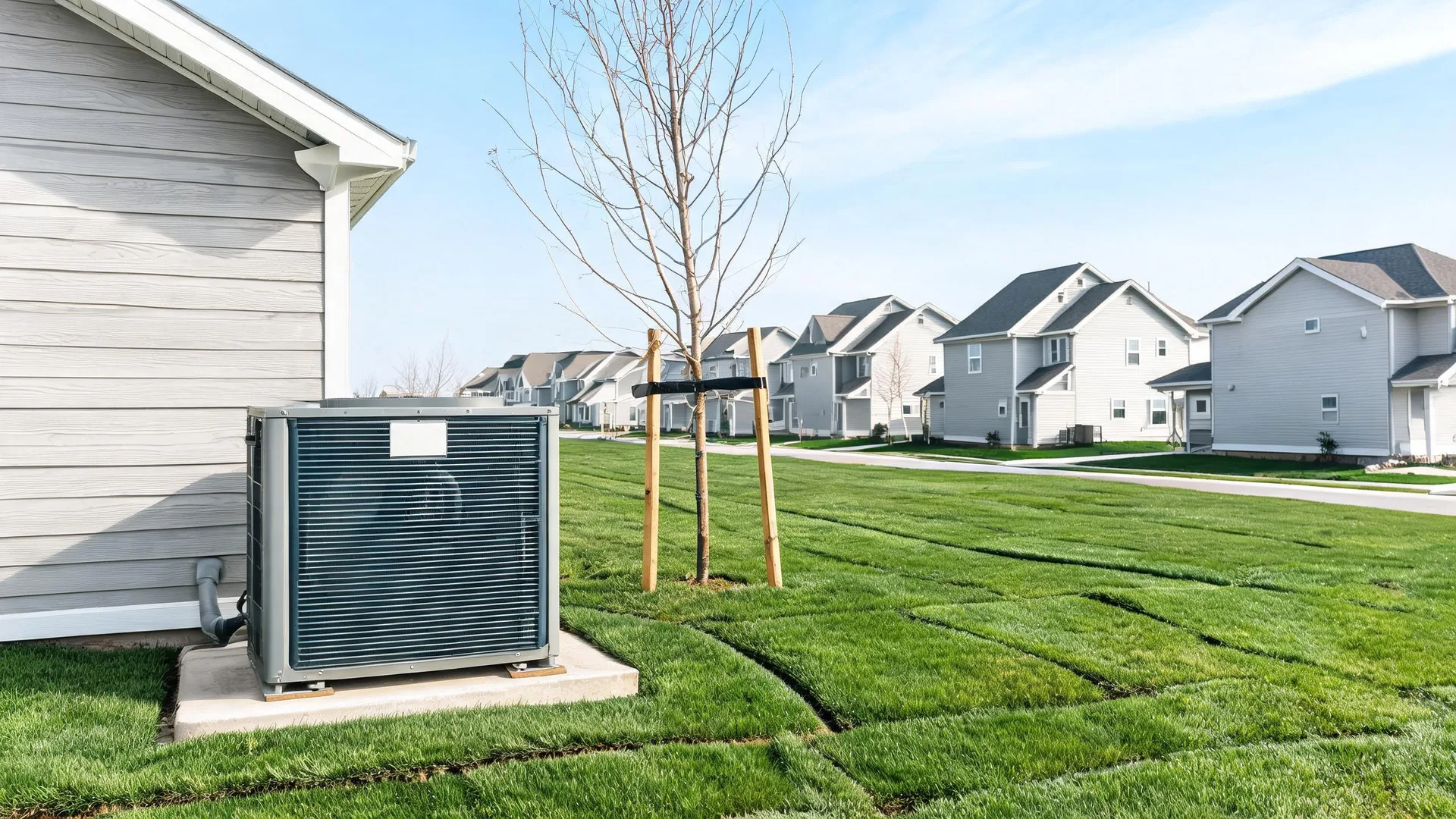
An outdoor heat pump unit mounted on a concrete pad beside a house with beige siding and a landscaped garden bed.

Heat Pump Repair in Concord, NC

Tell us about the job

Takes about a minute. No obligation.

RepairHeat PumpCabarrus County, NC
Step 1 of 2

What ZIP code is the job in?

Concord sits in Cabarrus County, where half the homes were built in 1997 or later. If your heat pump came with a newer house, it's probably not old enough to be the reason it's acting up. A compressor or control board issue on a unit that age is usually a repair, not a sign the system is done. Worth finding out what's actually wrong before anyone talks about replacing it.

7 months
October through April, your system heats
5 months
May through September, it cools
32°F
the average winter night it heats against
88°F
the average summer afternoon it cools against
Isometric cutaway illustration of a single-story house showing interior rooms, ceiling ductwork connected to an air handler, and an outdoor condenser unit linked by a line set.
Your system heats October through April and cools May through September.

NOAA nClimDiv, 1991–2020 normals

Winters are short and mild here, and summers run long and humid.

A heat pump in Cabarrus County isn't fighting hard weather most of the year, so a repair is usually worth it.

Cabarrus County sees 100 severe weather events a decade. If your outdoor unit took hail or debris, that's worth a look even if it's still running.

100 severe weather events from 2015 to 2024
25% of homes statewide lost power a day or more in 2024
60 damaging wind events from 2015 to 2024
Concord heat pump repairHeat runs October through April here, so a weak unit usually shows it first in October.

Since the system isn't under constant strain, what usually brings it down is a specific failure, not wear from overwork. That's worth knowing before a repair call. A technician can point to the actual part, a contactor, a stuck reversing valve, a low charge, instead of writing the whole unit off because of its age. If the outdoor unit has been through wind or hail in recent years, mention it when you call. A bent fin or a cracked fan blade can cause symptoms that look like something else entirely, and it changes what the technician checks first.

Find out what's actually wrong with it

Get the actual cause checked out before deciding anything about replacement. A repair tech here can tell you in one visit whether it's a part worth fixing.

Find a contractor
A man in a cap, dark T-shirt and tan work pants walks up porch steps toward an orange front door, carrying a canvas tool bag filled with hand tools, with a potted shrub in a terracotta planter at left.
A gray heat pump condenser unit mounted on a concrete pad against the gray lap-siding exterior wall of a house.

What to check before you call

Before anyone comes out, go outside and look at the unit itself. Clear any leaves, grass clippings or ice off the cabinet so air can move through it. Inside, check the thermostat is set to heat and the temperature is actually above room temperature, since a setting bumped by accident looks exactly like a dead system. Check your breaker panel for a tripped switch. Pull the air filter and hold it up to a light. If you can't see through it, swap it, because restricted airflow can cause the outdoor unit to ice up or the system to short cycle. Look at the outdoor coil for a heavy, solid sheet of ice rather than the light frost that's normal on a cold morning. If the system is blowing air that feels cool to the touch, that can be normal for a heat pump on a mild day and isn't necessarily a fault. None of this fixes a bad reversing valve or a low charge, but it rules out the easy stuff before a technician has to.

What you'll actually notice first

Heat that doesn't feel as warm as it used to, air blowing from the vents that's lukewarm instead of hot, or the system running long stretches without shutting off. Sometimes it's a smell, a burning or musty odor on startup. Sometimes it's a sound, a clicking from the outdoor unit that wasn't there before, or a hum with no fan turning. These show up before the system fails outright.
How soon it needs a technician

A unit that's icing over, short cycling, or tripping its breaker repeatedly needs a call soon, since running it that way can stress the compressor. A unit that's just weaker than normal, putting out cooler air but still keeping up, can usually wait for a scheduled visit. Either way, the longer a small part runs while failing, the more it can affect the parts around it.

A diagnostic visit starts outside, at the unit itself. A technician checks the refrigerant pressure, the amp draw on the compressor, and whether the reversing valve is actually switching when it's told to. Inside, they'll check the air handler, the filter, and the temperature of the air coming out of the vents compared to what's going in. Most of this is done with gauges and meters, not guesswork, so the readings either point to a part or they rule it out. If the outdoor coil has ice on it, they'll want to see how it forms before they decide whether it's airflow, charge, or the defrost cycle not kicking in. By the end of the visit you should hear the actual part that's failing, not just a guess at what's wrong.

Most heat pump failures come down to a single part, not the whole system giving out. A capacitor weakens. A contactor pits and starts sticking. Control board relays wear out after years of cycling on and off. None of that means the compressor is next. A compressor can keep running for a long time if the charge has always been right and the electrical side has been sound, so a failed part elsewhere doesn't say much about it. The question worth asking isn't how old the unit is, it's whether the failed part is one of those small ones or the compressor itself. A technician can tell you which after checking it, and that answer matters more than the age on the nameplate.