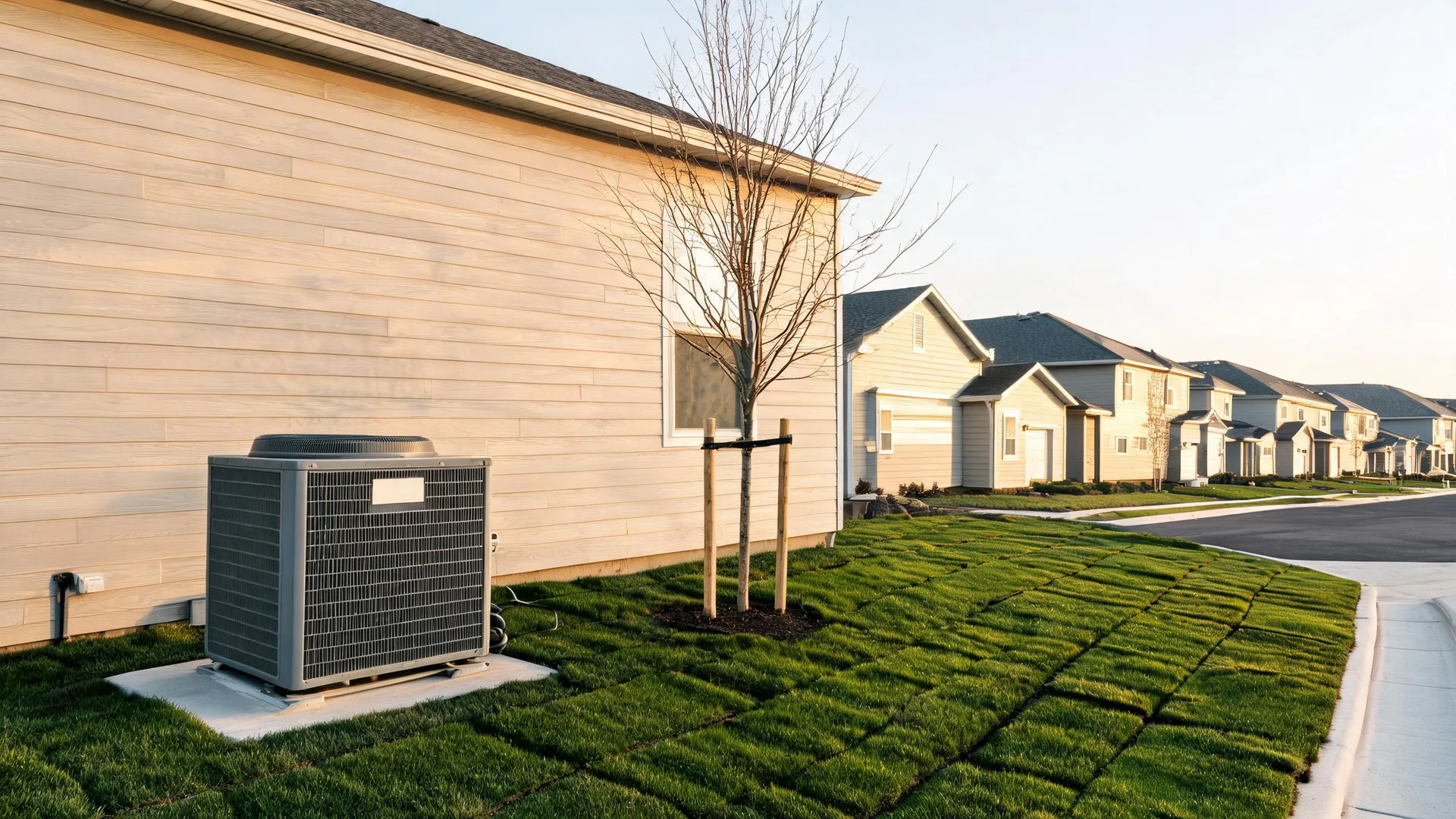
Storms here hit outdoor units
Forsyth County recorded 211 severe weather events between 2015 and 2024, including 174 damaging wind events and 20 hail events. An outdoor AC unit sits outside through all of it, exposed to whatever comes down.
Takes about a minute. No obligation.
Forsyth County recorded 211 severe weather events between 2015 and 2024, including 174 damaging wind events and 20 hail events. An outdoor AC unit sits outside through all of it, exposed to whatever comes down.
Hail can dent the fins on a condenser and wind can drive debris into the coil. The unit may keep cooling for a while after that kind of hit, but the damage is already there.

NOAA nClimDiv, 1991–2020 normals
Your AC starts its first real work in May.
A weak part that made it through last September often fails in the first warm week this year.



Your AC runs about five months a year here, May through September, with afternoon highs averaging 86°F in June, July and August. The dew point sits around 65°F those same months, so the air stays heavy and the system has to pull more moisture out along with the heat. That's steady, hard work for the compressor and the fan motor, not occasional work. A part that's been straining all summer doesn't always fail with a bang. Sometimes it just starts losing ground, and the house doesn't quite cool like it did in June. Getting the actual cause found, rather than guessed at, is what makes a repair hold.
If your outdoor unit took a hit from hail or flying debris and it's still running, that's not proof it's fine. A dented coil or bent fins can cut its output now and shorten its life later. Have it looked at before it has to carry you through the summer.
Find a contractor
If your house was built in 1984 or later, that repair is worth making. A system with years of life left under it is worth fixing when something fails, not replacing. Swap the part, get it running right, and let the rest of the equipment's life play out. Replacement starts to make sense later, when parts get hard to find or repairs keep piling up, not on the first failure.
Look at the outdoor unit first. Make sure nothing is blocking it, no leaves packed against the coil, no grass clippings, no shed branches sitting on top. Check the air filter inside and swap it if it's gray or clogged. Walk through the house and feel the vents. If some rooms blow cold and others don't, that's worth mentioning when you call. Check the thermostat batteries and make sure it's set to cool, not just fan. None of this fixes a refrigerant leak or a bad capacitor, but it rules out the simple stuff first.
Don't open the outdoor unit's electrical panel or touch the wiring. Don't add refrigerant yourself even if you can buy it, because a system low on charge usually has a leak, and adding more just hides the problem while it gets worse. Don't keep running the system if you hear grinding, squealing, or see ice on the copper line. That's the compressor or the coil telling you to shut it down before a small failure turns into a bigger one. If flipping the breaker doesn't bring it back, stop there and call.
Estimates for a typical Forsyth County home, compared with an older unit built to the previous federal minimum, from EIA household energy data, North Carolina fuel prices and NOAA climate normals. Your home will differ.
Repair makes sense when a part like a capacitor or contactor has failed.
Replacement makes sense when the compressor has failed or the system uses R-22 refrigerant, which is no longer made.
A repair decision usually comes down to what failed, not just how old the system is. A capacitor, a contactor, a fan motor, these are wear parts, and replacing one brings the whole system back to normal. A cracked heat exchanger or a compressor that's seizing up is different, because the part driving the failure is the one that's expensive and hard to access. When a technician diagnoses the problem, ask what actually broke and whether that part tends to take others down with it. A system that's been losing refrigerant slowly for years is telling you something different than one that just had a capacitor give out after a hot week. The failure itself is usually the best guide you have.