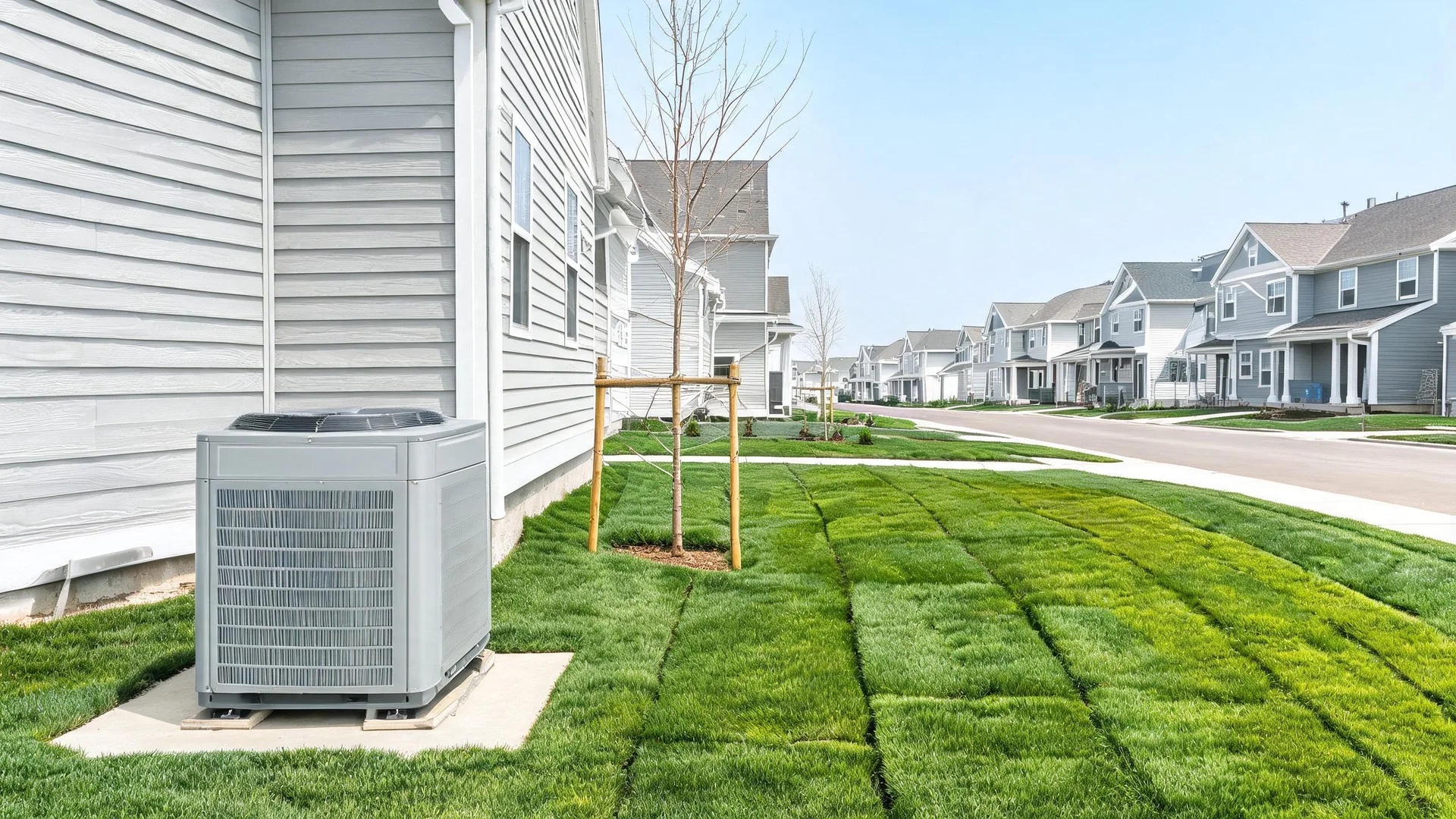
Aerial view of a residential air conditioning condenser unit mounted on a concrete pad next to a house with vinyl siding and a sliding glass door.

AC Repair in Thomasville, NC

Tell us about the job

Takes about a minute. No obligation.

RepairCentral ACDavidson County, NC
Step 1 of 2

What ZIP code is the job in?

Davidson County sees real storm damage

Davidson County recorded 169 severe weather events between 2015 and 2024, including 129 cases of damaging wind and 26 hail events. An outdoor AC unit sits outside through all of it, with nothing shielding the coil or fan from wind-driven debris or hail.


A unit that still runs can still be hurt

Hail can dent the fins on a condenser coil and bent fins block airflow the system needs to cool properly. A storm doesn't have to knock the unit out to leave it running worse than before, so a direct hit is worth a look even when the AC seems fine afterward.

5 months
May through September, your air conditioner is on duty
87°F
the average summer afternoon it cools against
26 hail events
in ten years, and hail bends the fins on outdoor coils
129 wind events
in ten years, and wind drives debris into outdoor units
Isometric cutaway illustration of a single-story house showing interior rooms with furniture, overhead ductwork, an indoor air handler unit, and an outdoor condenser unit connected by lines at the side of the building.
Your air conditioner works hardest from June through August.

NOAA nClimDiv, 1991–2020 normals

AC here starts running in May, right after a mild April.

A weak part that made it through winter often fails in those first warm weeks, so trouble in May is worth a same-week look.

Half the homes here were built in 1985 or later, with a lot of working life still ahead

Half the homes here were built by 1985
Cooling runs May through September
Summer afternoons average 87°F

Most AC failures come down to a handful of parts wearing out, not the whole system giving up. The capacitor is the one that goes most often. It gives the compressor and fan motor the jolt they need to start, and after years of heat cycling it weakens until the motor struggles to start or won't start at all. The run capacitor can fail the same way after the motor's already running. Contactors wear out too, from the arcing every time they open and close, and a pitted contactor eventually won't make contact at all. Refrigerant leaks usually show up at joints or the coil, slowly dropping the charge until the system cools less and less. Condenser fan motors and compressors fail less often, but when they do it's usually bearings wearing out after years of running, not something that happens overnight. Keeping the coil clean and the filter changed won't stop a part from aging out, but it keeps the system from working harder than it has to while that part is still good.

If a storm came through, get the unit looked at before summer proves there's a problem

If hail or wind came through recently, a quick check now is worth more than waiting to see if the AC acts up. Bent fins or a damaged fan can run for weeks before the system really struggles, and by then it's the middle of summer. A tech can look at the coil and fan in the time it takes to confirm the unit is fine, or catch the damage while it's still a small fix.

Find a contractor
An outdoor residential air conditioning condenser unit mounted on a concrete pad, surrounded by gravel with a blue sky in the background.

What a struggling AC sounds and feels like before it quits

Watch what the air coming out of the vents is doing before you watch the thermostat. Air that used to feel cold now feels cool, or barely moving at all, and that's usually the first thing anyone notices. The system is still running, the breaker hasn't tripped, but it's working harder for less. That gap between how long it runs and how little it does is the clearest sign something inside needs attention, whether that's a refrigerant leak, a failing capacitor, or a coil that can't shed heat the way it should. Short cycling is another one worth paying attention to: the unit kicks on, runs a few minutes, shuts off, then starts again shortly after. That's not normal wear, that's a system struggling to finish a cycle. Ice on the refrigerant line or the indoor coil means airflow or refrigerant charge is off, not that the system is working extra hard to cool. And any grinding, squealing or banging coming from the outdoor unit is a motor bearing or a loose part, not something that settles down on its own. None of these fix themselves, and all of them get more expensive to ignore the longer the system keeps running that way.

Check the thermostat and the breaker first

Make sure the thermostat is set to cool and set below room temperature, not just on. Check the breaker for the outdoor unit and the indoor air handler, since a tripped breaker on either side will stop the system cold. Look at the outdoor unit itself: if the fan isn't spinning and you don't hear any hum, that's different from a fan spinning while the air stays warm, and worth mentioning when you call.

Check the filter and the outdoor unit for anything blocking them

Pull the air filter and hold it up to a light. If you can't see light through it, it's choking airflow and the system is working against itself. Walk outside and look at the condenser unit for leaves, grass clippings or anything packed against the fins, and clear it away if you find it. Don't open the unit's panels or touch anything beyond clearing debris around it, since the capacitor inside holds a charge even with the power off.

Overhead view of an air conditioning condenser unit on a concrete pad next to a house with asphalt shingle roofing and vinyl siding.

A new air conditioner would cut about $40 a year off cooling for a typical Davidson County home.

  • A new one at the federal minimum, 14.3 SEER2$290 a year
  • An older air conditioner$330 a year

Estimates for a typical Davidson County home, compared with an older unit built to the previous federal minimum, from EIA household energy data, North Carolina fuel prices and NOAA climate normals. Your home will differ.

Repair makes sense when a part like a capacitor or contactor has failed.

Replacement makes sense when the compressor has failed or the system uses R-22 refrigerant, which is no longer made.

A diagnostic visit starts before any panel comes off. The tech will ask what the system was doing: warm air, no air, short cycling, strange noise, and when it started. Then they check static readings, pressures on the refrigerant lines, and electrical draw on the compressor and fan motor, since those numbers point to a bad capacitor, a low charge or a failing motor long before guesswork would. They'll check the indoor coil and the air handler too, not just the outdoor unit, because warm air at the vents can start indoors as easily as outside. A refrigerant leak gets found with a leak detector or dye, not by topping off the charge and hoping it holds. By the end, the tech should be able to point to the one part that's failing and explain what it does, not just hand over a list of things that might be wrong.