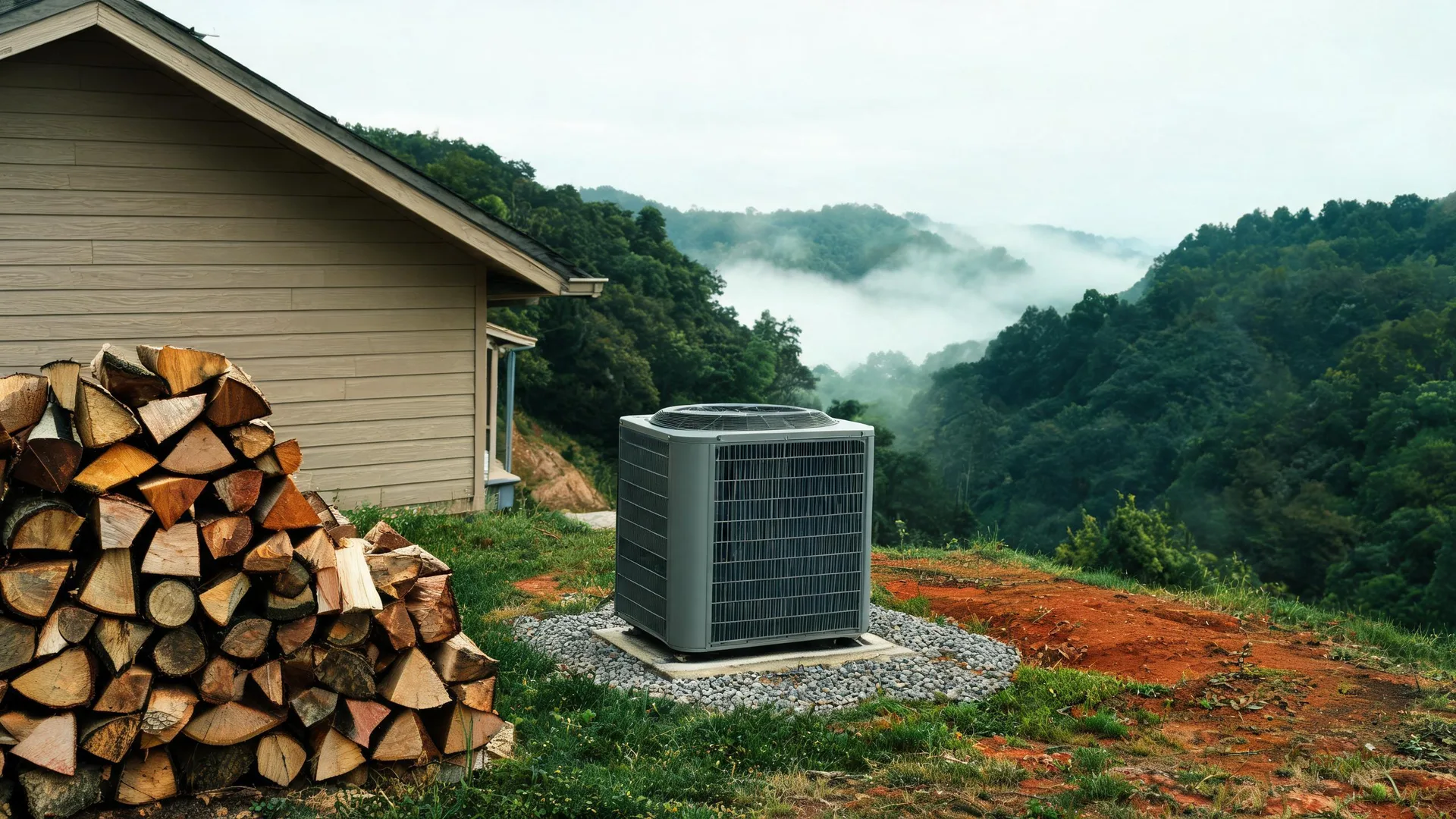
Storms come through often here
Nash County logged 135 severe weather events between 2015 and 2024, including 90 damaging wind events, 23 hail events and 5 tornadoes. An outdoor AC unit sits outside through all of it.
Takes about a minute. No obligation.
Nash County logged 135 severe weather events between 2015 and 2024, including 90 damaging wind events, 23 hail events and 5 tornadoes. An outdoor AC unit sits outside through all of it.
Hail and flying debris can bend fins or crack the fan without stopping the unit outright. If yours came through a storm and still cools the house, that is not proof it came through clean.
NOAA nClimDiv, 1991–2020 normals
AC here starts running in May, right after April's mild stretch.
A part that limped through last September can fail in the first hot week of May.



Cooling runs five months here, May through September, with afternoon highs near 88°F through the summer. The air stays heavy too, with a dew point around 67°F, so the unit is pulling moisture out of the air on top of cooling it. That is steady, hard work on the compressor and coil for most of the year. When something is off, it tends to show up as a system that runs longer and still can't keep the house comfortable. Have it looked at properly rather than guessed at, so whatever gets fixed holds for the rest of the summer.
A unit that still cools the house after a storm can still have a bent fin, a cracked fan blade, or a dented coil. Those don't always show up as a problem right away. Get it checked now, before the next storm or the next stretch of hot weather finds the part that's already damaged.
Find a contractorThis county logged 90 damaging wind events and 5 hurricanes or tropical storms between 2015 and 2024, on top of five straight months where the unit runs most of the day. That combination is what usually sits behind a system that's struggling, either steady heat wearing on a part or a storm that bent or cracked something without stopping the unit outright. A tech can tell you which one it is, and whether the fix is a quick part swap or something more. Guessing just means paying twice.
Make sure the thermostat is set to cool and set below room temperature, not just on. Check the breaker for the outdoor unit and the indoor air handler, since a tripped breaker on either one will stop the system cold. Look at the filter too. A filter packed with dust chokes airflow across the coil, and the system will run without cooling the house.
Look at the outdoor unit and note if the fan is spinning or if the unit is making noise but not blowing cold air. Check if ice has formed on the indoor coil or the refrigerant lines, since that points to airflow or refrigerant trouble rather than something simple. Telling the contractor what you saw, running but no cold air, iced lines, a smell, a noise, gets the right part on the truck the first time.
Estimates for a typical Nash County home, compared with an older unit built to the previous federal minimum, from EIA household energy data, North Carolina fuel prices and NOAA climate normals. Your home will differ.
Repair makes sense when a part like a capacitor or contactor has failed.
Replacement makes sense when the compressor has failed or the system uses R-22 refrigerant, which is no longer made.
A diagnostic starts outside, at the unit itself. The tech checks the capacitor and contactor first, since those fail often and are quick to test. From there it's refrigerant pressure, checked with gauges on the lines, and current draw on the compressor, measured with a meter. Airflow gets checked too, both at the return and across the indoor coil, because weak airflow can mimic a refrigerant problem. If the coil is iced over, that ice has to melt before any reading means much, so sometimes the first visit is about shutting the system down and letting it thaw. Whatever the tech finds gets explained in terms of what's broken and what it takes to fix it, not just a part swapped and a bill handed over.