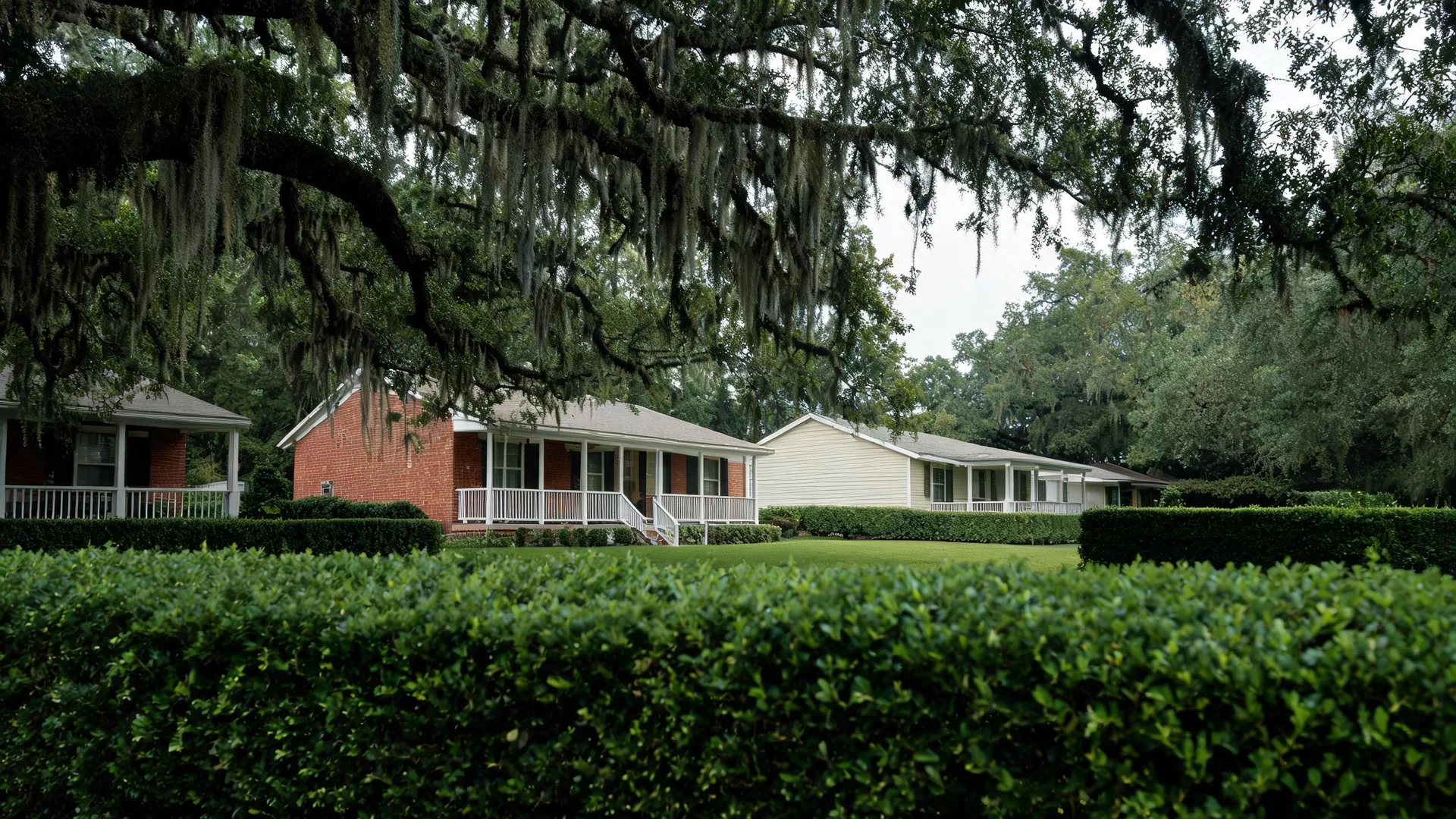
Single-story brick and white-sided buildings with covered porches behind a trimmed hedge and lawn, framed by overhanging oak branches draped with Spanish moss.

AC Repair in Lumberton, NC

Tell us about the job

Takes about a minute. No obligation.

RepairCentral ACRobeson County, NC
Step 1 of 2

What ZIP code is the job in?

Robeson County gets hit often

Robeson County recorded 127 severe weather events between 2015 and 2024, including 87 damaging wind events, 23 hail events and 8 tornadoes. A quarter of North Carolina households went at least a day without power in 2024.


The outdoor unit takes the hit

Your condenser sits outside in the open, where wind-driven debris and hail reach it. A unit that still runs after a storm can have a bent coil fin or a cracked fan blade that gets worse over time.

5 months
May through September, your air conditioner is on duty
90°F
the average summer afternoon it cools against
23 hail events
in ten years, and hail bends the fins on outdoor coils
87 wind events
in ten years, and wind drives debris into outdoor units
Isometric cutaway illustration of a single-story house showing interior ductwork and an air handler connected by lines to an outdoor condenser unit on a pad beside the building.
Your air conditioner works hardest from June through September.

NOAA nClimDiv, 1991–2020 normals

April is when AC problems in Lumberton show up, right as the system switches back on.

A part strained by last year's storms often fails the moment May's heat puts a full load on it.

At 14.46 cents a kilowatt-hour, a struggling AC runs up your bill before it quits

Power here costs 14.46 cents per kilowatt-hour
Cooling runs May through September
Summer afternoons average 90°F

Half the homes in Robeson County were built in 1986 or earlier. If yours is one of them, your AC may not be the original one, but whatever is out there now has likely done a lot of years of work in this heat. An older condenser that takes a hit from wind or hail has less give left in it than a new one would. It may keep running for a while after, just not as well, and the next storm or the next heat wave is what finishes the job. Before you pay for a major repair, it's worth asking the contractor how many years they think the unit has left in it.

Get the condenser checked after a storm, even if it's still running

If your unit has been through wind, hail or a fallen branch this year, get it looked at before the next one hits. A bent fin or a cracked blade won't always stop the unit cold. It just means less margin left for whatever comes next.

Find a contractor
A gray cylindrical air conditioning condenser unit mounted on a concrete pad next to a light-colored vinyl-sided house exterior.

Five months of heavy load, every year

Five months of cooling, May through September, with afternoon highs averaging 90°F in June, July and August. The dew point runs 69°F those same months, higher than most of the country sees, which means the unit is pulling moisture out of air that's already heavy with it. That's steady, long load, not the occasional hot week. A compressor built for that kind of season wears at a different rate than one in a place with a short, mild summer. When something finally gives out, it's usually a part that's been working at the edge of its limit since May.

Check the breaker and the disconnect

If the unit won't start at all, look at the breaker panel first. A tripped breaker can be reset once, but if it trips again, stop and leave it alone. There's also a disconnect box mounted right next to the outdoor unit, usually a gray metal box with a pull handle. It can work loose or get bumped open, and the unit won't run at all if it's not seated all the way in.

Look, listen, and check the air before you call

Check the air filter. A filter clogged with dirt chokes airflow and can make the whole system work harder or ice up the coil. Look at the outdoor unit for anything blocking it, leaves, grass clippings, a fallen branch, and clear it away if you can do it safely. Listen for a humming sound without the fan turning, that's different from a unit that's dead quiet, and worth telling the contractor when you call.

An outdoor central air conditioning unit mounted on a concrete pad beside a blue-sided house at sunset.

A new air conditioner would cut about $60 a year off cooling for a typical Robeson County home.

  • A new one at the federal minimum, 14.3 SEER2$390 a year
  • An older air conditioner$450 a year

Estimates for a typical Robeson County home, compared with an older unit built to the previous federal minimum, from EIA household energy data, North Carolina fuel prices and NOAA climate normals. Your home will differ.

Repair makes sense when a part like a capacitor or contactor has failed.

Replacement makes sense when the compressor has failed or the system uses R-22 refrigerant, which is no longer made.

A repair makes sense when the rest of the system is sound and the failed part is a known, contained job, a capacitor, a contactor, a fan motor. Those parts fail on their own schedule and swapping one doesn't tell you anything bad about the rest of the unit. Replacement starts to make more sense when the compressor is the thing failing, or when the refrigerant in it is on its way out and a leak keeps opening up in a different spot each time it's patched. Age matters too, not as a number but as a pattern: a unit that's needed a repair every season for the last few years is telling you something a single repair can't fix. The honest question to ask the contractor isn't just what's broken, it's whether fixing this part buys you one more season or several.