Three white clapboard houses with wraparound porches glow with warm interior and landscape lighting beneath Spanish moss-draped oak trees at dusk.

AC Repair in Hickory, NC

Tell us about the job

Takes about a minute. No obligation.

RepairCentral ACCatawba County, NC
Step 1 of 2

What ZIP code is the job in?

Catawba County sees its share of storms

Catawba County logged 117 severe weather events between 2015 and 2024. That includes 66 damaging wind events, 32 hail events and 5 tornadoes. Four tropical storms or hurricanes came through in that stretch too.


Outdoor units are out where the weather is

Your condenser sits outside year round, so wind-blown branches and hail have a straight shot at the fins and the fan. A unit that still runs after a storm can have damage you won't notice from the thermostat.

5 months
May through September, your air conditioner is on duty
87°F
the average summer afternoon it cools against
32 hail events
in ten years, and hail bends the fins on outdoor coils
66 wind events
in ten years, and wind drives debris into outdoor units
Isometric cutaway illustration of a single-story house showing interior rooms, ductwork and an air handler in the attic space, and an outdoor condenser unit connected by lines at the exterior wall.
Your air conditioner works hardest from June through August.

NOAA nClimDiv, 1991–2020 normals

A capacitor weakens slowly, then the compressor just won't start on a hot afternoon.

If your AC is struggling or short cycling, a failing capacitor is one of the first things worth checking.

Half the homes here were built in 1985 or later, and the AC in them usually has years left to give

Half the homes here were built by 1985
Cooling runs May through September
Summer afternoons average 87°F
May is when a weak AC gives outCooling starts in May here and runs through September, and the first hot stretch finds whatever was already failing.

If your AC is acting up, that's reason to call a repair tech before you start pricing a new system. A unit that came with a newer house hasn't had the years to wear out on its own. What usually takes an AC down early here is a storm or a part giving out, not age. A capacitor, a contactor, a fan motor, these fail on their own and get swapped out without touching the rest of the system. Get the diagnosis first and let that tell you what the repair actually is.

If your unit took a hit this storm season, get it looked at

Wind and hail have had plenty of chances at the condenser outside your home. If a storm came through recently and the AC seems off, or even if it doesn't, have a tech check the fins, the fan and the coil before the next hot stretch finds the damage for you.

Find a contractor
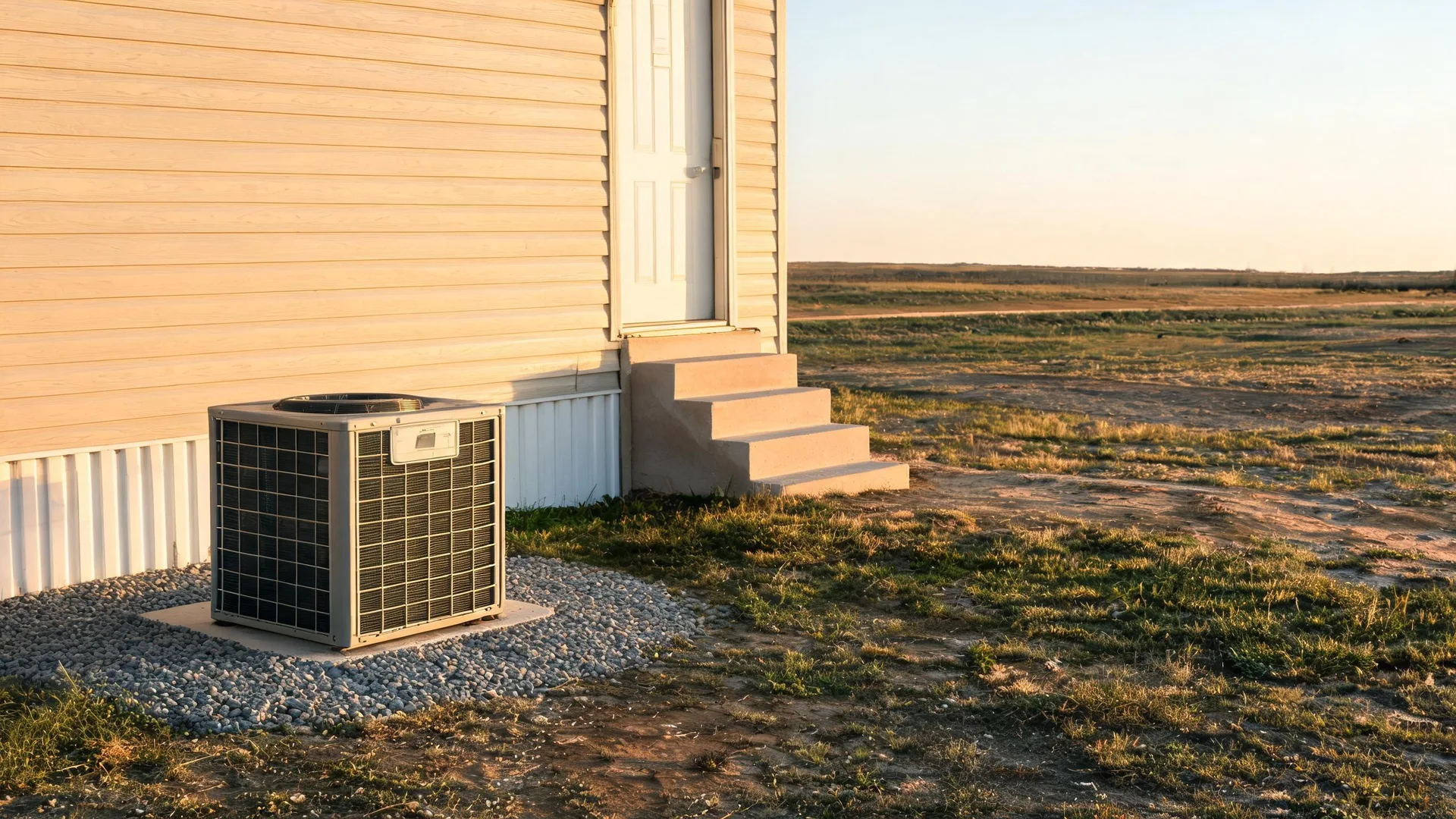
A gray residential air conditioner condenser unit mounted on a concrete pad in an open grass field.

Hours add up, and the machine tells you when they catch up with it

An AC that runs for months without a break shows its wear in specific ways. Warm air from the vents when the thermostat is set low usually points to the compressor losing strength or the refrigerant charge running low. Short cycling, where the unit kicks on and off every few minutes instead of running a full cycle, strains the compressor every time it restarts. Ice on the coil or the lines means airflow is restricted somewhere, often a dirty filter or a blower not pulling enough air through. A unit that runs constantly and never seems to catch up is working harder than it should, and that usually traces back to low refrigerant, a failing fan motor, or a coil caked with dirt. Listen for it too. A new rattle, a hum that wasn't there before, or a screech when the unit starts are all the machine telling you a part is wearing out before it fails outright.

A weak part can take out a stronger one

A failing capacitor makes the compressor pull harder to start. A dirty coil makes the compressor work harder to move heat. Run that compressor hard enough for long enough and it can burn out the windings or seize entirely, turning a cheap part swap into the most expensive repair the system has.

Ice on the coil means stop, not keep going

Once ice forms on the evaporator coil, airflow gets worse, so more ice builds, so airflow gets worse still. Running the system through that cycle pushes liquid refrigerant back toward the compressor, which isn't built to handle liquid. Shutting the unit off and calling someone beats running it until something breaks.

An outdoor air conditioning condenser unit positioned on a concrete pad next to a blue-sided house, surrounded by green shrubs and flowering hydrangeas at sunset.

A new air conditioner would cut about $40 a year off cooling for a typical Catawba County home.

  • A new one at the federal minimum, 14.3 SEER2$280 a year
  • An older air conditioner$320 a year

Estimates for a typical Catawba County home, compared with an older unit built to the previous federal minimum, from EIA household energy data, North Carolina fuel prices and NOAA climate normals. Your home will differ.

Repair makes sense when a part like a capacitor or contactor has failed.

Replacement makes sense when the compressor has failed or the system uses R-22 refrigerant, which is no longer made.

A diagnostic visit starts outside at the condenser. The tech checks the capacitor, the contactor and the fan motor, and watches whether the compressor starts clean or struggles. Refrigerant pressure gets checked at the lines, since too little charge shows up as warm air at the vents and ice on the coil. Inside, the tech pulls the filter, checks airflow at the return, and looks at the evaporator coil for dirt or frost. A set of electrical readings on the capacitor and the compressor windings tells you whether a part is still within range or on its way out. The visit ends with a straight answer: what's failing, what it takes to fix it, and whether anything else is close behind.