A white Southern-style house with a wraparound porch photographed at night, surrounded by Spanish moss-draped oak trees lit by landscape lights.

AC Repair in Greensboro, NC

Tell us about the job

Takes about a minute. No obligation.

RepairCentral ACGuilford County, NC
Step 1 of 2

What ZIP code is the job in?

Guilford County sees its share of storms

Guilford County recorded 214 severe weather events between 2015 and 2024, including 166 damaging wind events and 30 hail storms. Three tornadoes touched down in that same stretch, along with three tropical storms or hurricanes and 12 winter storms.

The outdoor unit sits outside

Hail dents fins and bends the cabinet. Wind throws branches and debris into the coil. A condenser can take a hit like that and still run, but running isn't the same as running right. If a storm has come through, it's worth having someone look at the unit even if the air coming out still feels cold.

5 months
May through September, your air conditioner is on duty
87°F
the average summer afternoon it cools against
30 hail events
in ten years, and hail bends the fins on outdoor coils
166 wind events
in ten years, and wind drives debris into outdoor units
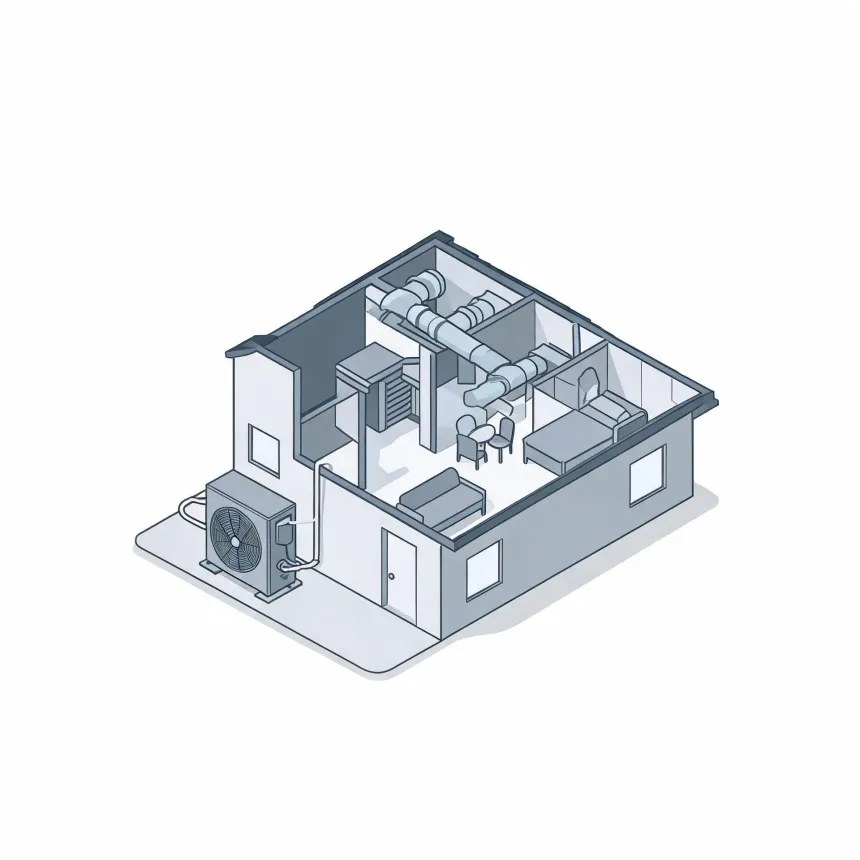
Isometric line illustration of a cutaway house showing interior rooms with furniture and ceiling ductwork, connected to an outdoor condenser unit with a fan beside the building.
Your air conditioner works hardest from June through August.

NOAA nClimDiv, 1991–2020 normals

Half the homes in Guilford County were built in 1987 or later.

A system that came with a newer house still has working life in it, and that makes repair worth a look before anything else.

Five months of 87-degree afternoons, and that's what's wearing this unit down

Cooling runs May through September
Summer afternoons average 87°F
166 damaging wind events from 2015 to 2024
May is when a weak part gives outCooling starts in May here and runs through September, and whatever didn't fail last year shows up fast once the load hits it.

A newer house usually means a newer system, and that changes what's worth doing when the AC starts acting up. A struggling unit is more likely a bad capacitor, a low charge, or a failed contactor than a system that's simply worn out. Those parts get replaced on their own without touching the rest of the unit. Before anyone talks about replacing the whole system, it's worth having a contractor check what actually failed. Half the time the fix is smaller than it looks.

If a storm came through, have the unit checked before it fails

If the outdoor unit took a hit this year, don't wait for it to stop working. A coil packed with debris or a cabinet bent from hail can run for months before it quits, and by then it's cost more than it should have. Get it looked at now, while it's still just a question.

Find a contractor
A man in a dark long-sleeve shirt and tan work pants walks up concrete steps toward an orange front door, carrying a waxed canvas tool bag in his right hand, with a potted shrub beside the gray-sided house.
An outdoor air conditioning condenser unit mounted on a concrete pad surrounded by gravel, photographed against a partly cloudy blue sky.

Five months of running is what finds the weak part

Five months a year this unit runs nearly every afternoon, and it doesn't get a break at night either once July and August settle in. That kind of stretch wears on the same parts every time, the capacitor, the contactor, the fan motor. If one of them was already weak, this is the stretch that finds it. When the unit is struggling, acting up, or short cycling, the cause is almost always a specific part, not the whole system. Getting it looked at now means whatever gave out gets replaced, and the rest of the unit keeps running.

What to check before you call

Check the thermostat is set to cool and the setting is actually below room temperature. Look at the breaker panel for a tripped breaker on both the indoor and outdoor unit, since a tripped breaker on either side will stop the system. Pull the air filter and hold it up to light. If you can't see through it, replace it before anything else, because a clogged filter can starve the system of airflow and cause it to ice up. Walk outside and look at the condenser. Clear away leaves, grass clippings or anything piled against the cabinet, and make sure nothing is blocking airflow on any side.

What tells you to stop and call

If the outdoor fan isn't spinning but you hear a humming sound, don't keep flipping the system on and off trying to get it to start. That's a sign of a failing capacitor or motor, and repeated attempts can burn out the motor completely. Ice on the indoor coil or the refrigerant line means something deeper is wrong. Turn the system off and let it thaw before a contractor looks at it, since running it iced up can damage the compressor. Any burning smell or a breaker that trips more than once means stop and get it checked rather than resetting it again.

Aerial view of a square outdoor air conditioning condenser unit on a concrete pad beside a house wall with a sliding glass door.

A new air conditioner would cut about $40 a year off cooling for a typical Guilford County home.

  • A new one at the federal minimum, 14.3 SEER2$290 a year
  • An older air conditioner$330 a year

Estimates for a typical Guilford County home, compared with an older unit built to the previous federal minimum, from EIA household energy data, North Carolina fuel prices and NOAA climate normals. Your home will differ.

Repair makes sense when a part like a capacitor or contactor has failed.

Replacement makes sense when the compressor has failed or the system uses R-22 refrigerant, which is no longer made.

A diagnostic starts outside at the condenser, with the panel off and the contactor and capacitor checked before anything is replaced. A tech will check refrigerant pressures on the gauges, check the run and start capacitors under load, and watch the contactor for pitting or burn marks. Inside, they'll check the coil for ice or buildup and check airflow off the blower, since weak airflow can look like a refrigerant problem when it isn't one. Electrical readings come next: amp draw on the compressor and fan motor, voltage at the disconnect, continuity on anything that might have failed open. None of this is guesswork. Each reading points at one part or rules it out, and the part that's actually bad is usually the only one that gets replaced.