Three white clapboard houses with wraparound porches glow with warm interior and landscape lighting beneath Spanish moss-draped oak trees at dusk.

AC Repair in Eden, NC

Tell us about the job

Takes about a minute. No obligation.

RepairCentral ACRockingham County, NC
Step 1 of 2

What ZIP code is the job in?

Rockingham County sees real storms

Rockingham County logged 209 severe weather events between 2015 and 2024, including 154 damaging wind events, 36 hail events, and 4 tornadoes. Across North Carolina, a quarter of households went at least 24 hours without power in 2024.


Your outdoor unit sits outside through all of it

Hail dents fins and bends the cabinet. Wind throws branches and debris into the coil. An air conditioner that still starts up after a storm can be running on a damaged coil or a bent fan blade, and that kind of damage gets worse the longer it runs.

5 months
May through September, your air conditioner is on duty
87°F
the average summer afternoon it cools against
36 hail events
in ten years, and hail bends the fins on outdoor coils
154 wind events
in ten years, and wind drives debris into outdoor units
Isometric cutaway illustration of a small home interior with furniture and ducting, showing an indoor air handler connected by lines to an outdoor condenser unit on a pad.
Your air conditioner works hardest from June through August.

NOAA nClimDiv, 1991–2020 normals

Your air conditioner runs from May through September here, with afternoon highs averaging 87°F through the summer.

That kind of stretch wears down parts faster, so trouble that shows up now often traces back to months of hard running.

Most AC calls in Eden come the first hot week of May

Cooling runs May through September
Climate zone 3A
Power here costs 13.32 cents per kilowatt-hour

Get a technician to actually check the unit rather than just reset it. If the problem traces back to a hard summer of running, a quick restart won't catch a coil that's already stressed or a capacitor on its way out. A proper diagnosis finds the part that's wearing thin before it quits in the middle of a hot stretch. That matters more here, where the unit runs five straight months and the afternoon heat doesn't let up. Worth asking the technician to check the outdoor unit for storm damage too, since wind and hail can leave marks that aren't obvious until the system is already under load.

Had a storm come through? Get the unit checked before it tells you itself.

If your outdoor unit took wind or hail this year, get it looked at now, even if it's still cooling the house. A bent fan blade or a dented coil doesn't always show up as a problem right away. It shows up as a bigger repair later.

Find a contractor
A man in a dark long-sleeved shirt and brown work pants carries a worn canvas tool bag up wooden porch steps toward a red-orange front door, with a potted shrub beside the entry.
An outdoor air conditioning condenser unit mounted on a concrete pad surrounded by gravel, photographed against a partly cloudy blue sky.

What to check before the service call

Before you call anyone, there are a few things worth checking yourself. Go to the thermostat first. Make sure it's set to cool and the temperature is actually below room temperature, not just sitting there. Batteries die quietly and a blank or frozen display is sometimes the whole problem. Next, check the breaker. A tripped breaker means the outdoor unit isn't getting power at all, and resetting it once is reasonable, but if it trips again, stop and leave it off. That's the system telling you something's wrong, not asking for a second try. Look at the outdoor unit itself. If the fan isn't spinning and you don't hear a hum, don't stick anything in there. Walk inside and check the air filter. A filter clogged with dust chokes off airflow, and the coil behind it can ice over when that happens. If you see ice on the indoor coil or on the copper lines running outside, shut the system off entirely and let it thaw. Running it iced up pushes liquid refrigerant back toward the compressor, and that's an expensive way to find out why you shouldn't. Last, check that the outdoor condensate line isn't blocked and that nothing is pressed up against the outdoor unit restricting airflow. None of this tells you what's actually broken. It just rules out the easy stuff before someone comes out to look at the rest.

Weak cooling means something specific

Warm air from the vents, long run times, or a house that never quite gets to temperature all point to lost capacity. That can be a refrigerant leak, a failing compressor, or a coil so dirty it can't pull heat out of the air anymore. Each one needs a different fix, but none of them get better by waiting.

Sound and smell tell you where to look

A grinding or screeching noise usually means a motor bearing is going out. A musty smell points to mold growing in the ductwork or on a coil that stays wet. A burning smell is electrical, and that one means shut it off and don't turn it back on until someone's looked at it.

Aerial view of a gray central air conditioning condenser unit on a concrete pad next to a house with vinyl siding.

A new air conditioner would cut about $40 a year off cooling for a typical Rockingham County home.

  • A new one at the federal minimum, 14.3 SEER2$280 a year
  • An older air conditioner$320 a year

Estimates for a typical Rockingham County home, compared with an older unit built to the previous federal minimum, from EIA household energy data, North Carolina fuel prices and NOAA climate normals. Your home will differ.

Repair makes sense when a part like a capacitor or contactor has failed.

Replacement makes sense when the compressor has failed or the system uses R-22 refrigerant, which is no longer made.

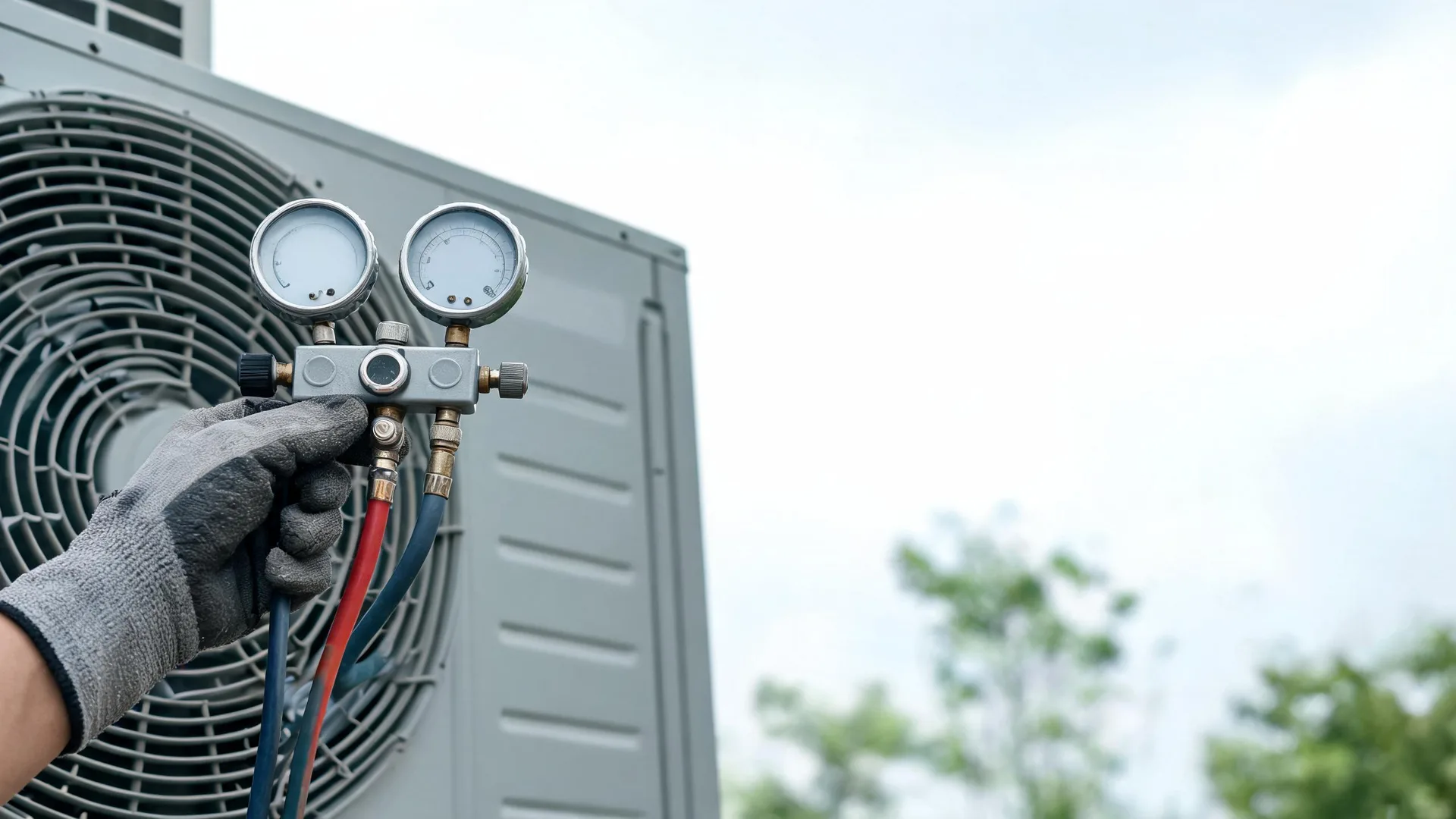
A diagnostic visit starts outside at the condenser, not inside at the thermostat. The technician checks refrigerant pressure with gauges, because that number tells them whether the system has a leak or is just dirty. They'll pull the access panel and look at the capacitor and contactor, since those are the parts that wear out from simple on and off cycling over the years. Electrical readings come next: voltage to the compressor, amp draw on the fan motor, checking that nothing is pulling more current than it should. Inside, they'll check the coil for ice or buildup and look at airflow across it, because weak airflow shows up everywhere else as a problem that looks like something bigger than it is. A good technician tells you what they found and what it means before they start replacing anything, not after.