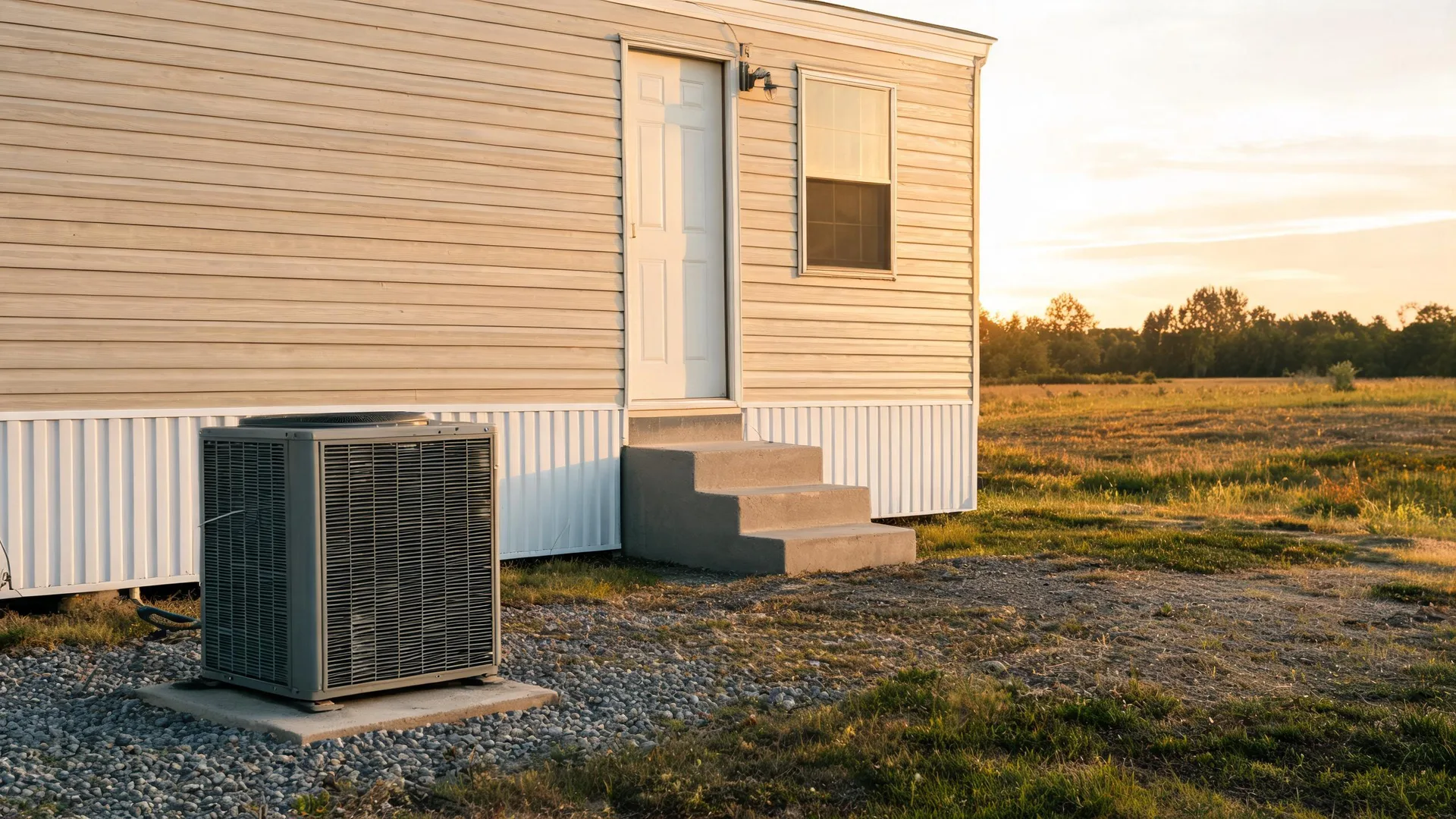
Storms come through often here
Cabarrus County logged 100 severe weather events between 2015 and 2024. That included 60 damaging wind events, 26 hail events, and 3 tornadoes. An outdoor AC unit sits outside through all of it, with no wall around it.

Takes about a minute. No obligation.
Cabarrus County logged 100 severe weather events between 2015 and 2024. That included 60 damaging wind events, 26 hail events, and 3 tornadoes. An outdoor AC unit sits outside through all of it, with no wall around it.
Hail and flying debris can dent a cabinet or bend fins without stopping the unit right away. It may still cool the house fine for weeks before the damage catches up with it. A unit that came through a storm is worth a look even if nothing seems wrong yet.

NOAA nClimDiv, 1991–2020 normals
Half the homes in Cabarrus County were built in 1997 or later.
A system that age usually still has years left in it, which makes repair the call worth checking first.



Most AC failures trace back to a handful of parts, and the capacitor is usually first. It gives the compressor and fan motor the jolt they need to start, and it weakens with age and heat until one day it can't do the job. A failing capacitor often shows up as a unit that hums but won't start, or a fan that spins slow. Refrigerant doesn't get used up, so a low charge almost always means a leak somewhere in the coil or the line set, and that leak only gets worse left alone. Motors wear out too, the fan motor outside and the blower motor inside, usually from bearings going bad after years of running. A dirty condenser coil or a blocked air filter forces every part of the system to work harder than it should, and that strain is what shortens the life of the parts above it.
If your outdoor unit took a direct hit from hail or debris this year, a storm running fine today doesn't rule that out. A bent cabinet or damaged fins can take weeks to turn into a real problem. Worth having someone check it now, while it's still just a look and not a breakdown.
Find a contractor
Before anyone comes out, a few things are worth checking yourself. Look at the thermostat first. Make sure it's set to cool and set below room temperature, and if it runs on batteries, swap them. Next, check the breaker box. A tripped breaker will shut the whole system down and it's a two-second fix if that's all it is. Go outside and look at the condenser, the unit sitting outside. If it's not running at all, check that nothing is blocking it, no leaves, no grass clippings, no plant growth crowding the cabinet. If the outdoor fan is running but the air inside isn't cold, check the air filter. A filter clogged with dust chokes off airflow across the indoor coil, and that coil can ice over when it doesn't get enough air moving through it. If you can see ice on the indoor coil or on the copper lines, shut the system off at the thermostat and let it thaw fully before anyone works on it. Running it iced up can push liquid refrigerant back to the compressor, and that's the one part in the system that's expensive to replace. Check the outdoor disconnect too, the small box mounted near the condenser. It should be pushed in all the way. None of this fixes a failed capacitor or a low refrigerant charge, but it rules out the simple stuff before anyone has to take the cabinet apart.
A system low on refrigerant will keep running if you let it, but the compressor still pulls liquid refrigerant back through the suction line while it does. That's the part that costs the most to replace, and it's not built to handle liquid. Running a low-refrigerant system for days instead of shutting it down can turn a simple recharge into a compressor job.
Once the indoor coil ices over, airflow drops to almost nothing, and the system keeps trying to cool against that blockage. Shutting it off stops things getting worse, but the ice already formed has to melt all the way before the system runs again. Switching it back on while the coil is still frozen just restarts the same cycle that caused it.
Estimates for a typical Cabarrus County home, compared with an older unit built to the previous federal minimum, from EIA household energy data, North Carolina fuel prices and NOAA climate normals. Your home will differ.
Repair makes sense when a part like a capacitor or contactor has failed.
Replacement makes sense when the compressor has failed or the system uses R-22 refrigerant, which is no longer made.
A diagnostic visit starts before the panels come off. A technician checks the thermostat call, the breaker, and the disconnect first, then watches the system run a full cycle rather than guessing from a single reading. Refrigerant pressure gets checked at the service ports, and electrical readings get taken on the capacitor and the compressor, since a capacitor can test weak long before it fails outright. The indoor coil and the outdoor condenser both get a look, because restricted airflow on either side can mimic a refrigerant problem that isn't really there. Airflow gets checked too, since a weak blower or a dirty coil can throw off every other reading taken that day. The point of all this is to find the actual failed part rather than replace things until one of them works.