






Two white Southern-style homes with wraparound porches lit by landscape lighting at night, flanked by live oak trees hung with Spanish moss.

AC Repair in Chapel Hill, NC

Tell us about the job

Takes about a minute. No obligation.

RepairCentral ACOrange County, NC
Step 1 of 2

What ZIP code is the job in?

Orange County saw 149 severe weather events between 2015 and 2024, and 121 of those were damaging wind. Twelve hail events happened in that same stretch, along with 3 tornadoes. An outdoor AC unit sits outside through all of it, exposed to whatever the wind throws or the hail drops. A unit can take a hit and keep running for weeks before the problem shows up as a refrigerant leak or a bent coil that's lost its efficiency. If your system went through a storm with hail or flying debris, it's worth having it looked at even if it's still cooling the house fine right now.

5 months
May through September, your air conditioner is on duty
87°F
the average summer afternoon it cools against
12 hail events
in ten years, and hail bends the fins on outdoor coils
121 wind events
in ten years, and wind drives debris into outdoor units
Isometric cutaway illustration of a single-story house with a dark shingled roof, showing interior rooms with ductwork and an indoor air handler connected to an outdoor condenser unit beside the building.
Your air conditioner works hardest from June through August.

NOAA nClimDiv, 1991–2020 normals

Cooling starts up again in May here.

A weak part that made it through last September often fails in the first hot week, not the last.

Half the homes here were built in 1990 or later, so the system is often still worth fixing

Half the homes here were built by 1990
Climate zone 3A
Power here costs 14.15 cents per kilowatt-hour

If your AC is giving you trouble, a repair call is the right place to start before you think about replacing anything. A system installed with a newer house usually still has years of working life in it, and a failed capacitor or a bad run of refrigerant doesn't mean the unit is done. Have the contractor check the part that's actually failing rather than pricing out a new system first. If your house came with the unit, the permit or install date is usually on a sticker inside the cabinet, and that will tell you more than guessing by the home's age.

If your AC took a hit this year, have it checked before summer does the rest

If your unit sat through hail or wind this year, get it looked at before you call it fine. A storm can leave a leak or a bent coil that won't show up as a problem for weeks. A quick check now tells you which one you're dealing with.

Find a contractor
A man in a cap, gray long-sleeved shirt and tan work pants, seen from behind, carries a canvas tool bag up steps toward an orange front door of a gray clapboard house, with a potted shrub to the right.
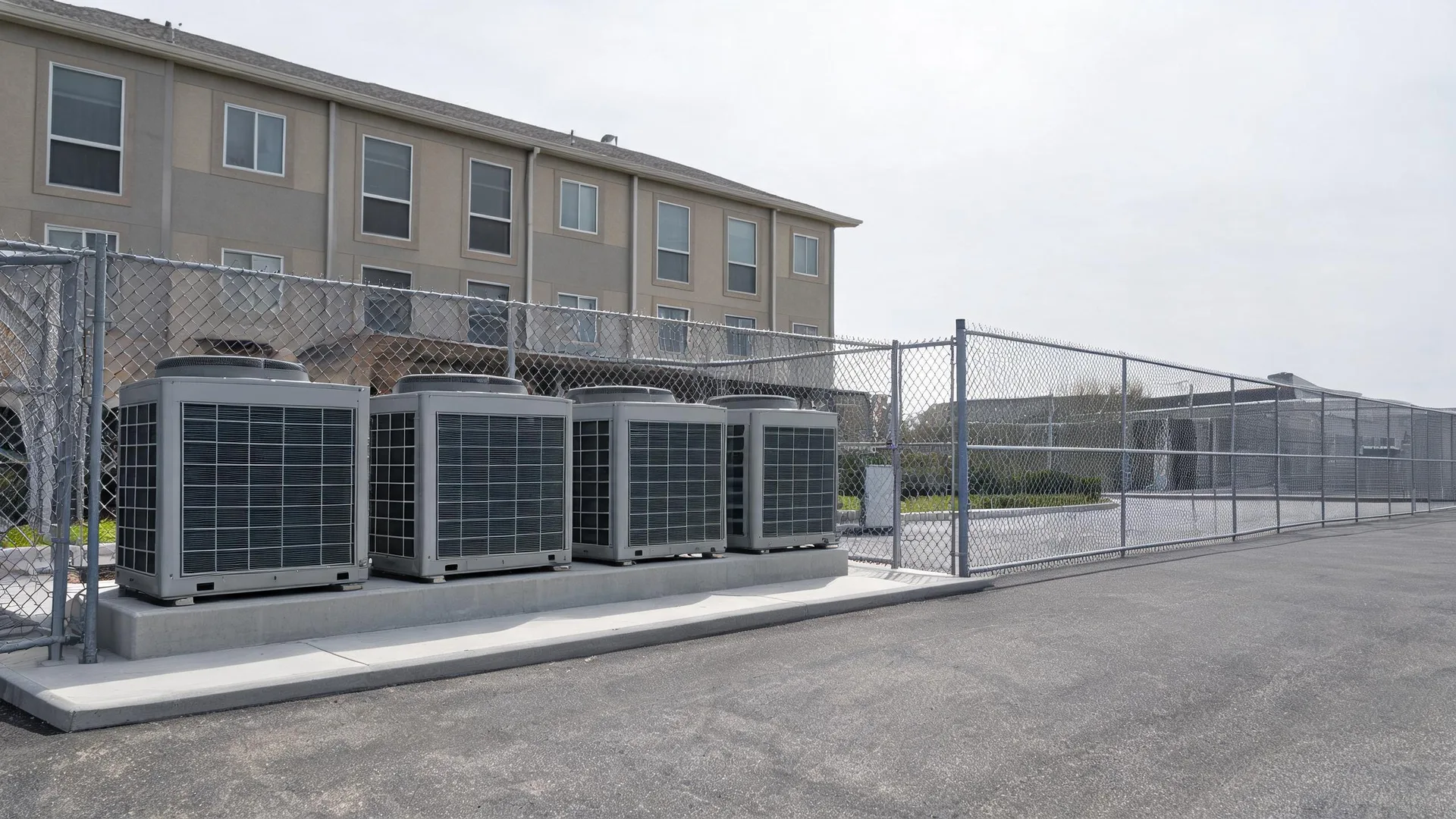
A gray metal air conditioning condenser unit mounted on a concrete pad in a flat grassy field under a partly cloudy sky.

What you can check yourself first

Before you pick up the phone, there are a few things worth looking at yourself. Check the thermostat first. Make sure it's set to cool, set below room temperature, and has power or fresh batteries if it runs on them. Next, go to the breaker panel and check whether the breaker for the outdoor unit has tripped. If it has, reset it once. If it trips again, stop and call someone, because that's telling you there's a short or an overloaded part, not a fluke. Look at the outdoor unit itself. If the fan isn't spinning and you don't hear any hum at all, that's different from a unit that hums but doesn't start, and worth mentioning to whoever comes out. Check the air filter. A filter clogged with dust chokes off airflow across the indoor coil, and that coil can ice over when it doesn't get enough air moving across it. If you can see ice on the indoor coil or on the refrigerant lines, turn the system off at the thermostat and let it thaw fully before anyone touches it, because running it iced up can damage the compressor. Walk around the outdoor unit and clear away leaves, grass clippings or anything stacked against it. The coil needs open air on all sides to shed heat. None of this tells you exactly what's wrong, but it rules out the simple stuff and gives the contractor a clearer starting point.

A refrigerant leak gets worse while the compressor keeps running

A compressor is built to pump refrigerant, not air. When the charge is low, it runs hotter and pulls less lubricant with it on each cycle. Keep it running and the compressor can score its internal parts or burn out the windings, turning a leak repair into a compressor replacement.

A frozen coil needs to thaw, not run harder

Once ice forms on the indoor coil, airflow across it drops even more, so the system freezes further instead of catching up. Running it this way floods the compressor with liquid refrigerant it was never meant to handle. Shutting the system off and letting the coil thaw fully is what keeps a bad afternoon from becoming a bad compressor.

Aerial view of a gray central air conditioning condenser unit on a concrete pad next to a house with vinyl siding.

A new air conditioner would cut about $40 a year off cooling for a typical Orange County home.

  • A new one at the federal minimum, 14.3 SEER2$290 a year
  • An older air conditioner$330 a year

Estimates for a typical Orange County home, compared with an older unit built to the previous federal minimum, from EIA household energy data, North Carolina fuel prices and NOAA climate normals. Your home will differ.

Repair makes sense when a part like a capacitor or contactor has failed.

Replacement makes sense when the compressor has failed or the system uses R-22 refrigerant, which is no longer made.

A repair decision usually comes down to what failed and what it's connected to. A capacitor, a contactor, a fan motor, these are parts that fail on their own and get replaced on their own, regardless of the age of the system around them. A compressor is different. It's the most expensive part in the unit, and when it fails, the labor to replace it often costs nearly as much as the part itself, so a contractor will usually walk you through whether that money is better spent on a new system. The refrigerant type matters too. Older systems used a refrigerant that's being phased out, and if yours needs a recharge, that refrigerant can be hard to find and priced accordingly. None of this means an old system is a lost cause or a new one is always smarter. It means the part that failed, and what it would take to fix it, tells you more than the age of the unit by itself.