A single-story brick house with a dark shingled roof set behind a lawn, framed by pine trees and a large spreading oak, photographed from a low angle with blurred grass in the foreground.

AC Installation in North Wilkesboro, NC

Tell us about the job

Takes about a minute. No obligation.

New system or replacementCentral ACWilkes County, NC
Step 1 of 2

What ZIP code is the job in?

Weather here does damage

Wilkes County logged 194 severe weather events between 2015 and 2024. That includes 147 damaging wind events, 22 hail storms, 6 tornadoes and 11 winter storms with heavy snow or ice. An outdoor condenser sits outside through all of it.


The power doesn't always hold

A quarter of North Carolina households went at least a full day without power in 2024. For a new system, that means thinking past the unit itself, toward what keeps the house heated and the water hot when the grid goes down.

4 months
June through September, your air conditioner is on duty
85°F
the average summer afternoon it cools against
22 hail events
in ten years, and hail bends the fins on outdoor coils
13.4 SEER2
the federal minimum any new unit must meet
Isometric cutaway illustration of a single-story house showing interior rooms with ductwork and an air handler, connected by refrigerant lines to an outdoor condenser unit on the left.
Your air conditioner works hardest from June through August.

NOAA nClimDiv, 1991–2020 normals

June starts the cooling season in Wilkes County.

Get the install done in May, before the heat and the storm season both arrive.

Most homes here run on electric heat, so your AC install should match what the house already runs on

73.5% of homes heat with electricity
Cooling runs June through September
Summer afternoons average 85°F

Wilkes County falls under zone 3A in the 2021 energy code, warm with a long cooling season and sticky summers. Any split-system AC installed here has to hit at least 14.3 SEER2 if its capacity is under 45,000 Btu an hour, or 13.8 SEER2 at or above that. That's higher than the 13.4 floor the rest of the country can install to. The standard applies at installation, not just manufacture, so the unit going on the house has to meet the regional number, not the national one. It narrows what a contractor can offer you here compared to a cooler zone, and it's worth asking which standard a quoted system actually meets.

Pick where the unit sits and how you'll stay warm without it

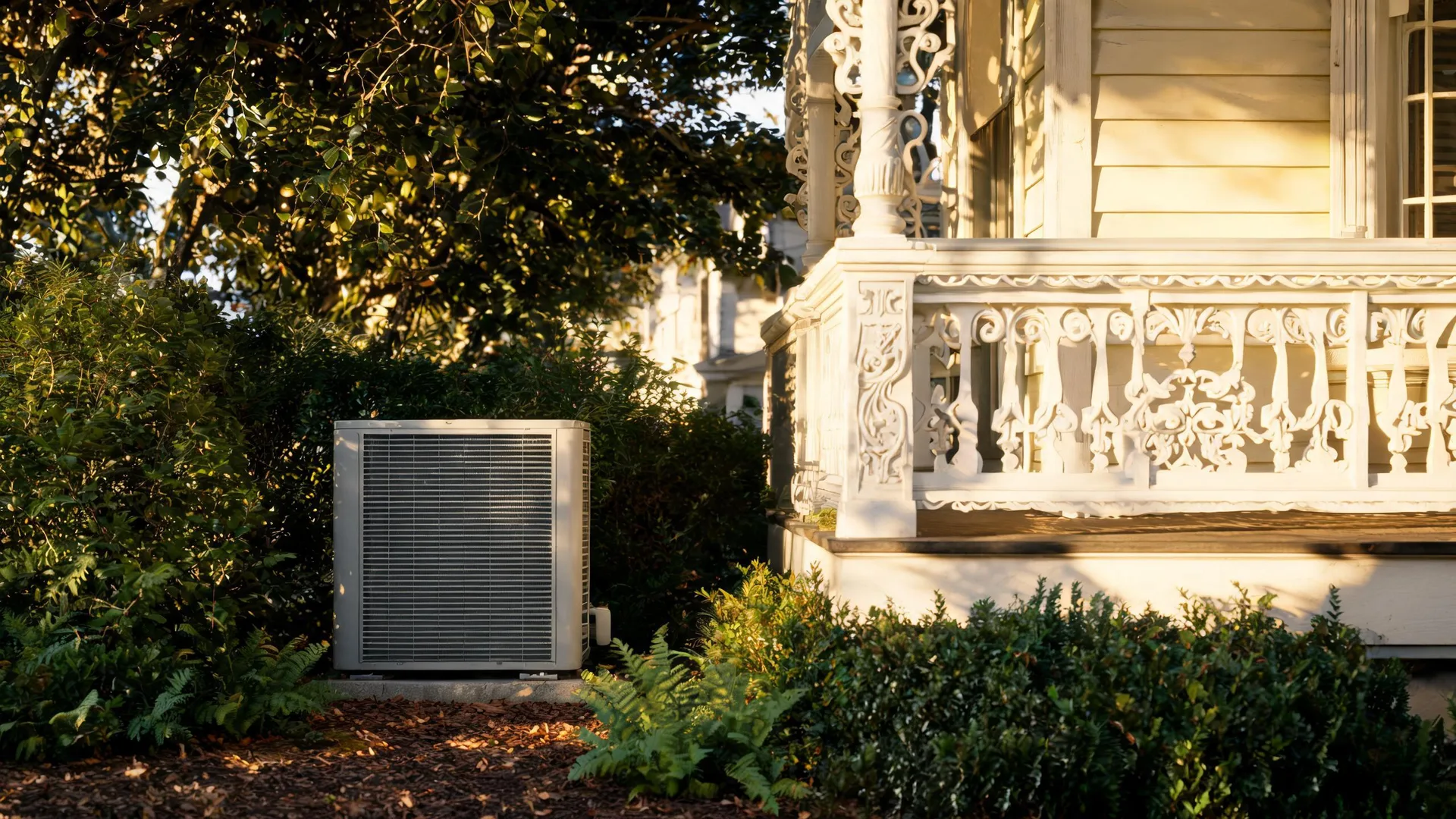
Ask the contractor to place the condenser where wind and falling limbs are less likely to reach it, and what guard goes over it. Ask what runs the furnace and water heater if the power is out for a day. That's the plan worth having before install day, not after a storm.

Find a contractor
A gray residential air conditioner condenser unit mounted on a concrete pad in an open grass field.

The number on the label only holds up if the install backs it

The SEER2 number on the label tells you how much cooling you get out of the power you put in, averaged over a season of starts, stops and partial loads rather than one lab moment. A higher number means the compressor and the coil are doing more with the same draw. That rating only holds if the system is sized and installed right. An oversized unit cycles on and off before it ever settles into the steady run where it earns that number. A low charge or a coil choked with dirt pulls the real number down no matter what the label says. The rating also assumes the ductwork is moving the air it was designed to move. Leaky or undersized ducts make a high-efficiency unit work like a cheaper one, because the compressor is doing the work and the duct is losing it. So the label is a starting point, not a promise. What the installer does with sizing, charge and airflow decides whether the house actually gets what the rating says it should.

Ask what size the load calculation came out to

A contractor should run a room-by-room load calculation on the house, not just measure the old unit and match it. Square footage alone doesn't tell you what size system to install. Window count, insulation and ceiling height all change the number. An oversized system cools the air fast but shuts off before it pulls moisture out, so the house feels clammy even at the right temperature. An undersized one runs constantly and never catches up on the hottest days. Ask for the actual number, not a guess based on the last unit.

Ask what happens to the ductwork, not just the condenser

A new condenser and air handler can only move the air the ducts let them move. If the existing ducts are leaky, crushed, or sized for a different system, a high-efficiency unit won't perform like one. Ask whether the installer is testing the ductwork or just assuming it's fine. Ask what static pressure the system will run at and whether the ducts were sized for this unit's blower. The equipment is half the job. The duct system carrying its air is the other half.

Overhead view of an outdoor AC condenser unit on a concrete pad next to a house with a dark shingle roof.

Going above the federal minimum saves little here, about $10 a year.

  • A higher-efficiency unit$200 a year
  • A new unit at the federal minimum, 14.3 SEER2$210 a year

Estimates for a typical Wilkes County home, from EIA household energy data, North Carolina fuel prices and NOAA climate normals. Your home will differ.

Installation starts before anyone touches the old unit, with a walkthrough to confirm what was quoted still matches the house. The old condenser and air handler come out first. If the line set or ductwork is being reused, the crew checks it for leaks and damage before tying in new equipment to it. Setting the new condenser means leveling the pad and making sure there's clearance around it for airflow. Inside, the air handler or furnace coil gets set, the line set gets connected, and the system is pressure tested before anyone adds refrigerant. Once it holds pressure, the system gets charged to the manufacturer's spec and the crew checks static pressure and airflow at the vents rather than just listening for the compressor to kick on. A thermostat gets wired and programmed last, and the whole system runs through a cycle or two while someone checks temperatures at the supply and return before calling the job done.