Profile view of a bearded man wearing a black baseball cap and a dark gray t-shirt against a plain white background.

AC drain line clogging in sticky North Carolina summers

Tune-up, service, or cleaningCentral ACNorth Carolina
Step 1 of 2

What ZIP code is the job in?

Why does my AC drain line keep clogging in the summer?

Your AC runs almost nonstop through the long North Carolina summer, and that means the drain line is working just as hard. If it clogs once, there's a good chance it'll clog again before fall, often right when you're relying on the system the most.

Algae and mold grow in the drain line and keep building back up

The condensate drain line carries away the water your AC pulls out of the air, and in a humid climate that line stays wet almost all the time. Algae, mold and fine dirt collect along the inside of the pipe, and that buildup narrows the path until water backs up instead of draining. Because the coil keeps producing condensate every time the system runs, a line that clogged once has the same conditions that caused it the first time, so it tends to clog again unless something changes inside the pipe itself. With a North Carolina summer running the AC for months at a stretch, that buildup has far more time to grow than it would somewhere drier or cooler.

A gray outdoor air conditioning condenser unit on a concrete pad beside a house with horizontal lap siding, with a wall-mounted electrical disconnect box and refrigerant lines, shrubs, mulch and lawn around it.

Drain line clear

Water moves through the line and out the end, away from the house. No musty smell near the vents, no water stain creeping across the ceiling below the air handler. The pan stays dry. This is what you want to see every time you check the unit on the side of the house.

An outdoor air conditioner condenser unit on a concrete pad beside a house wall with stucco lower section, horizontal siding above, and a white downspout to the right.

Drain line clogged

Algae and dirt have blocked the line, so condensate backs up into the pan and the unit shuts itself off to keep from flooding. You come home to a house that's warm and sticky, sometimes a drip stain on the ceiling or a puddle by the indoor unit. The grime on this one didn't happen overnight.

A smiling woman with long dark hair in a gray sweater sits behind a white countertop holding a glass of red wine, with a dimly lit living room and dark kitchen island in the background.
A woman in a beige knit sweater with her hair up laughs while looking to the side, seated in a dimly lit living area with a sofa, windows and a kitchen counter behind her, a glass of red wine in the lower right foreground.
A woman in a black sweater laughs while seated at a light stone counter with a glass of red wine, in a dimly lit living and dining room with bookshelves, a table lamp and framed artwork behind her.
A smiling woman with long dark hair in a beige sweater sits at a granite counter with a glass of red wine, with a living room, fireplace and dining area behind her.

Your coil pulls moisture out of the air all summer, and that water has to go somewhere. It drips into a pan, then down a PVC line that slopes out to the side of the house. Nothing pumps it. Gravity does the work, so the pipe has to stay open its whole length. The trouble starts because that line is wet and dark for months at a stretch, which is exactly what algae needs to grow. As it builds up on the pipe wall, it catches dust and lint coming off the air handler, and the opening narrows until water backs up instead of draining. Some systems catch this before it becomes a mess inside the house. A second pan sits underneath with its own float switch, and if water starts pooling there, it cuts power to the AC rather than let the pan overflow. That switch tripping is often the first sign anyone notices. The clearing itself only buys time. Once algae has a foothold, it tends to come back faster than it did the first time.

How the drain line actually clogs

  • Warm, humid air moves across the evaporator coil and leaves condensation that drips into a pan underneath it.
  • That pan feeds a PVC drain line, usually sloped so gravity carries the water out to the exterior.
  • Algae and mold grow inside the line because it stays wet and dark most of the summer, and that buildup narrows the pipe.
  • Dust and debris from the air handler settle into that slime and gradually build a plug near the trap or the outdoor opening.
  • Many systems have a second, backup drain pan with its own float switch that shuts the AC off if the main line backs up.
  • Once algae gets a foothold in the line, it regrows faster after each clearing unless something changes about how often it's cleaned.
A gray outdoor air conditioning condenser unit on a composite pad beside a house with horizontal lap siding, with a wall-mounted disconnect box, refrigerant lines, and a wooden fence and shrubs to the left.
The condenser sits on its pad, lines and conduit running up the wall, doing nothing unusual.
An outdoor air conditioning condenser unit on a concrete pad beside a house with light vinyl siding, with electrical conduit running to a wall-mounted disconnect box and a shrub in mulch to the right.
Water is still draining the way it should, so the unit outside just keeps running.
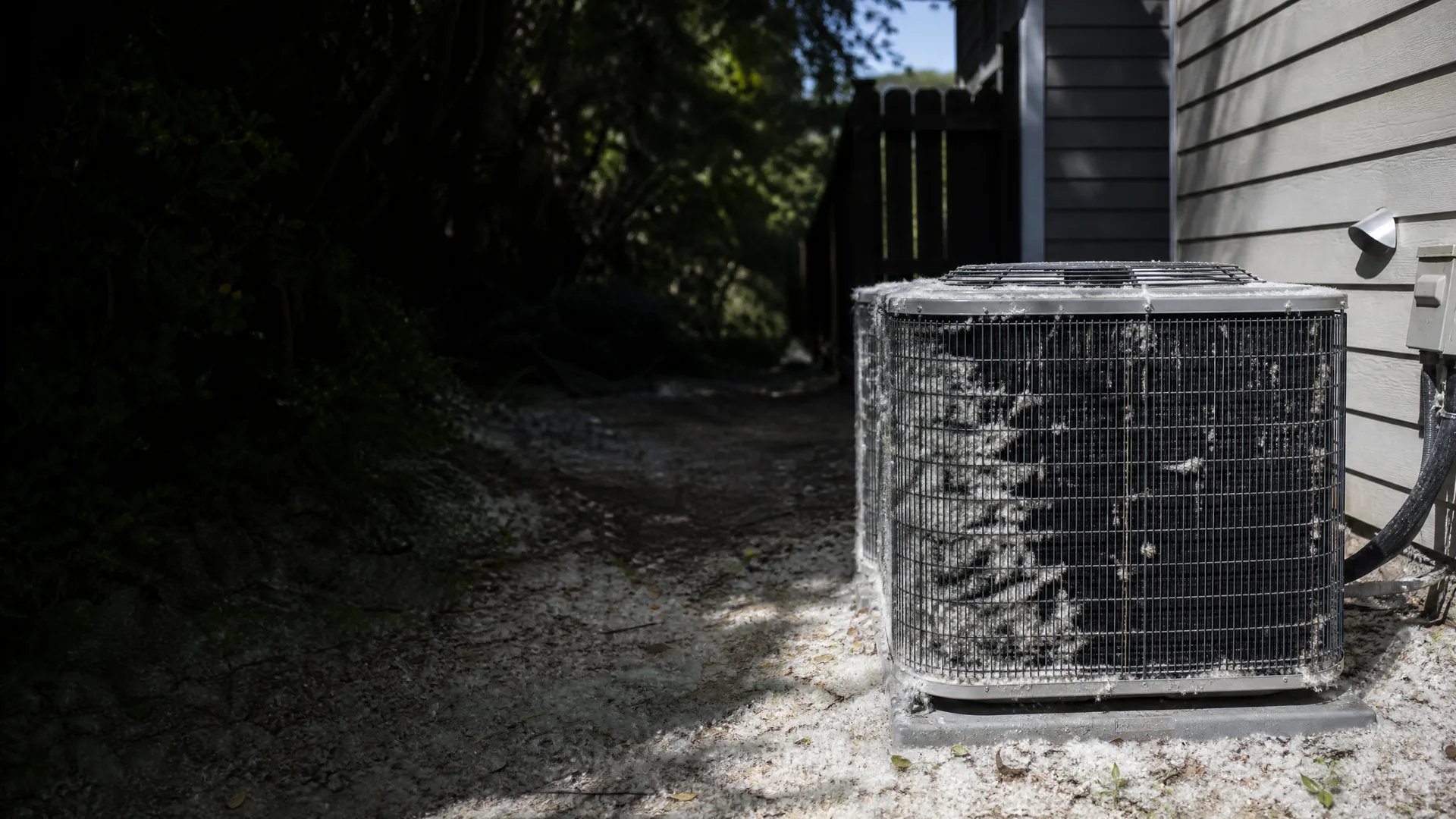
An outdoor air conditioner condenser unit covered in white foam-like debris sits on a concrete pad beside a light-colored lap-sided house, with white flecks scattered on the ground and dark trees and a wooden fence behind.

You walk out to the side yard in late May to grab the hose, and the condenser catches your eye. The fins are packed with white fluff, cottonwood drifting off the trees all week and settling against the coil. You didn't notice it happening. It just built up, day by day, while the unit ran through another sticky afternoon. You brush some off with your hand and it comes away gray with dust underneath. Inside, the drain line is doing its own version of this, just out of sight. You make a note to look at the pan under the air handler before you forget again, and head back inside out of the heat.


Describe it once

A licensed local pro takes the request for your air conditioner tune-up.

Asking costs nothing, and the choice to hire stays yours.

Why algae grows faster here

A North Carolina summer keeps the coil wet for months at a time. Warm air holds more moisture than cool air, so the longer the AC runs, the more condensation drips into that pan and down the line. Algae needs standing moisture to grow, and a line that's wet from April through October gives it exactly that. In a drier climate, the line gets a chance to dry out between cycles. Here, it often doesn't. That's the difference between a clog you deal with once a year and one that keeps coming back before the season's over.

What a float switch does

Many systems have a float switch sitting in the drain pan or the line itself. When water backs up past a certain point, the switch shuts the AC off before the pan overflows onto the floor or ceiling below. It's a safety device, not a fix. If the switch trips, the clog is still there, and the system won't run again until the line is cleared. A contractor who services this equipment regularly checks that switch along with the line itself, since a clog that trips it once usually isn't the last one.

A smiling man with curly graying hair and a dark knit sweater sits at a candlelit dinner table with a glass of red wine, a water glass and a bowl of salad in the foreground, in a dimly lit room with a lamp, framed picture and window behind him.
A woman in a cream knit sweater reclines on a gray sofa with her eyes closed and a slight smile, covered by a fleece blanket with a closed book on her lap, a lit table lamp and potted plants behind her.

Checked each spring

A technician flushes the line and checks the pan before algae has a chance to build up. You go into summer with a line that's already clear.

Fill out one form

Left alone until it backs up

The line clogs sometime in July or August, water backs up into the pan, and you're dealing with a shutoff switch or a ceiling stain instead of a quick flush.

Fill out one form

Power costs 14.00 cents per kilowatt-hour statewide

At 14 cents a kilowatt-hour, a clogged drain line costs you twice. The backup can trip the float switch and shut your AC down, and whatever runs after that is working against a system that was never clean to begin with. Keeping the line clear keeps your cooling bill tied to the weather, not to algae in a pipe.

EIA-861 2025 statewide residential average

You can keep checking the pan yourself every few weeks, pouring vinegar down the line and hoping it's enough to keep the algae from taking hold before the next stretch of hot, wet days.

Or someone local who deals with this exact line in this exact climate every summer can flush it properly each spring, before the water finds somewhere else to go.

An outdoor air conditioning condenser unit sits on a concrete pad beside a house with horizontal vinyl siding, with a gray electrical disconnect box and insulated refrigerant line on the wall above, surrounded by bare mulched ground.
Before you get your air conditioner maintenance
A gray outdoor air conditioning condenser unit sits on a concrete pad beside a house with horizontal siding, connected by insulated lines to a wall-mounted disconnect box, with a shrub and gravel bed to the right.
After you get your air conditioner maintenance

A clogged drain line is a maintenance problem, and it stays fixed once someone checks it on a schedule instead of waiting for the pan to overflow. That's what AC maintenance in North Carolina needs to cover every spring, before the coil starts sweating for months straight. You don't need a handful of companies competing for the job or a string of calls to explain the same line, the same pan, the same algae problem over and over. One licensed contractor near you, someone who works on this equipment all summer and knows this line clogs here faster than it does most places, handles the diagnosis and the fix. You check the pan less, worry about the float switch less, and the next stretch of hot, wet days doesn't turn into a ceiling stain or a dead AC on the hottest week of July. That's where this ends: a clear line, a dry pan, and a system that keeps running the way it's supposed to through the rest of the summer.

A covered porch with a wood front door with six upper glass panes, a lantern wall sconce, tapered column on a stone base, potted ferns and flowers, a woven doormat, and wide steps leading to a paver walkway bordered by shrubs and white hydrangeas.
A beige upholstered sofa with a cream cushion and chunky knit throw sits beside a white-framed window, with a leafy potted plant in a stone vase against a tan wall.
Sunlit corner of a room with a linen curtain beside a window, built-in shelves holding ceramic vases, wooden bowls, a potted green plant, stacked books and a woven basket, above a textured rug.
A dark wood three-drawer dresser against a pale wall holds a tall ceramic vase with leafy branches, stacked books and a shallow bowl, with a framed print above, a woven basket on the wood floor at left, and an upholstered sofa with a green pillow in the foreground.
A cream upholstered sofa with a textured ivory cushion and a rust-colored cushion sits beside a window with sheer linen curtains, with a potted leafy plant behind it and a wooden bowl on a wood table in the foreground.

One form, no calling around

Your request goes to one pro, not a list of companies.

Skip the search

Sending the form costs nothing.