





A row of single-story houses with porches, one brick and others with pale siding, behind a trimmed hedge and lawn, under oak branches draped with Spanish moss.

Heat Pump Repair in Clayton, NC

Tell us about the job

Takes about a minute. No obligation.

RepairHeat PumpJohnston County, NC
Step 1 of 2

What ZIP code is the job in?

Johnston County saw 202 severe weather events between 2015 and 2024, and most of that was wind. A heat pump's outdoor unit sits right in the path of it, exposed to hail and flying debris in a way nothing inside your house is. It can take a hit and keep running for months before the damage shows up as a refrigerant leak or a bent coil that cuts into airflow. If your unit has been through a storm, it's worth having someone look at it even while it's still keeping the house comfortable.

7 months
October through April, your system heats
5 months
May through September, it cools
33°F
the average winter night it heats against
89°F
the average summer afternoon it cools against
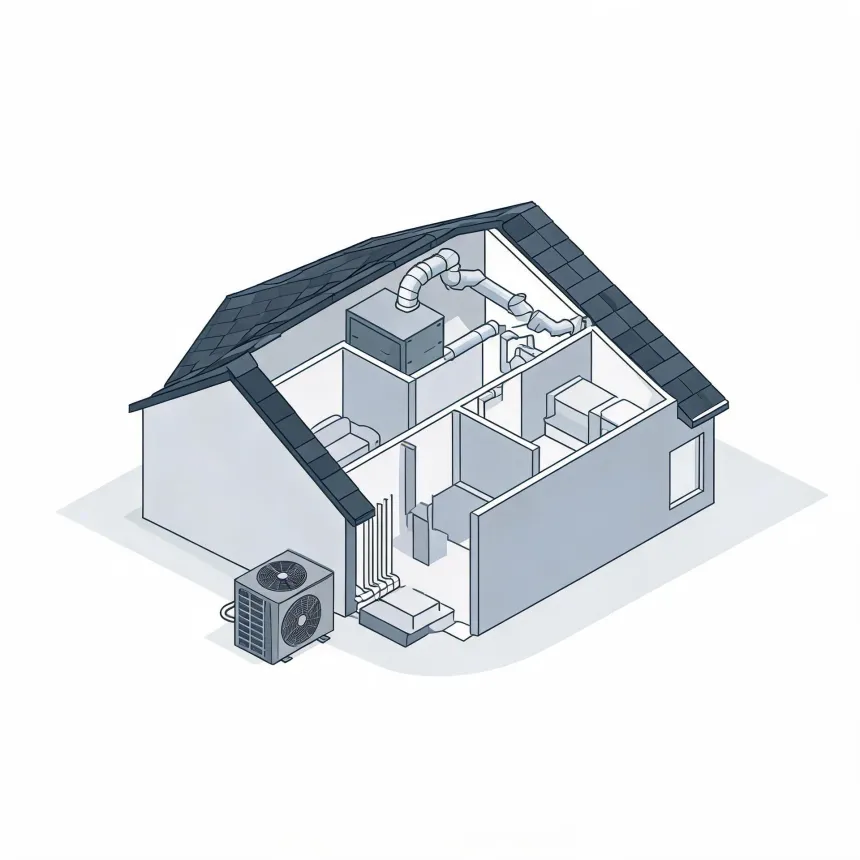
Isometric line illustration of a cutaway house showing interior rooms, an air handler with ductwork in the attic space, and an outdoor condenser unit beside the exterior wall.
Your system heats October through April and cools May through September.

NOAA nClimDiv, 1991–2020 normals

September is the month before heat runs here.

A weak part that made it through summer on the outdoor unit often fails once the heat pump switches over and carries the load for the house.

Half the homes in Johnston County were built in 2000 or later

Half the homes here were built by 2000
164 damaging wind events from 2015 to 2024
Power costs 14.13 cents a kWh statewide

A newer heat pump is a heat pump worth fixing

If your heat pump came with a newer build, it's likely still within its working life. A repair gets it back to doing its job, no need to think about replacement yet.

Find a contractor
A man in a dark shirt and tan pants, seen from behind, carries a canvas duffel bag up porch steps toward an orange front door beside a potted shrub.
A white mini-split heat pump outdoor unit mounted on a concrete pad beside a gray-sided house, surrounded by gravel and green shrubs.

What to check before the tech gets there

Before anyone comes out, walk outside and look at the outdoor unit. Check that nothing is blocking the sides, no leaves packed against the coil, no bush grown in too close. Airflow in and out of that unit matters as much as anything inside the house. Look at the fan on top and see if it's bent or wobbling. Check the line set, the pair of copper lines running to the house, for a crushed section or frost sitting on it when it shouldn't be there. Inside, change the air filter if it's dirty. A clogged filter starves the system and can look like a much bigger problem than it is. Check the thermostat is set to heat and the batteries aren't dead. At the breaker panel, make sure the breakers for the heat pump and the air handler haven't tripped. None of this fixes a bad compressor or a refrigerant leak, but it rules out the easy things first, and it gives the tech a clearer picture of what they're walking into.

A low charge gets worse with every cycle

A heat pump low on refrigerant doesn't just run weak. The compressor still tries to pump a full cycle through a system that's short, and it runs hotter doing it. Run it that way long enough and the compressor itself wears out, which turns a refrigerant leak into a compressor replacement.
A frozen coil can take the blower with it

A coil icing over, whether from low airflow or a refrigerant problem, blocks the unit from doing its job. Keep it running and the ice just builds. Liquid refrigerant can end up heading back to the compressor instead of turning to gas like it should, and that's the kind of thing that ends a compressor's life early.

A heat pump runs in both directions, and the reversing valve is what switches it between heating and cooling. When that valve sticks, the unit can blow cold air when it should be heating or get stuck in one mode no matter what the thermostat says. The outdoor fan motor takes a beating too, since it runs through every cycle in every season and sits right out in the weather. Contactors and capacitors wear from the start and stop cycling that any compressor goes through, and a heat pump cycles more than a system that only runs part of the year. None of this is something to diagnose by ear. A tech working on a heat pump checks the reversing valve, the fan motor, and the electrical parts together, because trouble in one spot often shows up as a symptom somewhere else.

A repair makes sense when the unit is still doing its job most of the time and what's failed is one part, like a capacitor, a contactor or a fan motor. Those are normal wear items. Replacing one doesn't say anything bad about the rest of the system. Replacement starts to make more sense when the compressor has failed, since that's the most expensive part in the unit and the labor to get at it is involved either way. It also makes sense when a tech keeps getting called out for different problems on the same unit, one thing fixed and another going a few months later. A unit that's been reliable for years and has one clear failure is usually worth fixing. A unit that's been nickel and diming you for a while is telling you something different.