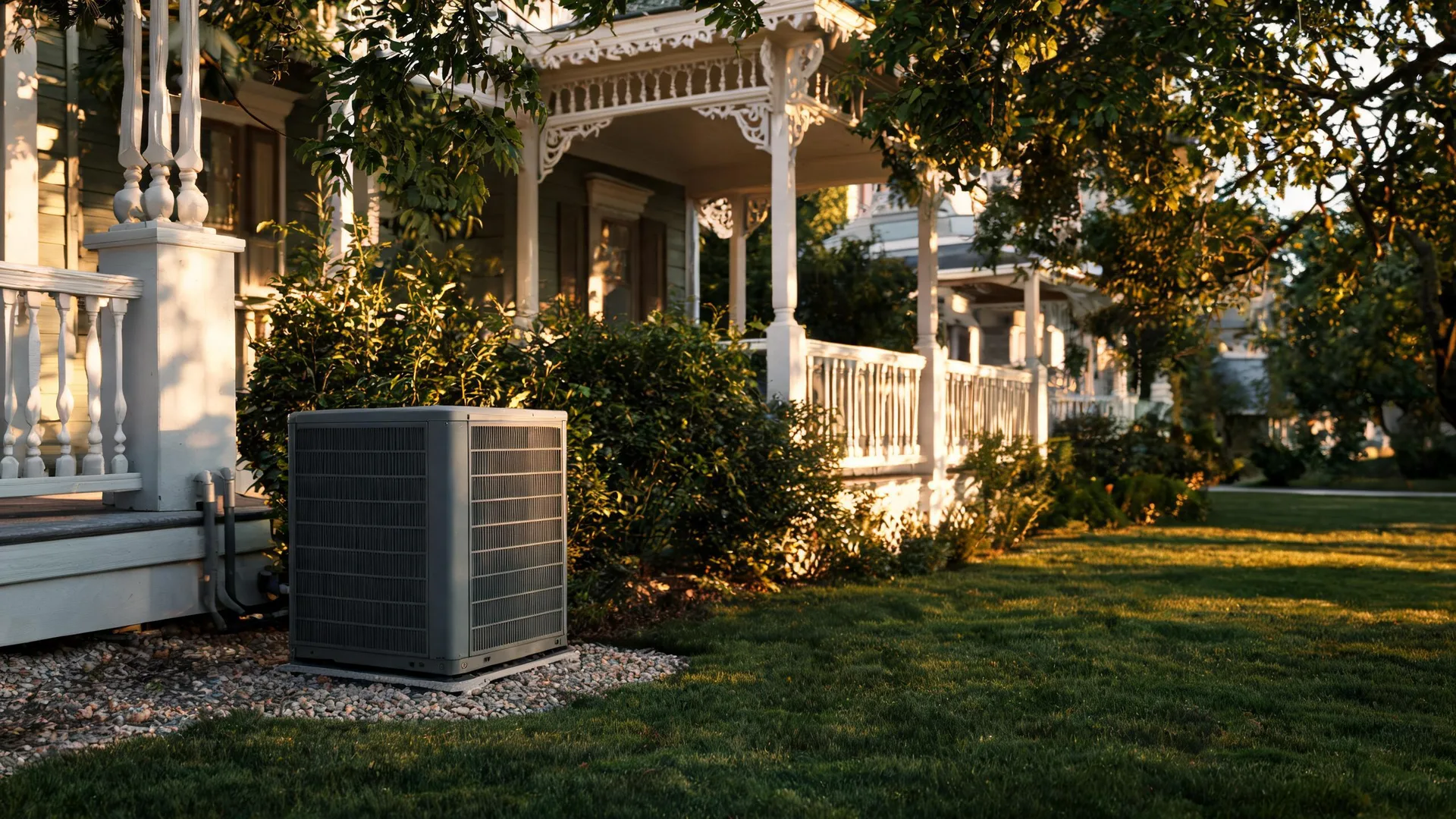
An outdoor air conditioning condenser unit installed beside the exterior wall of a blue vinyl-sided house at sunset.

AC Maintenance in Siler City, NC

Tell us about the job

Takes about a minute. No obligation.

Tune-up, service, or cleaningCentral ACChatham County, NC
Step 1 of 2

What ZIP code is the job in?

Electricity in Chatham County ran 14.86 cents per kilowatt-hour in 2025. A dirty coil or a low charge makes the compressor work harder to hit the same temperature, and that extra work shows up on the meter. A system due for a tune-up doesn't fail outright, it just quietly pulls more power than it needs to. In a place where the rate per kilowatt-hour already runs what it does, that difference matters more than it would somewhere cheaper. A unit running clean and charged right is doing the same job for less.

5 months
May through September, your air conditioner is on duty
88°F
the average summer afternoon it cools against
12 hail events
in ten years, and hail bends the fins on outdoor coils
125 wind events
in ten years, and wind drives debris into outdoor units
Isometric cutaway illustration of a house showing interior ductwork, an air handler and furnace unit, and an outdoor condenser connected by lines outside the wall.
Your air conditioner works hardest from June through August.

NOAA nClimDiv, 1991–2020 normals

Half the homes in Chatham County were built in 1998 or later.

A system that age still has years ahead of it, and a yearly check is what keeps it running cheap instead of just running.

A yearly check is what gets those years out of it

Half the homes here were built by 1998
Cooling runs May through September
Summer afternoons average 88°F
Five Months of WorkCooling season here runs May through September, with afternoon highs averaging 88°F.

May is when this starts, and it starts all at once. Cooling in Chatham County runs May through September, five months of the compressor working most days. A system that's been sitting since last September doesn't ease into that, it just starts carrying the load. Get the check done in April and whatever's dragging on it gets found before the first hot stretch asks the unit to do more than it should. Push it past April and the unit is already working the job while any problem sits unfound.

A clean, charged system costs less to run all summer

A tune-up gets a unit pulling only as much power as the job actually takes, instead of quietly running up the meter all summer. Have it checked before the compressor settles in for five straight months of work.

Find a contractor
A man in a cap, dark long-sleeve shirt and tan work pants walks up wooden porch steps toward an orange front door, carrying a canvas tool tote; an orange planter with ornamental grass stands to the right.
A gray residential air conditioning condenser unit mounted on a concrete pad outdoors, surrounded by green grass under a partly cloudy blue sky.

What a Dirty Filter Does Downstream

The filter is the first thing in the system's way, and it's the part most people forget. Air has to pull through it every time the system runs, and once it loads up with dust, the whole system has to work harder to move the same air. That strain lands on the blower motor first, then shows up at the coil behind it.

The coil is where the heat actually leaves the air, and it can only do that if air moves freely across it. Dust that gets past a dirty filter settles there too, and a coated coil can't shed heat the way a clean one does. The system ends up running longer to reach the same setting, and parts that were built to cycle on and off end up running closer to the whole time.

The drain line carries off the water that condenses on that coil, and it's a narrow path. Algae and sludge build up in there over time, same as any drain that stays damp. When it clogs, the water has nowhere to go but back up and out of the pan, usually right where it can reach the ductwork or the floor below. A system can be running fine and still cause damage through a clogged drain alone.

None of these three wear out on their own schedule. They clog and coat and build up quietly, and the system keeps running while it happens, just not the way it's supposed to.


What a Real Tune-Up Checks

A thorough visit means the panel comes off and the capacitor gets tested under load, not just looked at. The refrigerant charge gets checked against what the system actually calls for, with gauges, not guessed at. The condenser coil gets washed clean, not just brushed on the surface. The contactor gets checked for pitting, since that's a part that arcs every time it cycles. Electrical connections get tightened, because a loose one builds heat and eventually fails right there. A tech doing this work will have the panel open long enough to do all of it.

What a Quick One Skips

A fast visit is a visual check and a filter swap, done from outside the cabinet. Nobody pulls a capacitor reading, so a part that's failing slow looks fine until the day it isn't. Nobody confirms the charge, so a system that's been low for a year keeps running low. The coil gets glanced at, not washed, so the dirt that's choking airflow stays right there. A system can pass a quick check like this and still be the one that quits on the first hot day.

An outdoor air conditioning condenser unit positioned beside a blue-sided house at sunset.

Book your AC tune-up in April, before homes here start needing cooling in May.

  1. Jan
  2. Feb
  3. Mar
  4. Apr
  5. May
  6. Jun
  7. Jul
  8. Aug
  9. Sep
  10. Oct
  11. Nov
  12. Dec

A tune-up checks the refrigerant charge, cleans the coils, tests the capacitor and tightens the electrical connections.

A tune-up is really a short list of checks that each catch a different kind of failure. The capacitor gets tested under load, because a weak one still looks fine sitting still and only shows its age when the compressor actually tries to start. The contactor gets looked over for pitting, since that's the point that arcs every single cycle and eventually welds shut or stops making contact at all. Refrigerant gets checked against what the system is built to run, since too little and the compressor overheats, too much and it floods back liquid it was never meant to handle. The condensate drain gets cleared, because algae builds in that line whether the system is new or old, and a clog sends water somewhere it shouldn't go. None of these parts announce that they're failing. They just quietly ask the rest of the system to cover for them until the day they can't.