An outdoor air conditioning condenser unit positioned on a concrete pad next to a blue-sided house, surrounded by green shrubs and flowering hydrangeas at sunset.

AC Maintenance in Dunn, NC

Tell us about the job

Takes about a minute. No obligation.

Tune-up, service, or cleaningCentral ACHarnett County, NC
Step 1 of 2

What ZIP code is the job in?

Electricity here runs 15.07 cents a kilowatt-hour

Harnett County homes paid an average of 15.07 cents per kilowatt-hour in 2025. A dirty coil or a low charge makes the compressor work harder to cool the same house, and that extra work shows up on the meter.

A worn system runs longer to do the same job

A unit that's lost efficiency doesn't just use more power each minute, it takes more minutes to reach the temperature you set. Both add up on a bill in a place where the rate is already what it is.

5 months
May through September, your air conditioner is on duty
89°F
the average summer afternoon it cools against
17 hail events
in ten years, and hail bends the fins on outdoor coils
76 wind events
in ten years, and wind drives debris into outdoor units
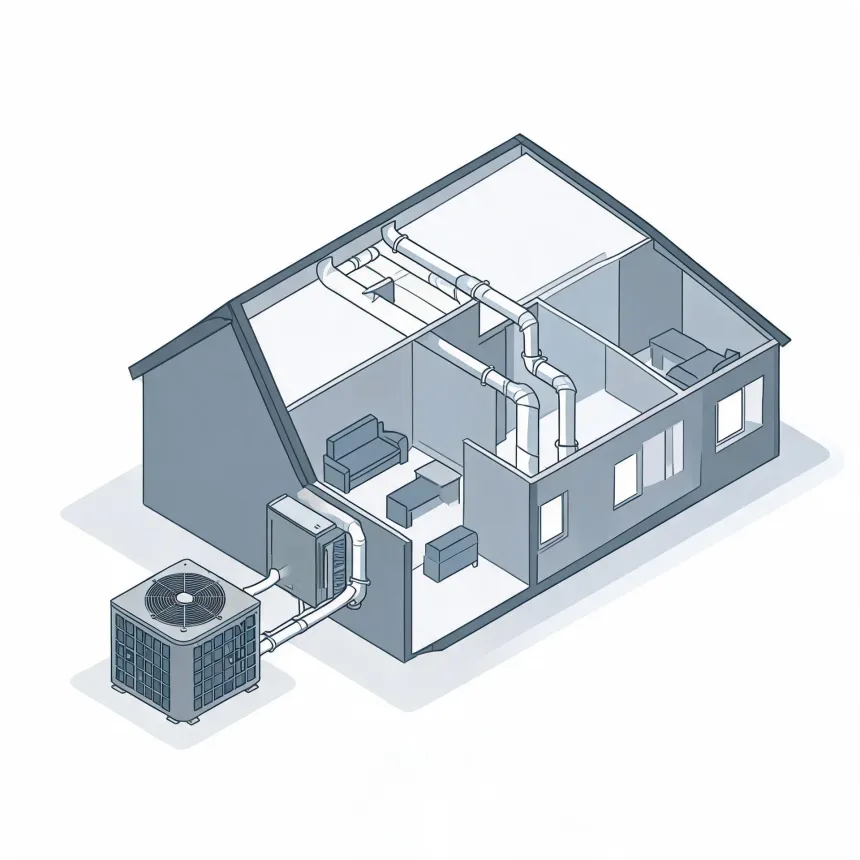
Isometric line illustration of a cutaway house showing interior rooms with ductwork, an indoor air handler, and an outdoor condenser unit connected by lines, on a white background.
Your air conditioner works hardest from June through August.

NOAA nClimDiv, 1991–2020 normals

Half the homes in Harnett County were built in 1997 or later.

A system that age still has years ahead of it, and a yearly check is what keeps it getting there.

Storm season leaves marks on an outdoor unit that sits outside all year

107 severe weather events from 2015 to 2024
25% of homes statewide lost power a day or more in 2024
76 damaging wind events from 2015 to 2024

Cooling starts in May here and runs five months, through September. April is the month before that, and it's the month to get the system looked at. A tune-up catches a weak charge or a dirty coil before the unit has to run hard day after day. Wait until the season's already started and the system is doing its heaviest work with whatever problem went unnoticed all spring.

A system that runs right costs less to run here

A tune-up gets the coil clean and the charge right before the compressor has to work hard to keep up. That matters here, where the rate already makes every extra minute of runtime cost something. Have it looked at before the season puts it to the test.

Find a contractor
A gray residential air conditioner condenser unit mounted on a concrete pad in an open grass field.

Five months of hard running shows up wear faster

Five months of cooling here means five months where the afternoon high sits around 89 degrees and the air holds that heavy 68 degree dew point. The compressor doesn't get a mild stretch to coast through. It's under load most of the time it runs, and a capacitor or contactor that's starting to go will show it sooner under that kind of load than it would somewhere cooler. The unit also sits outside through storm season, exposed to whatever a storm knocks loose or corrodes on top of the heat. None of that means the system is in trouble. It means whatever small wear is already there gets found faster here, and found early is cheap to fix.

Dirt and dust build up whether or not the system ever breaks

A coil collects a film of dust just from pulling air through it every day. A filter left in too long chokes the airflow across that coil. Neither one makes noise or throws an error. The system just keeps running with less of its surface able to do the job it was built to do.

A refrigerant leak doesn't heal on its own

Once a system starts losing charge, it keeps losing it. A compressor running low on refrigerant works harder to move the same heat, and that strain is what eventually takes the compressor out. A yearly check catches a leak while it's still a gauge reading, not a dead compressor.

Aerial view of a square outdoor air conditioning condenser unit on a concrete pad beside a house wall with a sliding glass door.

Book your AC tune-up in April, before homes here start needing cooling in May.

  1. Jan
  2. Feb
  3. Mar
  4. Apr
  5. May
  6. Jun
  7. Jul
  8. Aug
  9. Sep
  10. Oct
  11. Nov
  12. Dec

A tune-up checks the refrigerant charge, cleans the coils, tests the capacitor and tightens the electrical connections.

A proper tune-up starts with the coil. The tech cleans it, because a coil caked with dust can't give up heat the way it's supposed to, no matter how well the rest of the system runs. From there it's the refrigerant charge, checked against what the system calls for, since too little and the compressor strains, too much and it strains a different way. The contactor and capacitor get tested under load, not just looked at, because a capacitor can measure fine sitting still and still fail the first hot afternoon. The condensate drain gets cleared so it isn't backing up somewhere you won't notice until it does. The blower and the ductwork get a check too, since a system can have a clean coil and a good charge and still underperform if the air isn't moving through it right. None of this is guesswork. It's the same handful of things checked the same way, because those are the parts that fail first and the ones a yearly check actually catches in time.